

In the clamor of the digital gold rush, there emerges a counterpoint, a space defined not by volume, but by focus. PLASMA (XPL) has moved beyond being merely a minimalist blockchain. It has cultivated something more intangible and more powerful: a culture of craft. This is the third layer of its great subtraction—the removal of disposability.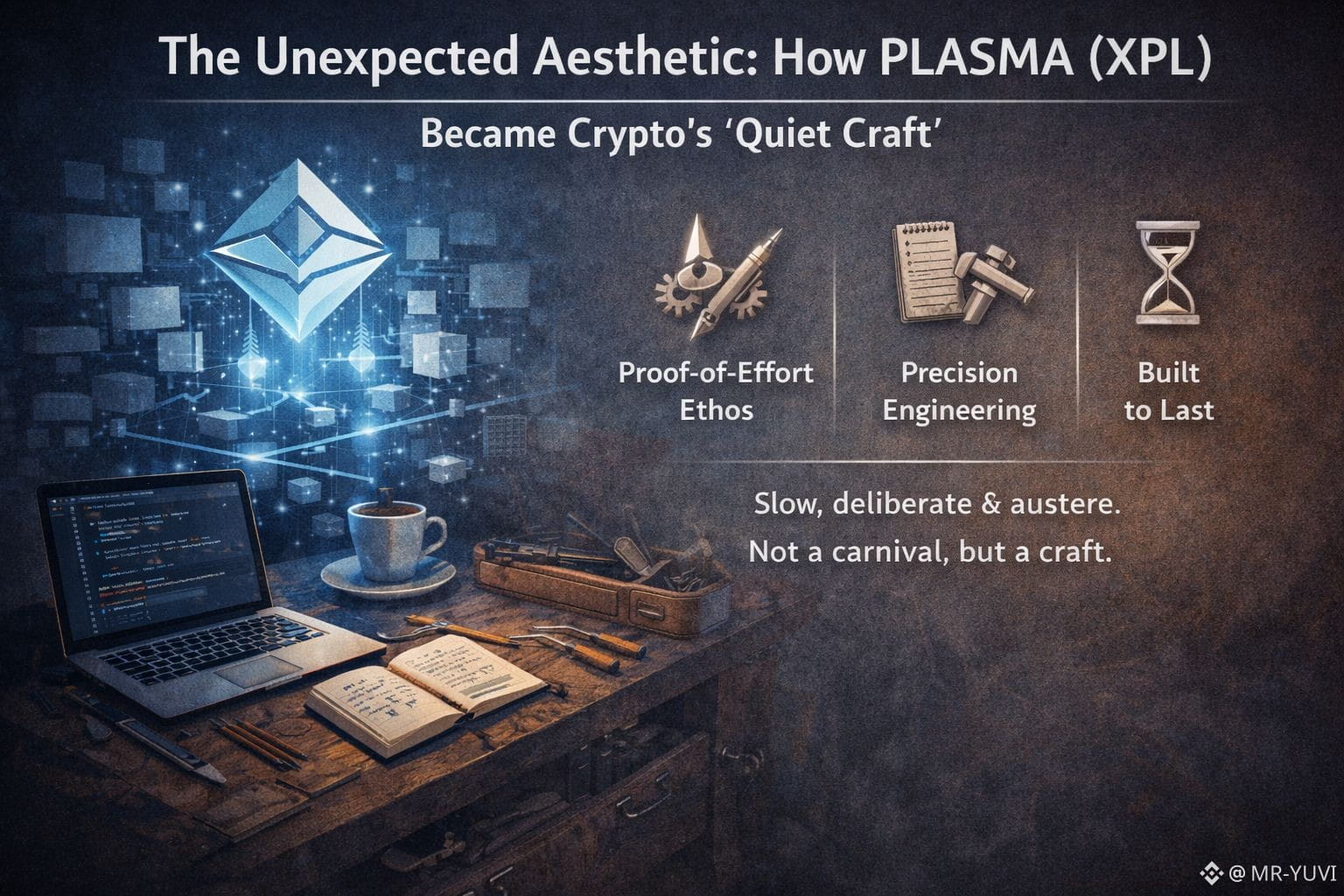
From Fast Finance to Thoughtful Fabrication
The broader crypto and DeFi landscape often feels startlingly ephemeral. Projects are forked, tokens are launched, and communities are rallied in a matter of weeks, all with a "move fast and break things" energy that can feel more suited to a Silicon Valley app than a foundational financial system. The result is a landscape littered with digital ghosts: abandoned protocols, dead tokens, and Discord servers that echo with last season's hype.
PLASMA stands in opposition to this disposability. By stripping away the mechanisms for rapid, speculative extraction—no pre-sales, no VC dumps, no inflationary rewards for mere staking—it implicitly attracts those who build for permanence. The development feels more like watchmaking or cabinetmaking than software sprinting. There’s a palpable focus on the integrity of the joint, the precision of the gear.
This manifests in code that is auditable out of necessity, in documentation that is technical and thorough, and in upgrades that are methodical rather than reactionary. The community doesn't just use the network; they steward it. They argue over attack vectors with the seriousness of engineers inspecting a bridge’s load-bearing calculus, because they know there is no corporate parent to bail it out. The protocol’s resilience is their direct responsibility.
The "Proof-of-Effort" Ethos
This gives rise to what you might call a "proof-of-effort" ethos. Value isn’t derived from marketing buzz or celebrity endorsement, but from demonstrable, grind-it-out work. A well-audited smart contract, a cleanly solved problem in the code repository, a patiently explained tutorial for a new user—these are the artifacts that hold status.
It creates a different kind of social layer, one that feels refreshingly meritocratic. The loudest voice in the room isn’t the one with the biggest bag; it’s often the one who can clearly articulate a solution to a technical challenge. By subtracting the direct link between financial shilling and social clout, PLASMA has—perhaps accidentally—fostered a rare online space where expertise is valued over exhortation.
The Loneliness and the Light
This path, of course, is not without its shadows. The focus on craft can feel insular. The lack of a hype cycle means there are fewer viral moments to bring in fresh waves of users. It can feel, at times, like a brilliant but secluded workshop—the sound of diligent work echoing in a space the wider world hasn’t yet discovered. For developers and advocates, this can be lonely. The feedback isn't the roar of a crowd, but the silent, steady growth of network nodes and the occasional "thank you" from a user who successfully navigated their first truly peer-to-peer swap.
Yet, in that quiet, there is a profound light. It’s the light of clarity. When every unnecessary feature, every extractive mechanism, every piece of performative noise has been cleared away, what’s left is pure intent. The intent to create a tool for sovereign exchange. A tool that doesn’t seek to capture you, but to empower you. A tool that is meant to outlast its creators.
This is PLASMA’s ultimate subtraction: the removal of obsolescence. They are not building for the next market cycle; they are building for the next decade. In a world obsessed with the new, the next, and the now, this is a quietly rebellious act. It’s an argument that in the realm of trust and value, slow, deliberate, and austere is not just a choice—it’s a virtue.
The project whispers a question the rest of the space is too loud to hear: What if the future of finance isn't frenetic, but focused? Not a carnival, but a craft?

