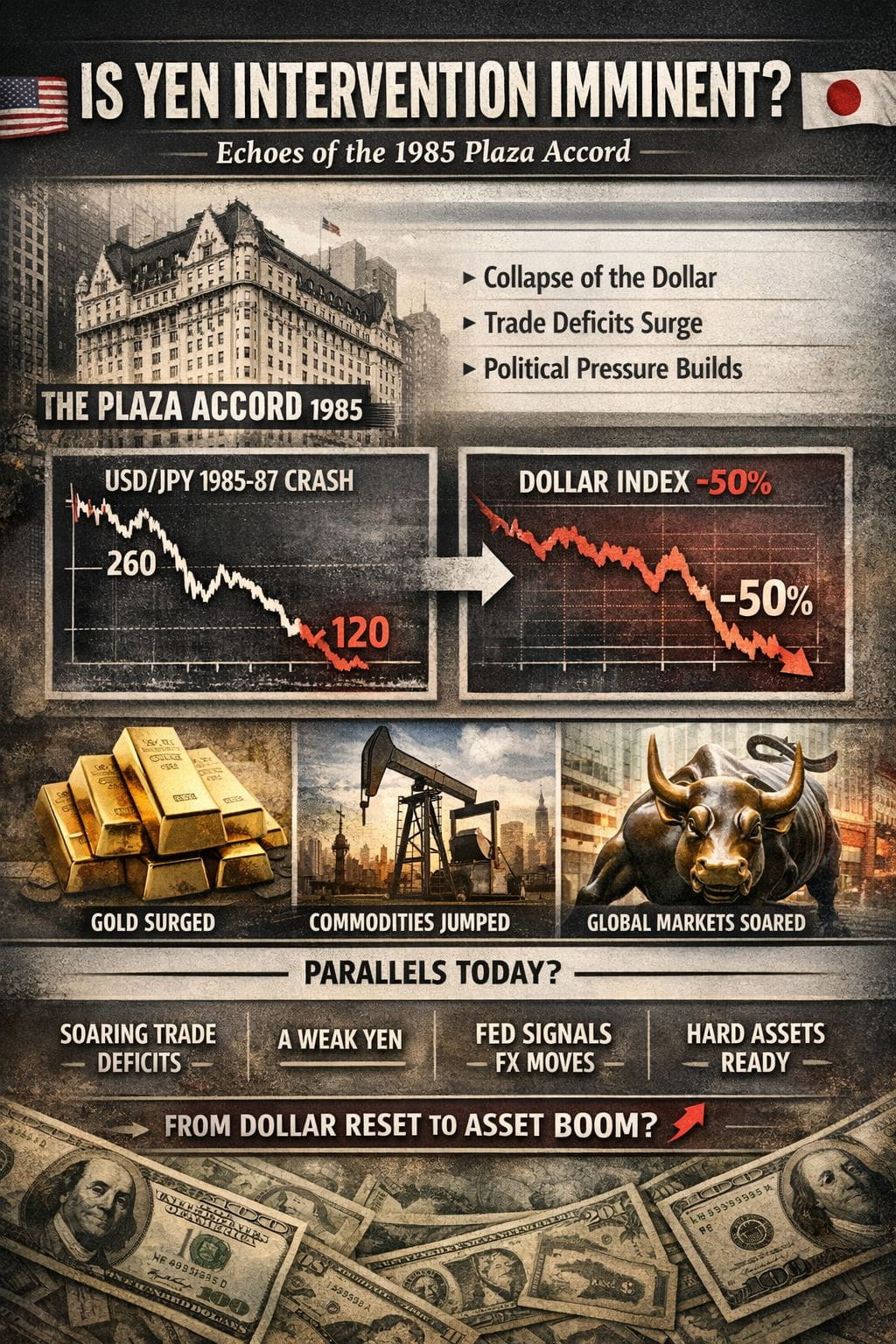
The #Fed Reserve Is Quietly Signaling Conditions That Historically Precede Yen Intervention — A Setup Not Seen Since 1985
Most traders are treating recent currency movements as routine volatility.
They are not.
What is developing in the FX market has historical precedent — and the last time this structure formed, it triggered one of the most significant currency realignments in modern financial history.
To understand the gravity of the moment, we need to revisit The Plaza Accord of 1985.
The 1985 Precedent: When Governments Reset the Dollar
By the mid-1980s, the U.S. dollar had appreciated to unsustainable levels.
The consequences were severe:
U.S. exports became globally uncompetitive
Domestic manufacturing deteriorated
Trade deficits widened aggressively
Political pressure mounted inside the United States
This was not just an economic issue — it became a geopolitical and industrial stability risk.
In response, the finance ministers and central bankers of:
United States
Japan
West Germany
France
United Kingdom
met at the Plaza Hotel in New York and reached a coordinated agreement to weaken the dollar.
This became known as The Plaza Accord.
It was not market-driven. It was policy-engineered currency realignment.
What Followed Was Not Normal Market Behavior
The aftermath was historic:
U.S. Dollar Index fell nearly 50% over the following years
USD/JPY collapsed from ~260 to near 120
The Japanese yen effectively doubled in value
Global capital flows shifted rapidly
This event demonstrated a key principle:
When governments coordinate foreign exchange policy, markets adjust — forcefully and without resistance.
Asset Repricing After Dollar Weakness
The currency shift triggered widespread asset inflation outside the U.S.:
Commodities surged
Gold entered a powerful repricing phase
Non-U.S. equities outperformed
Dollar-denominated assets rose in nominal terms as the currency weakened
This was not speculative excess. It was mechanical repricing due to currency debasement.
Why The Current Setup Rhymes With 1985
Today, we observe striking parallels:
1985 Conditions
Current Conditions
Large U.S. trade deficits
Trade deficits at structural highs
Dollar strength hurting exports
Strong USD pressuring global trade
Severe currency imbalances
Wide divergence in FX valuations
Japan under currency strain
Yen historically weak
Political pressure rising
Increasing rhetoric around trade and competitiveness
The macro structure is not identical — but the stress points are aligned.
The Signal Markets Are Watching
Recent Federal Reserve activity in the USD/JPY funding and rate environment has drawn institutional attention.
Historically, such monitoring and liquidity checks have preceded:
Coordinated communication
Verbal intervention
Direct FX intervention when volatility accelerates
No formal action has been announced.
But FX markets trade on anticipation of policy, not just policy itself.
And traders remember what happened after Plaza.
If a Coordinated Dollar Weakening Cycle Begins
The implications are nonlinear.
When the reserve currency weakens by policy design:
Dollar-denominated assets reprice higher
Hard assets benefit
Scarce assets outperform
Global capital rotates out of cash into stores of value
This environment historically favors:
Precious metals
Commodities
Emerging market flows
Alternative monetary assets
High-beta risk instruments
Because this is not just a trade. It becomes a currency regime shift.
Why Most Participants Miss It Early
Retail focuses on headlines. Institutions watch liquidity, funding stress, and currency misalignment.
Major macro transitions begin quietly — then reprice violently.
The early phase looks like “noise.” The later phase looks like “obvious history.”
We are still in the first phase.
Conclusion
The discussion around a potential “Plaza Accord 2.0” is not conspiracy — it is a reflection of mounting macro imbalances that historically required coordinated solutions.
If intervention dynamics emerge, the move will not be gradual.
Currency policy shifts cascade into:
FX → Commodities → Hard Assets → Risk Markets
This is not a short-term narrative. It is positioning ahead of a possible structural currency adjustment.
Smart capital studies these periods.
Most participants only recognize them in hindsight.
Positioning before recognition is where asymmetric opportunity lives.
— PROFITSPILOT25 🚩$BTC



#Mag7Earnings #SouthKoreaSeizedBTCLoss #ClawdbotTakesSiliconValley #ETHWhaleMovements