


For years, the blockchain industry has faced a persistent tension between security and practicality. On one hand, on-chain storage offers immutability and verifiable trust; on the other, it is slow, costly, and limited in capacity. This has forced developers to rely on off-chain solutions, from cloud servers to decentralized networks like IPFS, creating fragmented systems where critical data often resides outside the blockchain’s trust boundary. Vanar Chain’s Neutron layer offers a revolutionary solution to this longstanding trade-off. By introducing the concept of Private AI Memory, Vanar moves beyond merely storing data to creating intelligent, queryable, and private knowledge objects that exist natively within the blockchain ecosystem. This represents a profound shift in how data can be stored, accessed, and utilized in Web3.
Traditional on-chain storage involves writing raw data directly into a blockchain transaction or smart contract. While this approach works for simple states or value transfers, it struggles with larger or more complex data. Storing sizable files, such as a short video or detailed document, can become prohibitively expensive, often costing thousands of dollars in gas fees on major chains like Ethereum. Beyond cost, the stored data is inert: smart contracts can verify its existence through a hash, but they cannot interpret the content or extract meaningful insights. To circumvent these limitations, developers typically store only a content identifier on-chain, while the actual file remains on an external server or decentralized network. This practice introduces a vulnerability known as the “ownership illusion,” where the on-chain reference loses value if the external storage fails, undermining the promise of trustless verification. For AI-driven systems, which require persistent, verifiable, and instantly queryable context, this architecture falls short.
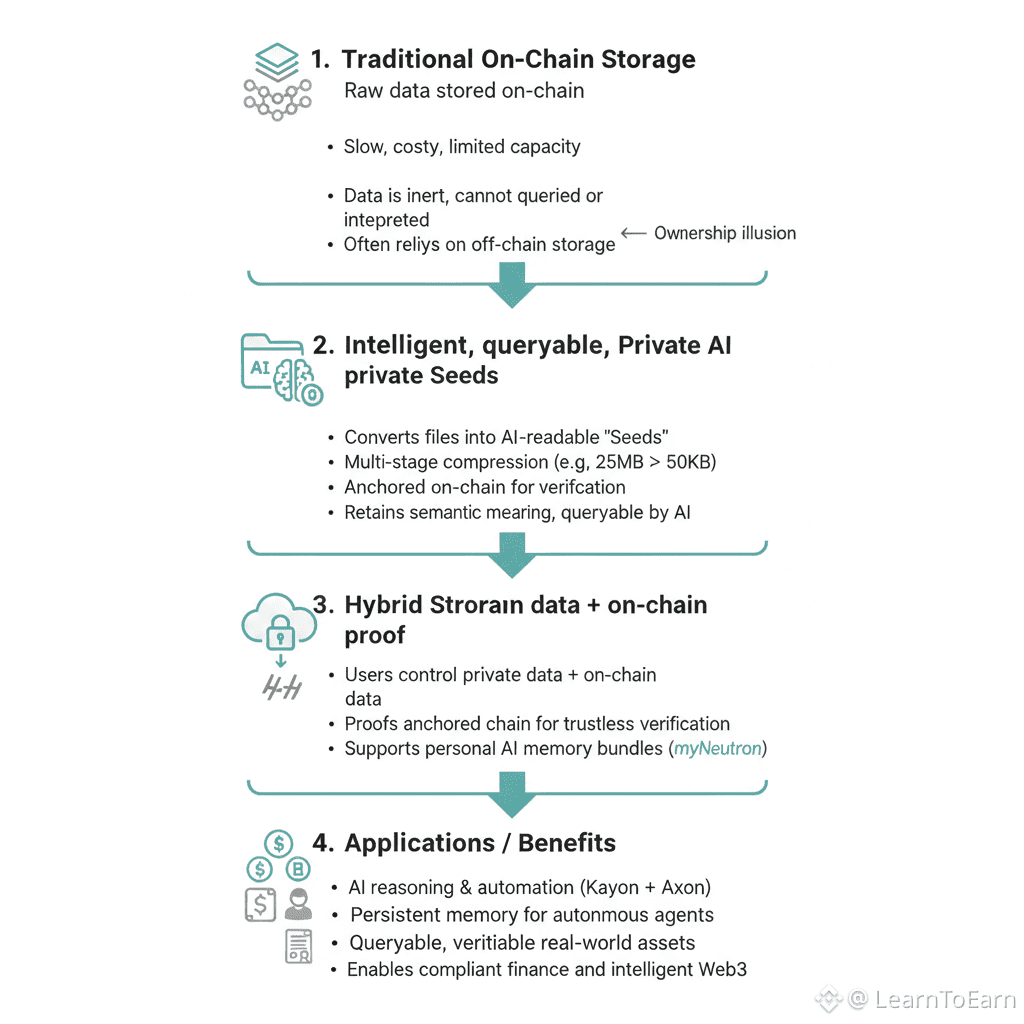
Neutron addresses these limitations by redefining what it means to store data on-chain. Instead of treating files as static blobs, Neutron converts them into “Seeds,” AI-readable knowledge objects that preserve semantic meaning and context. Through multi-stage compression and semantic embedding, even a large 25MB video can be reduced to a 50KB cryptographically verifiable packet—a 500:1 compression ratio—making it feasible to anchor proofs on-chain while retaining intelligence. Unlike a conventional compressed file, a Seed is structured so that AI engines can query and reason over its content directly, enabling a new class of autonomous, intelligent applications.
Vanar’s approach also introduces a nuanced hybrid storage model that balances privacy, performance, and verifiability. Primary Seed data is stored off-chain by default, encrypted and fully under the user’s control. When proof of existence, ownership, or integrity is required, a hash or critical metadata of the Seed can be anchored on-chain, creating an immutable record without revealing sensitive information. This design allows users to maintain control over their private data while still participating in a trustless, verifiable network. Tools like myNeutron extend this concept, enabling users to create personal AI memory bundles from documents and conversations that can be kept local, selectively shared, or anchored on-chain for permanence and auditability.
The implications of this architecture are far-reaching. In finance, for example, an invoice stored as a Seed can be read and interpreted by Vanar’s AI engine, Kayon, which can automatically validate compliance rules and trigger a settlement via the Axon automation layer, all without exposing sensitive data or requiring human intervention. For autonomous AI agents, Seeds provide a persistent memory that allows context-aware decision-making across sessions, while users retain full control over access. Even tokenized real-world assets, such as property deeds, can exist as verifiable, queryable Seeds, ensuring that ownership records and legal documents are unified on a secure, tamper-proof platform.
The $VANRY token underpins this ecosystem, serving as payment for transactions, Seed creation, querying, and AI reasoning services. It also provides a staking mechanism to secure the network, aligning economic incentives with the integrity of the intelligent infrastructure. As AI-driven tools and subscriptions increasingly rely on Neutron’s capabilities, $VANRY demand is directly linked to the consumption of private, intelligent memory services.
The evolution from traditional on-chain storage to Private AI Memory is more than a technical upgrade; it is a paradigm shift. Vanar Chain’s Neutron moves the industry from merely recording “what happened” to understanding “why it happened.” By ensuring that data is intelligent, private, and verifiable by design, Vanar lays the foundation for autonomous agents, compliant finance, and a Web3 capable of interacting meaningfully with human and business complexity. In redefining what blockchain data can do, Vanar is building not just a chain, but the infrastructure for a verifiable, accountable, and intelligent economy.
How Vanar Prevents Context Leakage Between AI Agents: Building Trust in a Multi-Agent Web3
The future of Web3 and enterprise AI lies in the collaborative power of autonomous agents. These agents are designed to orchestrate complex tasks, from managing decentralized finance portfolios to executing smart contracts and coordinating supply chains. Yet this promise of collaboration introduces a critical vulnerability: context leakage. When agents share a memory or communication channel, sensitive information from one task or user can unintentionally influence another, threatening privacy, security, and trust. For an AI-native blockchain like Vanar, preventing such leakage is not an optional feature—it is a core architectural requirement.
Context leakage occurs when information from one session, domain, or user inadvertently becomes visible to another. In systems of interconnected AI agents, the risk is magnified. An agent managing a user’s private financial data might accidentally expose transaction histories or wallet balances to another agent working on an unrelated smart contract. In a Web3 environment, the consequences are severe: lost funds, compromised competitive advantage, and irreversible privacy breaches due to the immutability of blockchain records. Research shows that modern AI agents are particularly susceptible to these issues, as large language models often lack built-in mechanisms to enforce contextual integrity. Sophisticated attacks now target agents’ memory modules, external data feeds, and communication channels, exploiting the very systems agents rely on to collaborate—a class of exploits known as context manipulation. These attacks are especially dangerous because agents inherently trust their own memories and communications, making them vulnerable to subtle, cascading leaks.
Vanar addresses these challenges with a purpose-built, multi-layered architecture designed to enforce strict data isolation and sovereignty. At the foundation is Neutron, Vanar’s semantic memory layer. Unlike traditional shared databases, Neutron treats each agent’s memory as a sovereign, private asset. Instead of storing raw user data on-chain, Neutron transforms files into compressed, cryptographically verifiable “Seeds” that capture the semantic meaning without revealing the content itself. Each agent operates with its own set of these Seeds, and access is strictly controlled at the protocol level. For instance, an agent handling a user’s tax optimization can only access the Seeds explicitly authorized for that task and cannot infer or browse data from unrelated Seeds belonging to the same user or others. Raw data can remain encrypted on the user’s device, with the agent interacting only with the on-chain proof, dramatically reducing exposure to memory injection attacks.
The Kayon layer, Vanar’s on-chain AI reasoning engine, further mitigates leakage by reasoning only over the context provided for a given session. It does not maintain a persistent global memory that could inadvertently accumulate sensitive data across different interactions. Every decision Kayon produces is explainable and auditable, allowing automated or manual verification that outputs are based solely on the appropriate context. This ensures, for example, that a financial trading decision cannot improperly leverage confidential information from a separate legal contract task.
For secure collaboration between agents, Vanar implements a structured agent-to-agent orchestration system. A coordinator or arbiter agent manages workflows, receiving a user’s goal, breaking it into sub-tasks, and delegating each to specialized worker agents. These workers communicate exclusively through the coordinator using structured, opaque messages, preventing direct access to each other’s internal memory or tools. Each agent has a verifiable on-chain identity, and the coordinator authenticates these identities before assigning tasks, ensuring that malicious actors cannot impersonate legitimate agents to gain access to sensitive data.
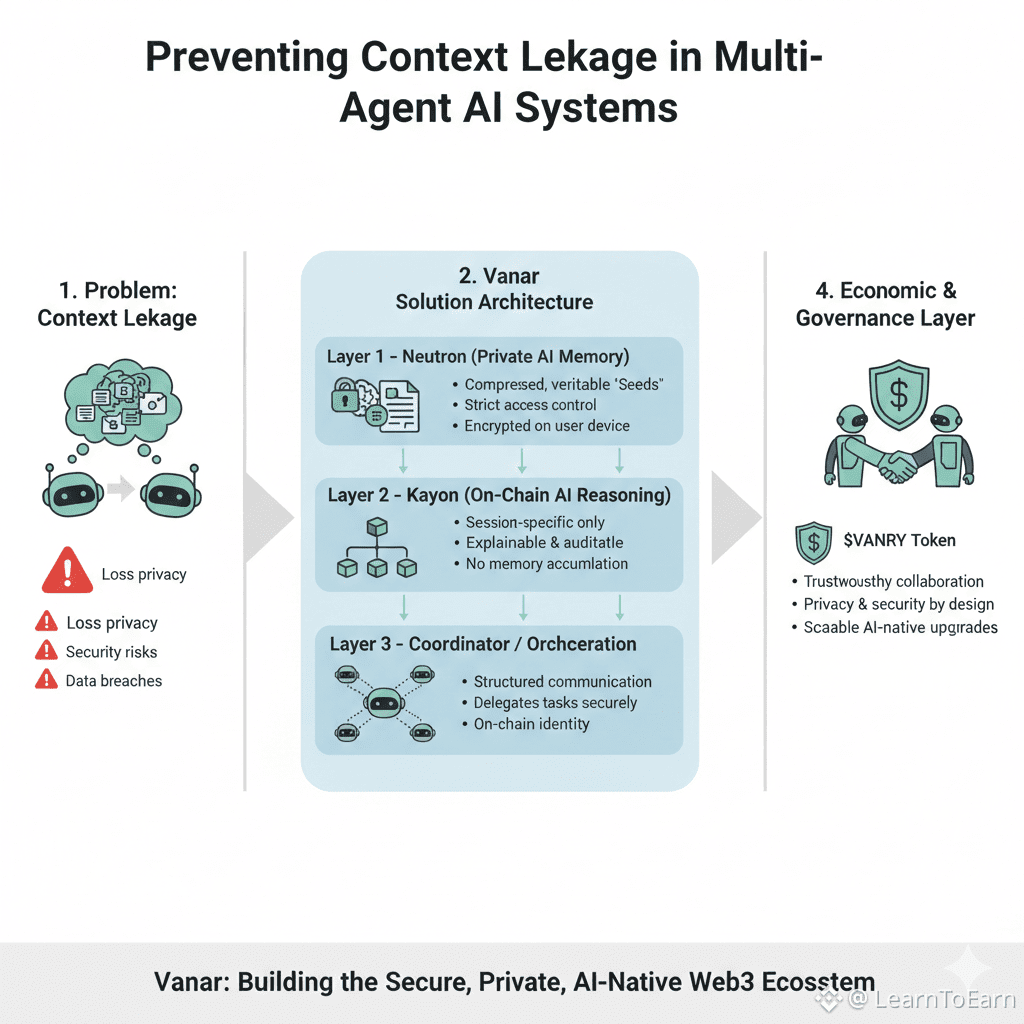
The VANRY token underpins this privacy-preserving ecosystem. It fuels private computation, paying for the creation of Neutron Seeds, scoped queries to Kayon, and execution of coordinator-mediated tasks. Validators and node operators stake VANRY to secure the network, with slashing penalties for malicious behavior, ensuring cryptoeconomic integrity. Additionally, VANRY holders govern upgrades to protocols managing agent isolation and privacy, allowing the system to adapt to evolving threats in a decentralized way.
Ultimately, the promise of a multi-agent AI future hinges on trust. Users and enterprises will only delegate significant authority and sensitive data to autonomous systems if they are confident that context will remain private. Vanar does not treat privacy as an afterthought; it is built into the very architecture. By combining native memory isolation through Neutron, context-bound reasoning via Kayon, and secure, orchestrated communication, Vanar addresses not only accidental leaks but also sophisticated adversarial attacks. In doing so, it lays the foundation for a Web3 where AI agents can collaborate at scale without compromising user sovereignty, and where VANRY represents not just utility, but a stake in the integrity of the future of collective digital intelligence.
AI-Native Privacy vs. Web2 AI Data Hoarding: Vanar’s Decentralized Vision for User Sovereignty
The current paradigm of artificial intelligence, built atop the centralized infrastructure of Web2, has created a global economy of data extraction. User information is treated as a passive commodity to be collected, hoarded, and monetized by platform corporations. Every click, scroll, purchase, or pause contributes to an intricate behavioral profile, allowing these companies to map preferences, predict actions, and model vulnerabilities with unprecedented precision. Large-scale AI systems intensify this dynamic, consuming not only metadata but private conversations, prompts, and emotional signals. As a result, users interact with AI as if confiding in a trusted partner, while in reality, the system internalizes their private lives for corporate gain. This centralized hoarding model has produced systemic vulnerabilities, from massive data breaches to opaque algorithmic biases, leaving users without verifiable control over how their data is stored, shared, or monetized.
Web3 promised to remedy this by decentralizing trust, yet its early implementation created a different problem: excessive transparency. Immutable public ledgers transformed all transactions and interactions into visible records, opening users to a new kind of surveillance. Chain analytics firms can now profile behavior with a granularity surpassing traditional banks. In effect, users face a false choice: surrender privacy to centralized data hoarders in Web2, or expose themselves entirely in Web3. Neither model truly returns control to the individual, as both systems prioritize external visibility over user sovereignty.
Vanar Chain offers a fundamentally different vision by embedding AI-native privacy into the architecture itself. Privacy is not a feature bolted onto a blockchain; it is a core design principle integrated into every layer of the stack. At its foundation, Vanar Chain provides a secure, high-throughput modular Layer 1 optimized for intelligent, privacy-preserving operations. On top of this, Neutron transforms bulky files—PDFs, videos, or documents—into compressed, AI-readable “Seeds.” These Seeds preserve semantic meaning and verifiable proof without exposing the underlying data. A single 25MB file can be compressed up to 500:1, enabling on-chain storage of meaningful, queryable intelligence while keeping sensitive content private. Neutron ensures that data is not only verifiable and actionable but also immune to scraping or hoarding by intermediaries, turning property deeds into private proofs and invoices into agent-readable memory that remains under user control.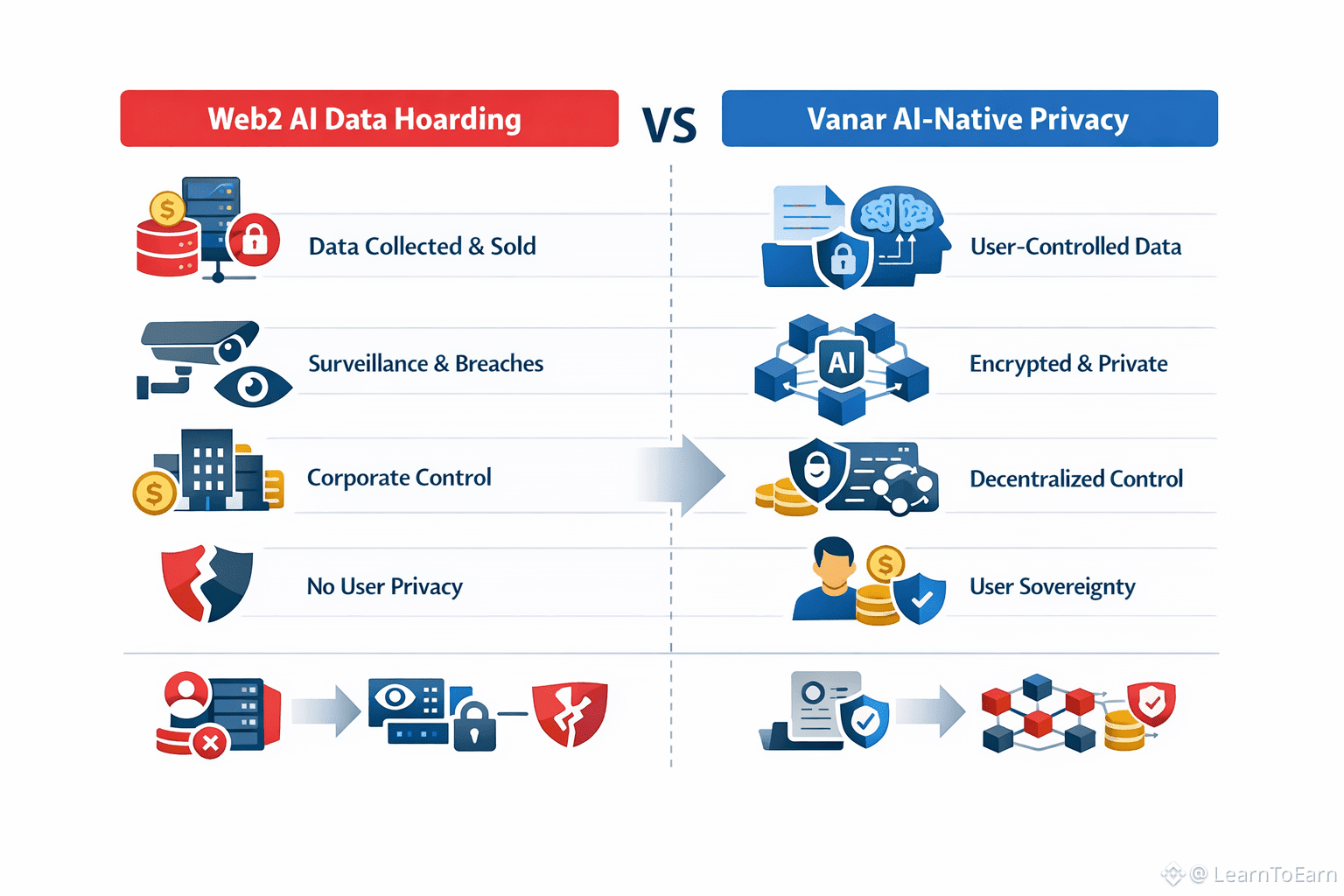
Kayon, Vanar’s on-chain AI reasoning engine, enables smart contracts and autonomous agents to reason over Neutron Seeds without ever decrypting the raw data. This allows for verifiable compliance, automated logic, and accountable computation in a privacy-preserving manner. Axon and Flows complete the ecosystem, turning verified intelligence into actionable outcomes for real-world applications such as decentralized finance, tokenized assets, and other industry-specific operations.
The contrast between Web2 AI data hoarding and Vanar’s AI-native privacy is profound. While Web2 treats data as a corporate asset harvested for profit, Vanar positions data as user-centric intelligence. In the former, privacy is an afterthought, and value accrues to platform operators. In the latter, privacy is the default, control is decentralized, and the benefits of intelligent data flow directly to the user. Where Web2 users are data producers subjected to surveillance and algorithmic manipulation, Vanar users are sovereign owners, empowered to choose what to reveal and when.
The VANRY token fuels this ecosystem, linking economic incentives to the consumption of privacy-preserving services. Every operation—creating a Neutron Seed, querying Kayon, or executing an automated action—requires VANRY, ensuring that network resources are used responsibly. Validators stake VANRY to secure the network, with slashing penalties for malicious behavior, guaranteeing the integrity of private data verification. The token also serves as the medium for accessing advanced AI tools and subscriptions, tying the economy of privacy directly to real utility.
Ultimately, the evolution from Web2 data hoarding to AI-native privacy is a shift from extraction to empowerment. Vanar Chain demonstrates that AI can be powerful and accountable while respecting individual sovereignty. By integrating privacy into the core of its blockchain stack—through Neutron’s semantic compression, Kayon’s verifiable reasoning, and a user-centric architecture—Vanar ensures that data belongs to the person who produces it, and transparency becomes a voluntary act of choice, not a condition of participation. In doing so, Vanar and VANRY are not merely building technology; they are redefining the principles of trust, privacy, and ownership in the age of intelligent systems.
