

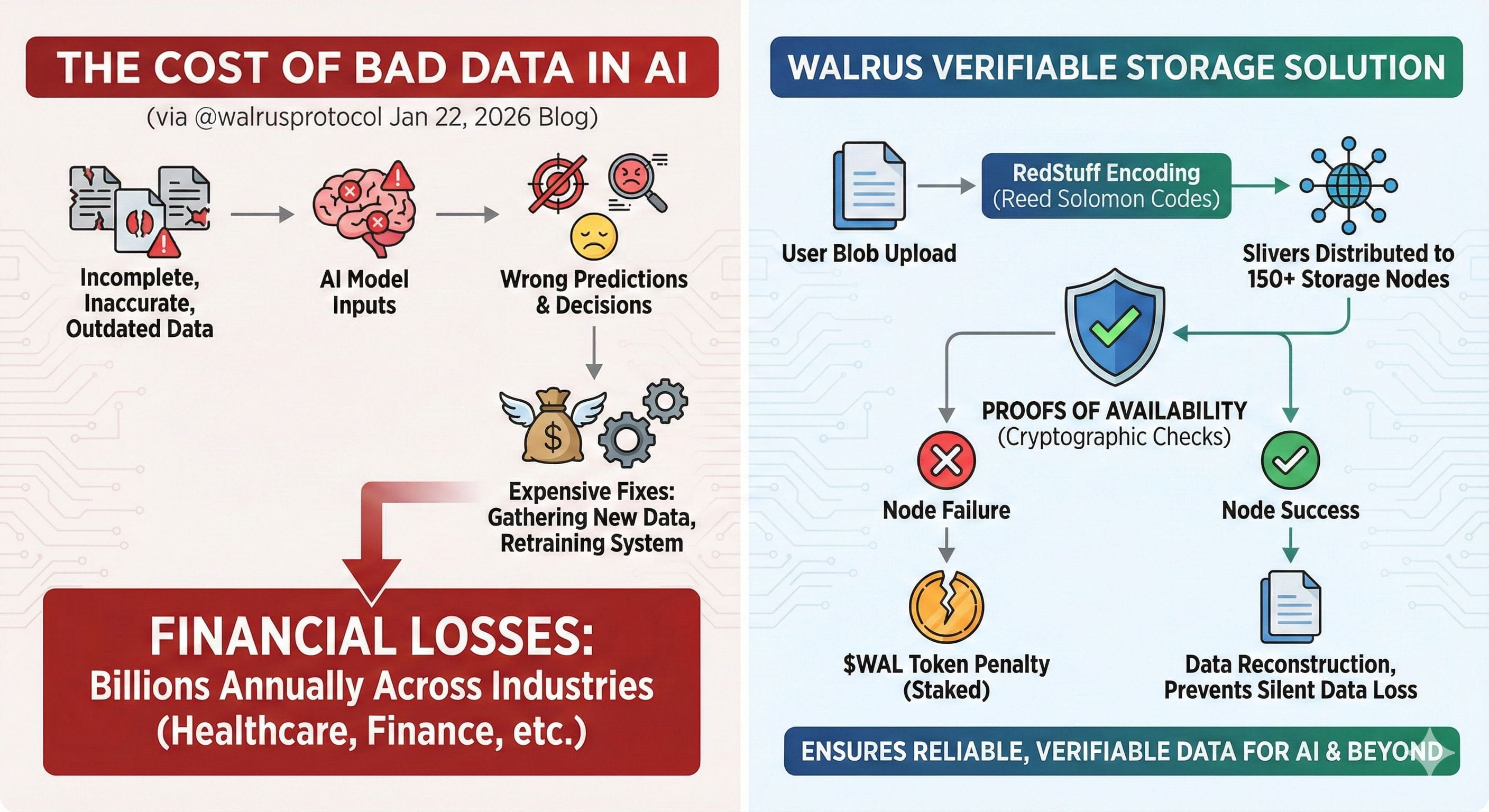
Companies continue to suffer large financial losses from bad data in artificial intelligence systems, and the January 22, 2026 blog post from @Walrus 🦭/acc provides a clear explanation of why this problem persists. Incomplete, inaccurate, or outdated data can cause AI models to generate incorrect predictions or decisions, forcing organizations into costly remediation such as recollecting data or retraining entire models. In sectors like healthcare or finance, a single data error can translate into millions of dollars lost through misdiagnoses or flawed investment decisions. According to industry reports cited in the post, these failures add up to billions in losses every year.
Walrus Protocol addresses this risk through a design centered on verifiable storage. When users upload files, known as blobs, the data is broken into smaller units called slivers using RedStuff encoding based on Reed Solomon codes. These slivers are distributed across more than 150 independent storage nodes. Each node must continuously prove that it still holds its assigned data through cryptographic proofs of availability. Nodes that fail these checks are penalized through WAL slashing, creating a strong incentive for operators to maintain reliability. This structure ensures that data can always be reconstructed as long as a sufficient number of slivers remain available, even if some nodes go offline. As a result, silent data loss, a major contributor to bad data, is effectively eliminated.
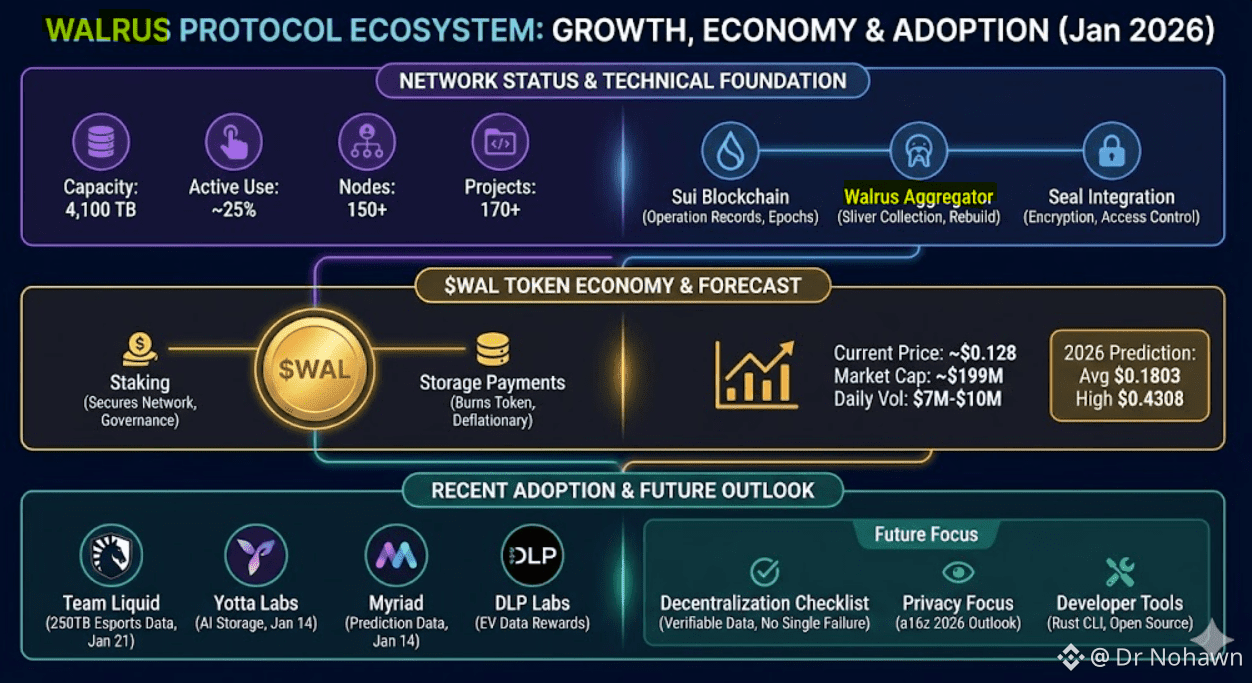
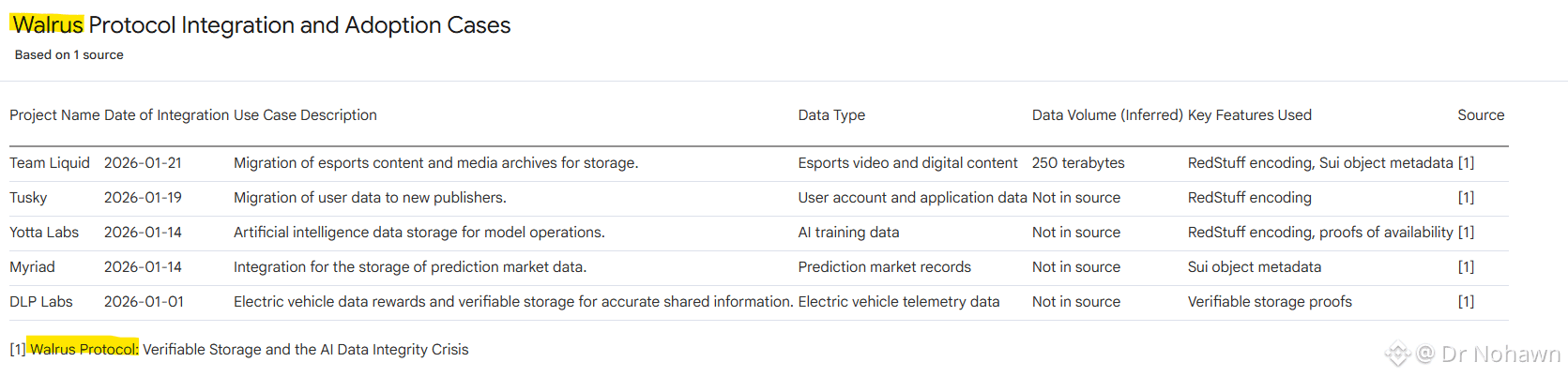
Network statistics underline this capability. As of early January 2026, Walrus operates with approximately 4,100 terabytes of total storage capacity, with around 25 percent actively utilized. The network supports more than 170 projects. Recent examples include Yotta Labs selecting Walrus for artificial intelligence data storage on January 14, 2026, and Myriad integrating Walrus on the same day for prediction market data. DLP Labs also uses Walrus for electric vehicle data rewards, where verifiable storage is essential to confirm the accuracy of shared information. These real world deployments demonstrate how transparency and accountability at the storage layer help reduce the impact of bad data.
From a technical perspective, Walrus integrates closely with the Sui blockchain. Each stored blob is associated with a Sui object that records metadata such as storage duration, measured in epochs of roughly two weeks on the main network. Users can extend these epochs if data needs to persist longer, or burn the object to reclaim fees when storage is no longer required. An aggregator service reconstructs the original file from slivers upon request. Additional features, such as blob attributes, allow metadata to be attached for use cases like web serving. For sensitive datasets, Seal integration provides encryption and access controls so that only authorized parties can retrieve the data. This is particularly important for artificial intelligence workloads involving private or regulated information.
The January 8, 2026 blog post on how Walrus stays decentralized at scale provides further context for its reliability. It explains how the network avoids centralization by rewarding nodes based on verifiable performance rather than size or geographic concentration. Lessons learned from earlier test networks led to refinements such as longer epochs and clearly defined maximum storage periods. Since mainnet launch in March 2025, the network has grown from an initial set of just over 100 nodes to more than 150, overseen by an independent foundation responsible for development and grants.
The WAL token plays a central economic role in this system. Node operators and delegators stake WAL to determine participation in each epoch’s committee, while users pay storage fees in $WAL. Stakers earn rewards from network activity, aligning security with long term participation. As of January 2026, WAL trades around $0.128, with a market capitalization near $199 million and daily trading volume ranging between $7 million and $10 million. Forecasts for 2026 suggest an average price of $0.1803 and a potential high of $0.4308, reflecting expected ecosystem growth. A deflationary mechanism burns a portion of WAL used in storage transactions, directly linking increased adoption of verifiable storage to reduced token supply.
Recent events reinforce this momentum. On January 21, 2026, Team Liquid migrated 250 terabytes of esports content to Walrus, marking the largest single dataset move on the network to date. This followed the Tusky migration deadline on January 19, when users transitioned data to new publishers. On January 15, Upbit resumed $WAL deposits, improving liquidity. The 2026 crypto outlook from a16z highlights Walrus as an important component of decentralized infrastructure, particularly for privacy and data intensive applications.
For builders, Walrus provides practical tooling. The Rust based command line interface allows developers to store, retrieve, and extend blobs, while the aggregator can be used for metadata queries. The open source codebase, released under the Apache 2.0 license, enables customization such as building JavaScript clients for direct node interaction with transport layer security. Developers can run local nodes or rely on hosted services depending on their needs.
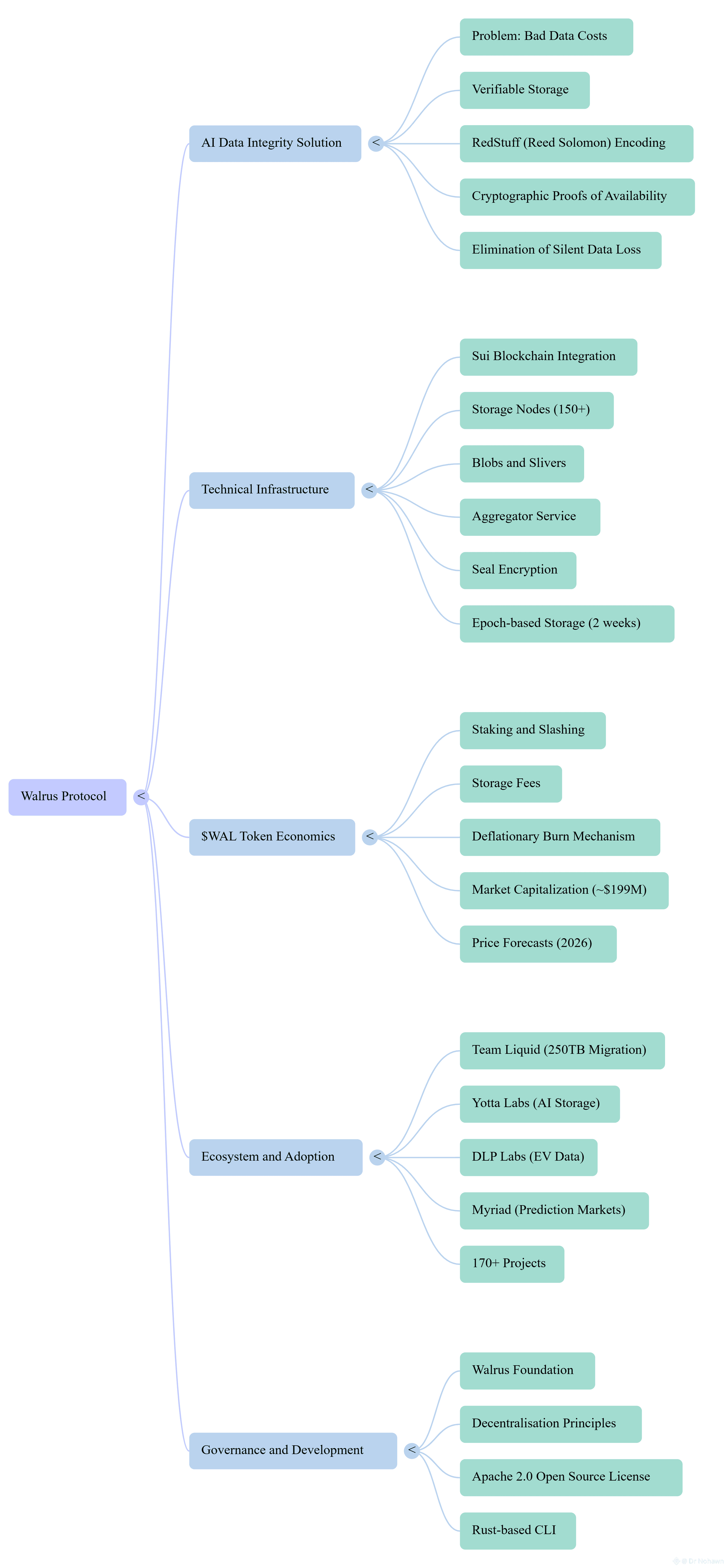
Challenges remain, particularly around maintaining decentralization as the network scales. Walrus emphasizes clear principles: avoiding reliance on any single operator, ensuring data remains verifiable at all times, and scaling without privileging large participants. Feedback from test networks led to meaningful adjustments, including extending epoch lengths from one day to two weeks to improve stability.
Overall, Walrus Protocol stands out for its focus on verifiability as a solution to the bad data problem. By combining robust cryptographic guarantees with economic incentives through $WAL , it supports a wide range of applications, from artificial intelligence to real world assets. As adoption grows and partnerships expand, Walrus positions itself as a dependable data layer for high stakes, data heavy systems. Staking $WAL not only helps secure the network but also enables participation in its governance and long term rewards. #Walrus


