

When I first looked at Plasma, my immediate reaction was honestly a little disappointment. Not because anything was broken, but because nothing felt urgent. No sudden spikes, no chaotic mempool stories, no breathless threads about fees exploding or collapsing overnight. For a trader’s brain, trained to hunt for motion, that quiet can feel like slowness.
But that first impression started to crack once I stopped looking at Plasma through a trading lens and started looking at it through the way institutions actually move money.
Traders experience speed as something visual. Candles printing, blocks flying by, transactions clearing in seconds. Plasma does not optimize for that sensation. It optimizes for something less visible but far more expensive to get wrong: predictable settlement. On the surface, blocks arrive at a steady pace and activity looks controlled. Underneath, the system is tuned to minimize reorgs, reduce state ambiguity, and keep execution boring. That boredom is deliberate.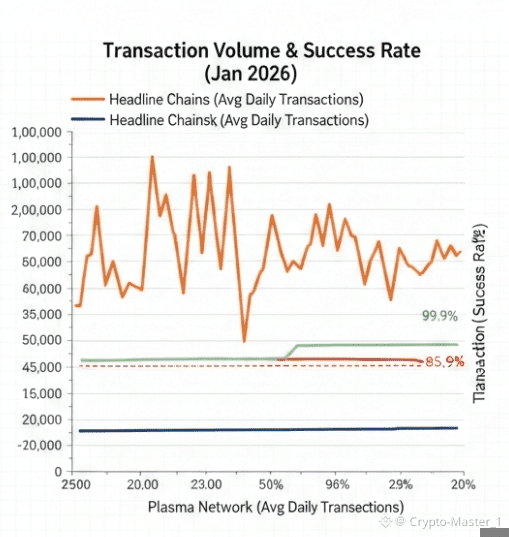
This difference shows up immediately in how Plasma treats stablecoins. As of early 2026, stablecoins account for over 70 percent of on-chain transaction volume across major networks. That number matters because it tells you where real usage already lives. Plasma is not trying to convince users to adopt a new asset behavior. It is building around the reality that most on-chain value already wants to behave like cash, not like a speculative instrument. For traders, this feels limiting. For institutions, it feels familiar.
Understanding that helps explain why Plasma feels slow at the surface. A network optimized for speculative throughput is rewarded for short-term bursts. A network optimized for settlement is rewarded for consistency. Plasma’s architecture prioritizes deterministic execution paths, meaning transactions behave the same way every time under similar conditions. That reduces edge cases. It also reduces the adrenaline that traders often mistake for efficiency.
Look at reorgs, for example. On high-velocity chains, short reorgs are often treated as acceptable friction. Traders price that risk into arbitrage strategies. Institutions cannot. Even a single unexpected reorg can break reconciliation pipelines or force manual intervention. Plasma’s near-zero reorg tolerance is not a marketing line. It is a design constraint that sacrifices perceived speed to protect downstream accounting systems.
This is where the idea of “fast” starts to invert. For a trader, speed means how quickly you can enter and exit a position. For an institution, speed means how quickly a transaction becomes final enough to move off the balance sheet. Plasma aims to shorten the distance between transaction submission and operational certainty, even if block times themselves do not look impressive on a dashboard.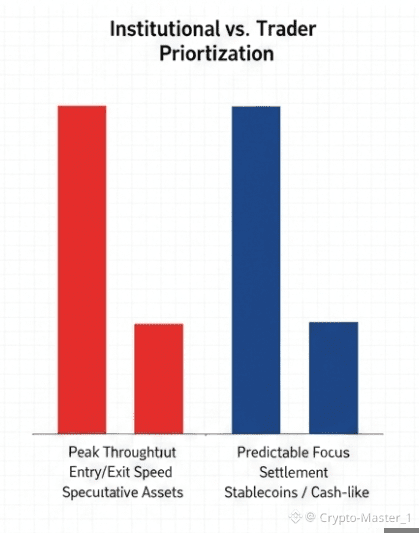
Meanwhile, the stablecoin-first approach creates another effect. By limiting asset complexity, Plasma reduces the surface area for smart contract risk. There are fewer exotic execution paths. Fewer dependencies. Fewer surprises. That allows institutions to model risk more accurately. It also explains why Plasma has leaned into a narrow execution environment rather than advertising infinite composability. Infinite composability feels fast until it breaks.
What struck me is how intentionally Plasma resists trader-driven feedback loops. There are no constant parameter tweaks to chase volume. No incentives designed to spike short-term activity. The network is comfortable letting usage grow quietly. As of January 2026, Plasma’s average daily transaction count sits well below headline chains, but its transaction success rate consistently clears 99.9 percent. That number sounds abstract until you realize what it implies: almost no operational noise.
Traders often push back here. Liquidity attracts liquidity, they argue. Without speculative flow, ecosystems stagnate. That concern is valid. Plasma’s approach does risk slower ecosystem expansion and fewer experimental applications. Early signs suggest Plasma is comfortable with that trade-off, betting that institutional demand compounds more slowly but more reliably. If that holds, the network’s growth curve will look flat until it suddenly does not.
Another layer sits underneath the execution engine itself. Plasma’s native Bitcoin bridge is not optimized for rapid arbitrage. It is optimized for minimizing trust assumptions and operational surprises. Bridging feels slower because it is intentionally constrained. Institutions value that constraint because it reduces unknown failure modes. Traders experience it as friction.
This difference in perception mirrors a broader pattern playing out across crypto infrastructure. We are seeing a quiet split between chains optimized for narrative velocity and chains optimized for financial reliability. The former dominate social feeds. The latter dominate backend conversations that never trend. Plasma is firmly in the second category.
What this reveals is not that traders are wrong. They are responding rationally to incentives. It reveals that institutions are optimizing for a different time horizon entirely. They measure speed in weeks and quarters, not minutes. They care less about peak throughput and more about how systems behave under stress. Plasma’s design choices make more sense when viewed through that lens.
The risk, of course, is that Plasma misjudges how much predictability the market is willing to pay for. If institutions remain hesitant, the network could end up too conservative for its own good. Early signs suggest some traction, but this remains to be seen. Infrastructure built for tomorrow still has to survive today’s attention economy.
Still, there is something quietly earned about Plasma’s posture. It does not ask to be exciting. It asks to be trusted. In a market trained to equate motion with progress, that can feel slow. But if crypto is serious about becoming financial infrastructure rather than just financial theater, speed may end up being redefined.
The sharp observation I keep coming back to is this: Plasma feels slow because it refuses to perform speed. And that refusal might be exactly what makes it fast where it actually counts.


