
When the world first heard about blockchain and crypto, many people thought privacy was the ultimate freedom. The idea was simple and attractive: move money without anyone watching, with no one knowing your balance or your history. For early adopters drawn to decentralization, that felt like power. It felt like independence.
But time changes things. What sounds powerful in theory doesn’t always work in real financial systems where trust, accountability, and legal verification matter. Traders, institutions, regulators, and serious investors ask a different question from the idealistic vision of complete invisibility. They ask: Can this system protect sensitive data without breaking rules, and can it prove it?
That question is exactly where Dusk is positioning itself quietly but meaningfully and where proof matters more than total anonymity.
Why the Old Way Isn’t Enough
Many early blockchains started with full transparency built into their design. Every transaction was visible, every wallet traceable to anyone who cared to look. That model made things simple for traders and speculators because you could see everything. For chart followers and short-term players, nothing mattered but price action.
But for real finance, that model fails in fundamental ways. In traditional markets — stocks, bonds, securities — institutions do not want every trade visible to competitors or the public. Funds do not want their strategies exposed. Corporations do not want their cash flows or ownership structures visible to everyone. That level of transparency is often legally impossible in regulated industries.
Even more important, regulators demand proof. They want systems to show that trades followed the rules, that Anti-Money Laundering (AML) and Know Your Customer (KYC) protocols were observed, and that financial instruments and positions are legitimate. If a blockchain can’t satisfy that basic requirement, many major players simply won’t participate. Liquidity suffers. Adoption stalls.
This is the problem most privacy-focused chains never address openly. They chase absolute privacy, but in doing so they isolate themselves from the institutions and capital that could make them thrive.
Dusk Takes a Different Path
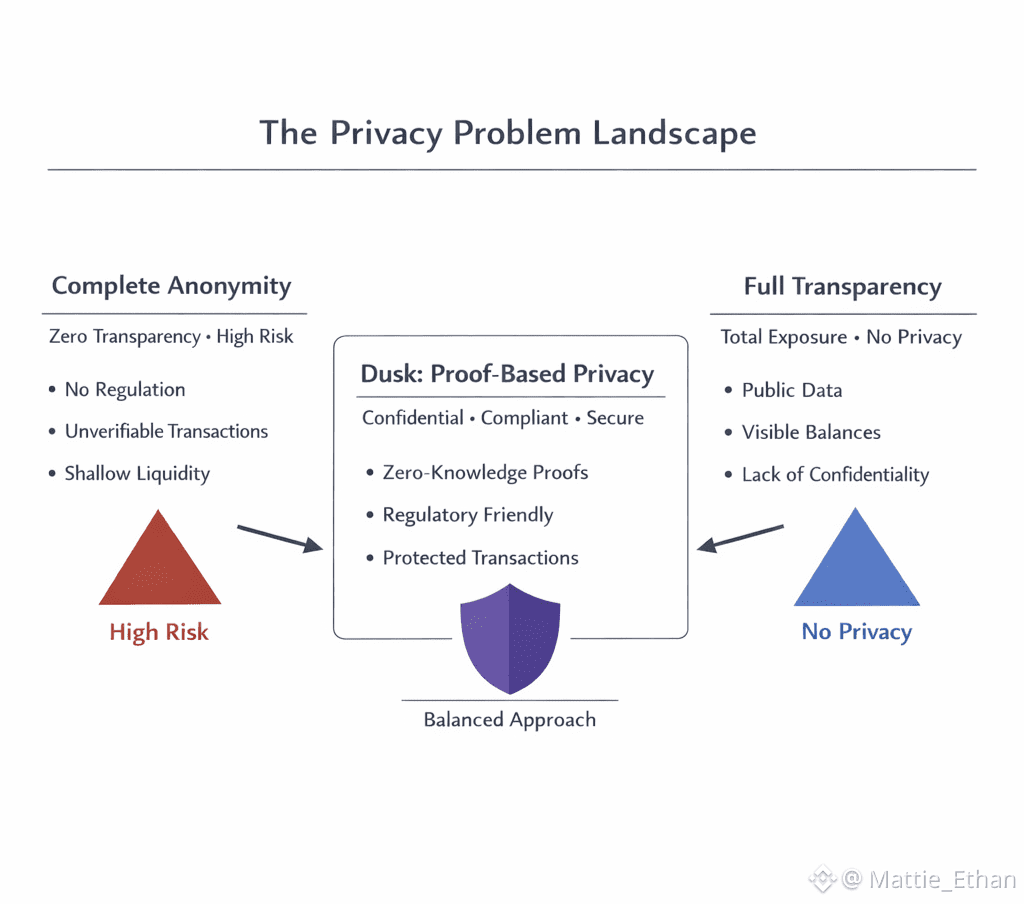
Dusk doesn’t chase total invisibility. It focuses on cryptographic proof — on verifiable confidentiality — where privacy and accountability coexist. Confidential transactions stay hidden from the public eye, but the system can still prove that they follow all necessary rules. This shift may look subtle, but it changes everything.
At the core of Dusk’s design is zero-knowledge proof (ZK proof) technology. This form of cryptography lets someone prove that something is true without revealing the underlying information itself. On Dusk, that means you can show regulators or counterparties that a transaction is compliant, that contracts are valid, and that rules are followed — all without exposing sensitive details about balances or identities.
This makes privacy workable rather than theoretical.
Think Like Institutions, Not Traders
People who trade on charts every day look for patterns, for signals, for short-term moves. But institutions think differently. They ask whether a system can operate at scale, protect competitive advantages, and meet legal requirements.
Institutions don’t want a system where every asset move or corporate action is public. They also don’t want a system that regulators can’t audit or verify. What they want is privacy with accountability — a blockchain where sensitive data stays hidden from those who don’t need to see it, but where proof can be shown to those who must see it. That is exactly what Dusk’s architecture enables.
In effect, Dusk lets users have both sides of the old “privacy versus transparency” debate — without forcing a hard choice.
How Dusk Works Technically
To understand the significance of this approach, it helps to look at how Dusk’s technology is built.
Dusk is a Layer-1 blockchain designed specifically for regulated financial systems. It’s not just another smart contract platform with privacy options bolted on later. Privacy is woven into the foundation of the network from the ground up. Its modular architecture combines:
Zero-knowledge proofs for confidentiality,
Native privacy rules and on-chain compliance,
Fast, final settlement without intermediaries,
And a structure that meets strict financial regulations.
Unlike networks where privacy is optional or an afterthought, in Dusk it’s native. That means privacy is part of the protocol itself, not an add-on.
One of the key innovations is the transaction models that let users choose between public and shielded flows depending on their needs. Phoenix and Moonlight, for example, give developers and participants flexibility in how they handle visibility and confidentiality.
Behind the scenes, the network uses a consensus mechanism called Succinct Attestation, which ensures fast and final settlement of transactions. This avoids long confirmation times while keeping privacy intact.
Dusk also integrates identity and permissioning protocols like Citadel, which enable institutions to maintain compliant access controls and enforce rules automatically on-chain, instead of relying on traditional off-chain back-office processes.
Confidential Smart Contracts and Real Use Cases
One of the big differentiators for Dusk is that it supports confidential smart contracts — the ability to execute contract logic without exposing the details publicly. Dusk’s Confidential Security Contract (XSC) standard is designed to let businesses issue and manage tokenized securities where sensitive financial data stays private but compliance is ensured.
Imagine a company issuing shares or bonds on-chain. Under traditional public blockchains, every transfer and every investor holding is visible to everyone. For most businesses, that’s unacceptable. With Dusk, the blockchain can enforce legal and regulatory requirements while keeping ownership specifics confidential. That opens the door for real institutions to use blockchain technology without compromising their competitive advantages.
This is the future of tokenization and real-world assets on blockchain: markets that respect privacy without sacrificing trust.
Why Proof Matters More Than Anonymity
Complete anonymity may sound appealing, but it creates real barriers in actual financial systems.
If a blockchain can’t show that transactions follow the law, exchanges and institutions become cautious. Liquidity dries up because major players won’t take the risk. Regulatory uncertainty means platforms can get shut down or blocked, leaving users stranded. Ultimately, people move away — not because the technology is uninteresting — but because the ecosystem never grows beyond speculative novelty.
Proof, on the other hand, scales. When a system can prove compliance without exposing sensitive data, it becomes trustworthy. Investors feel safe allocating capital. Developers build real applications. Institutions integrate with confidence. Liquidity deepens. That matters more than slogans about invisibility.
In traditional markets, confidentiality is the norm, not the exception. Corporations guard financial positions, strategies, and transactions every day. Dusk’s privacy model mirrors that real-world expectation on-chain, while still providing cryptographic proof where needed.
Binance Square and Dusk’s Ongoing Dialogue
As part of expanding its reach and educating the broader community about privacy with proof, Dusk participated in a Binance Square AMA event with its CTO. This dialogue highlighted Dusk’s positioning at the intersection of regulated finance and decentralized innovation, and underscored the real, practical problem the project is solving for future financial infrastructure.
These kinds of conversations are important because they show that Dusk’s mission isn’t just theoretical. It’s actively engaging with developers, investors, and industry participants to explain why compliance-ready privacy matters.
Instead of chasing surface narratives about anonymity, Dusk’s team emphasizes substance: how we actually build privacy that financial systems can use.
Why This Approach Attracts Serious Participants
For years, traders equated blockchain with transparency because that’s what they could see on public ledgers. But serious markets don’t work that way. Liquidity doesn’t come from noise or hype. It comes from participants who trust the system, who know they won’t be exposed unfairly, and who believe that legal and audit needs are met.
Networks that promise absolute anonymity face constant pressure: from regulators, from exchanges, and from institutions. This creates friction at every turn. Listings can be delisted, access restricted, and integration blocked. Uncertainty stays high. Capital hesitates.
Dusk’s proof-focused model reduces that uncertainty. It doesn’t hide from rules. It embraces them in a way that protects privacy while satisfying compliance. That is adaptability — and adaptability matters far more over multiple market cycles than any temporary surge in price or attention.
The Emotional Side of Financial Tools
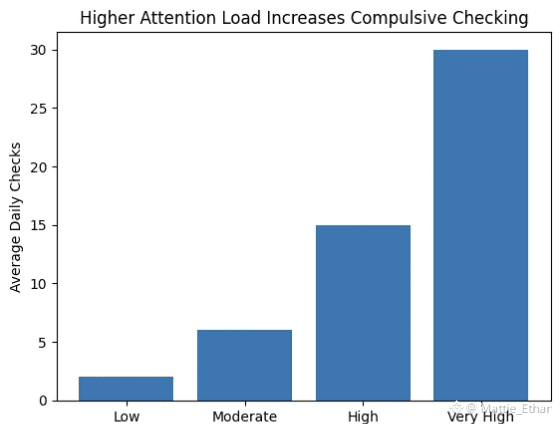
There’s a deeper element here that many traders don’t talk about. The constant chase for attention, alerts, and updates wears people down. Markets can be exciting, but that excitement also creates noise, distraction, and emotional stress. Traders eventually realize that being busy doesn’t mean being productive.
Dusk’s architecture reflects a different philosophy. It doesn’t need to grab attention. It doesn’t offer flashy alerts or gimmicks. It quietly does what it’s built to do: settle transactions, execute contracts, and protect sensitive data. Over time, users realize they don’t need to check it constantly. The system just works.
This doesn’t mean Dusk is boring. It means Dusk is built for stability and long-term engagement, not short-term hype. Serious investors aren’t looking for the next big chart breakout. They’re looking for infrastructure that won’t break under regulatory, economic, or operational pressures.
A New Paradigm for Privacy and Trust
The broader trend in financial markets is toward privacy with accountability. Traders may not see this reflected in daily price movements. But they see it in who is building, who is partnering, and who stays relevant over time.
People who are serious about being in this space long term ask different questions than casual traders. They ask:
How is privacy achieved?
Can the system prove compliance without revealing users?
Could institutions realistically use this five years from now?
These are not rhetorical questions. They are foundational to whether a blockchain project becomes infrastructure or remains style. Dusk’s approach — privacy that can be audited and verified when required — answers them without contradiction.
Conclusion: Privacy That Works in the Real World
In a space where many projects promise invisibility, Dusk quietly focuses on credibility. Its model recognizes that privacy isn’t the absence of accountability. It’s the control over visibility with verifiable proof. That is the distinction that matters most when you bridge cryptographic innovation and regulated finance.
Dusk isn’t about hiding from the world. It’s about participating on your own terms — protecting confidential information while satisfying real-world legal and financial expectations.
This approach won’t necessarily move markets overnight, but it builds a foundation that outlasts cycles. Over time, what keeps people coming back to infrastructure is not excitement or slogans. It’s consistency, trust, and proof. Dusk is building exactly that.
