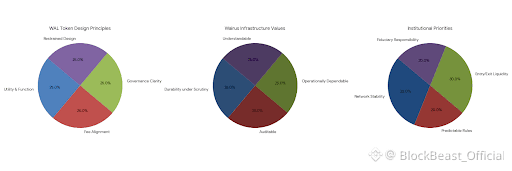
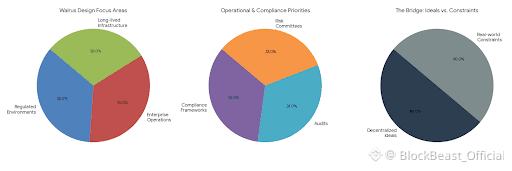
Walrus is best understood not as a statement about the future of finance, but as a set of conservative choices about how decentralized systems might coexist with the realities of regulated environments, enterprise operations, and long-lived infrastructure. From the perspective of someone accustomed to compliance frameworks, audits, and operational risk committees, the protocol’s design reads less like a manifesto and more like an attempt to narrow the gap between decentralized ideals and the constraints that govern real-world deployment.
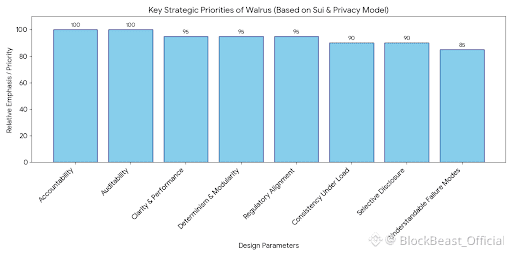
The decision to anchor Walrus on the Sui blockchain is illustrative. Sui’s object-based model and focus on predictable execution provide a foundation that prioritizes clarity and performance over experimentation. This matters in practice. Institutions and serious operators care less about novelty than about whether a system behaves consistently under load, whether failure modes are understandable, and whether upgrades can be planned without disrupting dependent applications. By relying on an execution environment that emphasizes determinism and modularity, Walrus signals an intent to reduce operational uncertainty rather than to push the boundaries of what is technically possible.
Privacy within Walrus is framed as a gradient rather than a binary. This is an important distinction that aligns closely with regulatory expectations. Absolute privacy is rarely acceptable in production financial systems, not because regulators oppose confidentiality, but because accountability, auditability, and selective disclosure are non-negotiable. Walrus’ approach to private transactions and data storage appears to acknowledge this reality. The system does not treat regulatory visibility as an external imposition, but as a design parameter. In practice, this means allowing for controlled disclosure when required, supporting audit trails, and recognizing that different participants—users, enterprises, and authorities—operate with different but overlapping information rights.
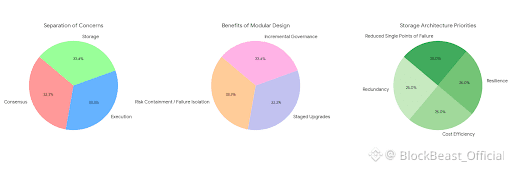
The storage architecture reinforces this pragmatic stance. The use of erasure coding and blob storage to distribute large files across a decentralized network is not particularly glamorous, but it addresses a real problem: how to achieve redundancy and cost efficiency without assuming perfect network behavior or perpetual node availability. These choices trade simplicity for resilience. They introduce complexity in coordination and retrieval, but they also reduce single points of failure and align with the expectations of organizations that already think in terms of disaster recovery, redundancy, and service-level guarantees. From an operational standpoint, these are familiar trade-offs, not revolutionary ones.
Walrus’ separation of concerns—between consensus, execution, and storage—further reflects conservative engineering. Modular design is often discussed as a scaling strategy, but its more important role is risk containment. When components are loosely coupled, failures are easier to isolate, upgrades can be staged, and governance decisions can be made incrementally. For regulated entities, this reduces the blast radius of change. It allows legal, compliance, and technical teams to reason about the impact of modifications without having to reassess the entire system each time.
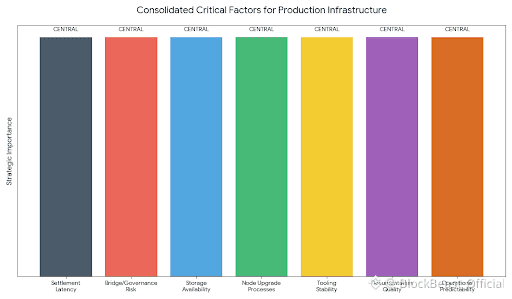
None of this eliminates limitations. Settlement latency remains a consideration, particularly when integrating with systems that expect near-instant finality. Cross-chain interactions and migrations introduce trust assumptions that cannot be abstracted away by design alone; bridges remain operational and governance risks, regardless of how carefully they are implemented. Storage availability depends on incentives and network participation, which may fluctuate over time. These are not edge cases. They are central factors in deciding whether and how such infrastructure can be used in production, and they demand ongoing attention from governance participants rather than optimistic assumptions.
The less visible aspects of the protocol are arguably the most important. Node upgrade processes, tooling stability, documentation quality, and operational predictability determine whether a system can be maintained over years rather than months. In regulated environments, unclear documentation or brittle tooling can be as disqualifying as a security flaw. Walrus’ long-term credibility will depend less on feature velocity and more on whether operators can run the network with confidence, auditors can understand its behavior, and developers can build without relying on institutional memory or informal knowledge.
The WAL token, when viewed through an institutional lens, is less about upside and more about function. Liquidity matters not for speculation, but for entry and exit without market disruption. Staking and governance mechanisms are meaningful only insofar as they align incentives with network stability and provide clear, predictable rules. Tokens that entangle economic participation too tightly with price narratives often struggle when markets turn or when scrutiny increases. A more restrained design—one that emphasizes utility, fee alignment, and governance clarity—better fits environments where capital allocation decisions are subject to oversight and fiduciary responsibility.
In aggregate, Walrus presents itself as infrastructure built with an awareness of how systems fail and how they are examined when something goes wrong. Its value proposition is not speed, dominance, or disruption, but the quieter promise of durability under scrutiny. If it succeeds, it will not be because it captured attention, but because it proved understandable, auditable, and operationally dependable over time. In financial and data infrastructure, those qualities are rarely celebrated, yet they are the ones that allow systems to persist long after narratives fade.