

Crypto adoption did not come from complex financial instruments. It came from stablecoins. Today, stablecoins are used for remittances, merchant payments, treasury management, payroll, and cross-border settlement. Despite this reality, most blockchains still treat stablecoins as just another token type, running on infrastructure designed for experimentation rather than reliability. Plasma exists because that mismatch becomes visible at scale.
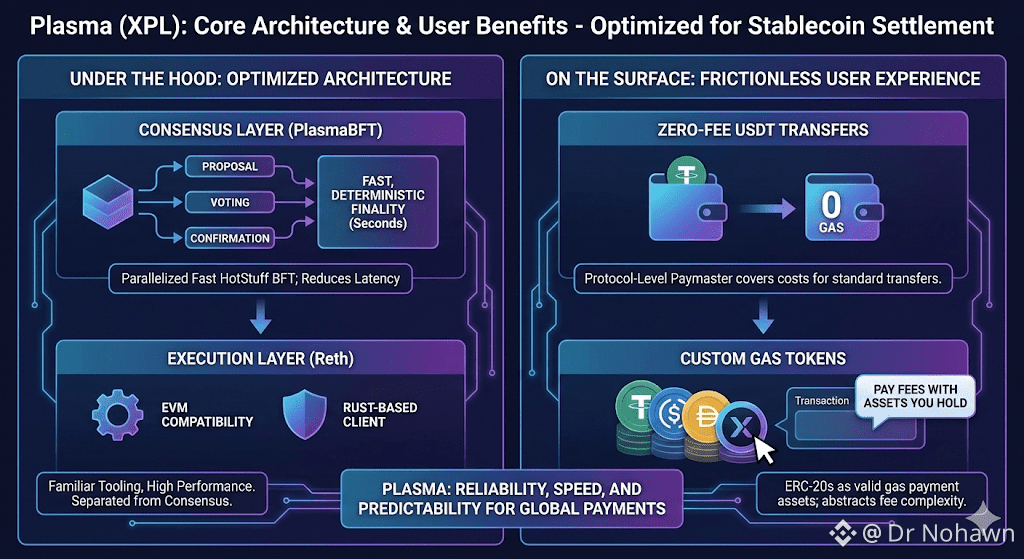
Plasma is an EVM-compatible Layer 1 blockchain designed specifically for stablecoin payments. It does not attempt to be a universal execution environment for every possible narrative. Instead, it optimizes for a narrow but critical workload: high-frequency, high-volume value transfer where cost, speed, and predictability matter more than novelty.
The network is secured by PlasmaBFT, a consensus mechanism derived from the Fast HotStuff Byzantine Fault Tolerant protocol. Traditional BFT designs rely on sequential communication steps that introduce latency as validator counts grow. PlasmaBFT improves on this by parallelizing block proposal, voting, and confirmation phases. This reduces communication overhead and enables transactions to reach finality within seconds. For payment systems, this property is essential. A transaction that finalizes quickly and predictably can support real economic coordination, while delayed finality introduces risk and inefficiency.
Plasma cleanly separates consensus from execution. While PlasmaBFT handles ordering and finality, the execution layer runs on Reth, a Rust-based Ethereum client. This provides full Ethereum Virtual Machine compatibility, allowing developers to deploy Solidity smart contracts and use existing Ethereum tooling without modification. From a builder’s perspective, Plasma feels familiar, but under the hood it behaves very differently from congested general-purpose chains.
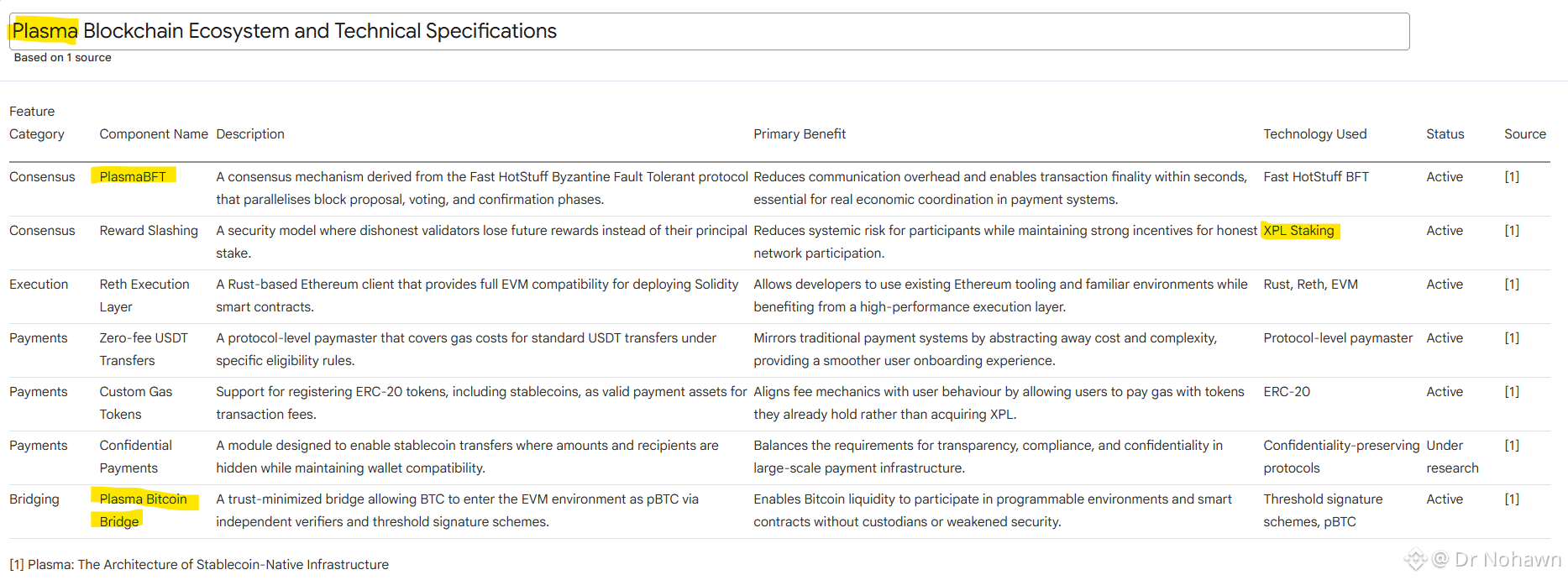
One of Plasma’s most impactful features is zero-fee USDT transfers. Through a protocol-level paymaster maintained by the Plasma Foundation, gas costs for standard USDT transfers are covered under defined eligibility rules and rate limits. Users can send USDT without managing gas balances or worrying about network fees. This mirrors traditional payment systems, where cost and complexity are abstracted away from the end user. The result is a smoother onboarding experience and a more intuitive payment flow.
For transactions beyond basic transfers, Plasma introduces support for custom gas tokens. Applications can register ERC-20 tokens, including stablecoins, as valid payment assets for transaction fees. This allows users to pay gas with tokens they already hold, such as USDT, rather than acquiring XPL solely for transaction costs. This design aligns fee mechanics with real user behavior and reduces unnecessary friction across the ecosystem.
Privacy is another area Plasma is actively exploring through its Confidential Payments module. The goal is to enable stablecoin transfers where sensitive details like amounts and recipients can be hidden, while remaining compatible with existing wallets and decentralized applications. Although this module is still under research, it reflects Plasma’s understanding that large-scale payment infrastructure must eventually balance transparency, compliance, and confidentiality.
Plasma also integrates Bitcoin through a trust-minimized bridge. The Plasma Bitcoin bridge allows BTC to enter the EVM environment without custodians or traditional wrapped assets. Independent verifiers confirm Bitcoin deposits and mint pBTC, a token backed one-to-one by BTC. pBTC can be used in smart contracts, as collateral, or transferred across chains using omnichain standards. When users withdraw, pBTC is burned and BTC is released back to the user via threshold signature schemes. This design allows Bitcoin liquidity to participate in programmable environments without weakening security assumptions.
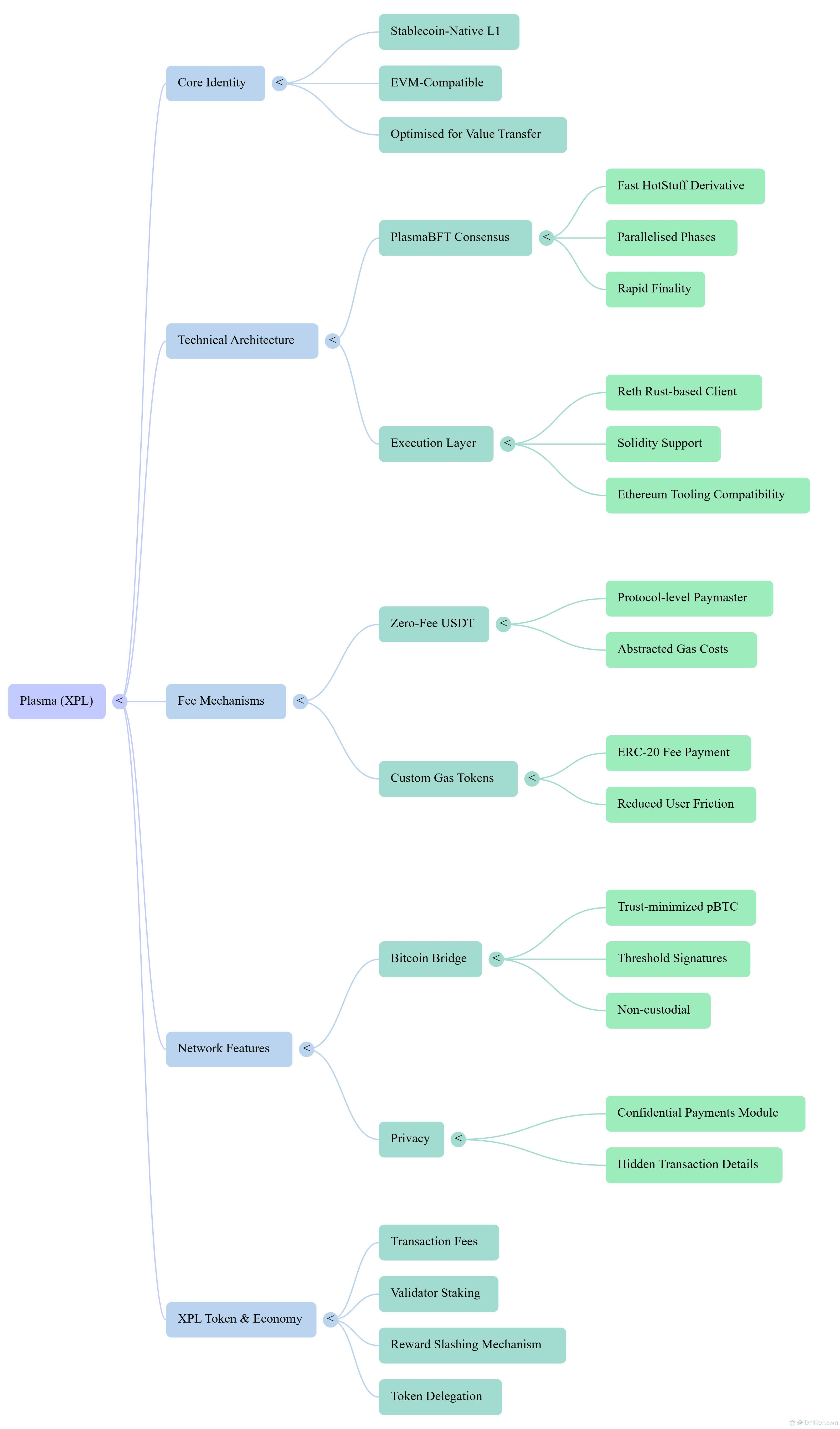
The XPL token underpins the entire Plasma ecosystem. XPL is used for transaction fees where applicable, staking by validators, and distribution of network rewards. Plasma applies reward slashing rather than stake slashing, meaning validators who act dishonestly lose future rewards instead of their principal stake. This reduces systemic risk while maintaining strong incentives for honest participation. XPL holders will also be able to delegate their tokens, enabling broader participation in network security without operating validator infrastructure.
Plasma’s inclusion in Binance HODLer Airdrops highlights its positioning as long-term infrastructure rather than short-term speculation. Its design choices reflect a focus on sustainability, usability, and real economic activity.
In a crowded landscape of general-purpose blockchains, Plasma stands out by narrowing its scope. By treating stablecoins as foundational infrastructure and optimizing every layer around their real-world usage, Plasma offers a settlement network built for consistency, predictability, and scale. @Plasma $XPL #plasma


