
In a blockchain industry often driven by speed, hype, and experimentation, Dusk has taken a markedly different path. Rather than chasing short-term narratives, it has spent years building something far more ambitious and far more difficult: a Layer-1 blockchain designed specifically for real financial markets, where privacy, regulation, and institutional trust are not optional features but foundational requirements. Formerly known as Dusk Network, the project’s evolution into simply “Dusk” reflects a sharpened vision—one that places regulated, privacy-preserving finance at the very center of its identity.
Founded in 2018 and headquartered in Amsterdam, Dusk emerged from a simple but powerful observation. Traditional finance cannot simply migrate onto public blockchains without sacrificing confidentiality, legal compliance, and operational control. At the same time, decentralized finance cannot reach its full potential while ignoring regulatory realities. Dusk exists precisely at this intersection, aiming to bridge TradFi and DeFi without forcing either side to compromise on its core principles. Its mission is not to replace financial institutions, but to give them a blockchain infrastructure that finally speaks their language.
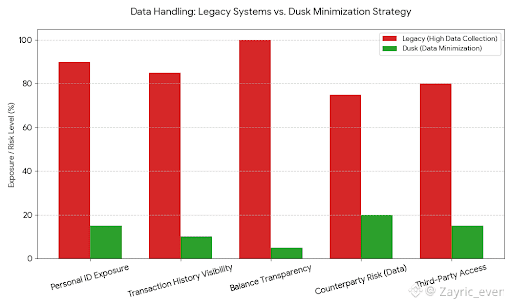
At the heart of Dusk’s design is the belief that privacy and regulation are not opposites. In fact, the project treats privacy as a prerequisite for compliant finance. Banks, exchanges, and asset issuers cannot operate in fully transparent environments where positions, balances, and counterparties are publicly exposed. Yet regulators still require visibility, auditability, and enforcement. Dusk resolves this tension by embedding cryptographic privacy directly into the protocol while enabling selective disclosure when legally required. This approach transforms privacy from a liability into a compliance tool.
Technically, Dusk is built as a modular blockchain stack, separating settlement, execution, and future privacy computation into distinct layers. The settlement layer, known as DuskDS, handles consensus, finality, and data availability while enforcing the protocol’s privacy and regulatory logic at the base level. This is where Dusk’s institutional mindset becomes most visible. Settlement is deterministic, fast, and designed to support real financial workflows such as clearing, settlement, and delivery-versus-payment. Rather than optimizing for raw decentralization at the cost of performance, Dusk prioritizes predictable outcomes and low latency—qualities institutions depend on.
Above the settlement layer sits DuskEVM, an execution environment compatible with Ethereum’s tooling and developer ecosystem. This choice is strategic. By supporting EVM smart contracts, Dusk lowers the barrier for developers and institutions already familiar with Ethereum, allowing them to deploy regulated DeFi applications without learning an entirely new stack. Lending protocols, tokenized asset markets, and compliance-aware DeFi primitives can all be built using familiar tools, while still benefiting from Dusk’s privacy guarantees underneath. In the future, DuskVM is planned as a dedicated privacy execution environment, expanding the platform’s ability to run fully confidential smart contracts at scale.
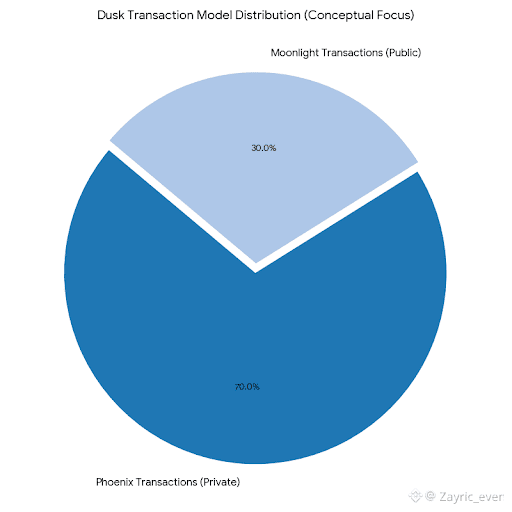
Privacy on Dusk is not a single feature but a system-wide property enabled by advanced zero-knowledge cryptography. Using techniques such as PLONK, the network allows transactions to remain confidential while still being verifiable. This is expressed through Dusk’s dual transaction model. Phoenix transactions enable private transfers with shielded balances and selective reveal, ensuring sensitive financial data remains hidden. Moonlight transactions operate in a public context, enabling interoperability and transparency where it is appropriate. Together, these models allow assets and data to move seamlessly between private and public contexts without breaking compliance or usability.
Consensus on Dusk is built around a Proof-of-Stake mechanism tailored for institutional use. Rather than relying on probabilistic finality, Dusk’s Succinct Attestation model uses committee-based validation to deliver fast, deterministic settlement. This is complemented by Kadcast, an optimized network propagation protocol that ensures blocks and attestations move efficiently across the network. The result is a blockchain capable of supporting time-sensitive financial operations, where delays or reorgs are unacceptable. For institutions accustomed to strict settlement guarantees, this design choice is critical.
One of Dusk’s most defining characteristics is how deeply regulation is woven into the protocol itself. Instead of treating compliance as an external layer handled by applications or intermediaries, Dusk integrates regulatory logic at the blockchain level. The network is explicitly designed to align with frameworks such as MiCA, MiFID II, the EU DLT Pilot Regime, and GDPR-style data protection rules. This means requirements like KYC, AML, eligibility restrictions, and reporting can be enforced cryptographically without exposing private data on-chain. For regulators, this offers visibility and control. For users and institutions, it preserves confidentiality and legal certainty.
These design choices have positioned Dusk as a natural platform for regulated financial use cases. One of its primary focuses is the tokenization of real-world assets, including equities, debt instruments, and structured products. By enabling compliant issuance, trading, and settlement on-chain, Dusk opens the door to more efficient capital markets while preserving the legal frameworks that govern them. Institutional DeFi is another core area, where lending, automated market making, and structured financial products can operate with confidential positions and rule-based access control. Unlike traditional DeFi, these systems are built to accommodate institutions, not exclude them.
Identity and permissioning also play a central role in Dusk’s ecosystem. Through its Citadel framework, the network enables privacy-preserving identity management and access control. Users can prove eligibility or compliance without revealing unnecessary personal data, supporting self-sovereign identity models that satisfy both privacy advocates and regulators. In payments and settlement, Dusk enables confidential transfers between institutions and robust delivery-versus-payment mechanisms, reducing counterparty risk and operational friction.
The transition from theory to reality accelerated with Dusk’s mainnet launch on January 7, 2025. This marked the project’s move from years of research and testing into a production environment. Since then, the ecosystem has expanded steadily. A bidirectional cross-chain bridge introduced in 2025 allows assets to move between Ethereum-compatible networks and Dusk, extending liquidity while maintaining privacy features. The public launch of the DuskEVM testnet in late 2025 opened the platform to a broader developer audience, enabling smart contract experimentation with familiar tools like MetaMask.
Early network usage data following mainnet showed tens of thousands of active addresses and consistent transaction activity, signaling genuine adoption rather than speculative traffic. While Dusk has never marketed itself as a retail-focused chain, its growth reflects increasing interest from institutions exploring on-chain finance within regulatory boundaries. This is further reinforced by partnerships and pilots, particularly in Europe. Collaborations with entities such as NPEX, a licensed European stock exchange, have demonstrated Dusk’s ability to support regulated marketplaces and tokenized securities in real-world settings. Reports of growing institutional wallet usage and hundreds of millions of dollars in tokenized real-world assets underline the platform’s strategic direction.
The DUSK token underpins this entire system. It is used to pay transaction fees, secure the network through staking, and will play a role in governance as the ecosystem matures. With a fixed total supply of one billion tokens and roughly half circulating by 2026, the token’s economics are designed to balance long-term security with ecosystem incentives. Unlike many utility tokens, DUSK’s value proposition is closely tied to real economic activity on the network, particularly in regulated finance and institutional adoption.
Looking ahead, Dusk’s roadmap is structured around progressive phases that reflect increasing sophistication rather than rushed expansion. From the initial public launch to enhanced privacy features, institutional tooling, and eventual ecosystem maturity, each phase builds on a stable foundation. Future development continues to focus on deeper DeFi functionality, expanded privacy execution, and tighter integration with regulatory and financial infrastructure. Rather than pivoting with market trends, Dusk remains consistent in its long-term vision.
What ultimately sets Dusk apart is its restraint. In an industry often driven by maximalism, Dusk embraces constraints—legal, technical, and operational—and turns them into strengths. By aligning privacy with compliance, decentralization with institutional needs, and innovation with regulation, it offers a glimpse into what blockchain adoption at scale might actually look like. Dusk is not trying to reinvent finance overnight. It is quietly rebuilding its infrastructure, one compliant, private transaction at a time.
