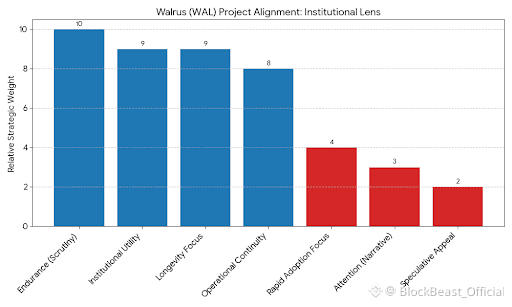
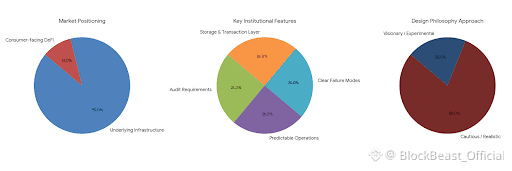
@Walrus 🦭/acc presents itself less as a consumer-facing DeFi product and more as a piece of underlying infrastructure, and it is best evaluated on those terms. From the perspective of someone accustomed to regulated financial environments and long-lived systems, its design choices read as cautious rather than visionary. The emphasis is not on disintermediation for its own sake, but on building a storage and transaction layer that can exist alongside real institutional constraints, including audit requirements, predictable operations, and clear failure modes.
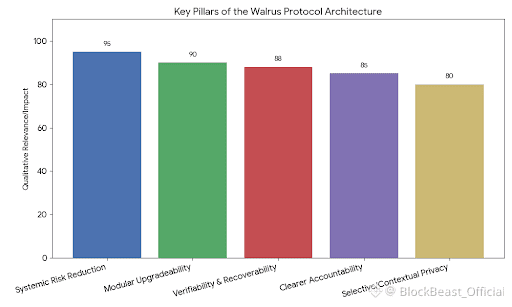
Operating on the Sui blockchain already signals a preference for a modular, performance-oriented base rather than attempting to reinvent consensus or execution from scratch. Walrus inherits Sui’s separation of concerns, where consensus, execution, and storage are not tightly entangled. This separation is not an aesthetic choice; it reduces systemic risk. In regulated systems, the ability to upgrade or modify one layer without destabilizing others is often more valuable than theoretical efficiency gains. It allows for incremental change, controlled migrations, and clearer accountability when something goes wrong.
Privacy within the Walrus protocol is framed implicitly as selective and contextual, not absolute. Private transactions and data storage are supported, but the architecture does not suggest an attempt to make information permanently opaque to all parties. In real-world financial systems, privacy is rarely binary. Regulators, auditors, and counterparties require different levels of visibility at different times. Systems that acknowledge this reality tend to survive longer than those that treat disclosure as an existential threat. Walrus’s approach to privacy-preserving storage, combined with verifiability and recoverability through erasure coding, aligns more closely with enterprise data practices than with ideological anonymity.
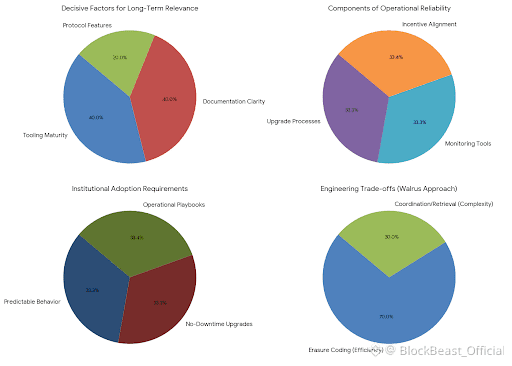
The choice to focus on decentralized blob storage and large-file distribution addresses a practical constraint often ignored in blockchain design: most economically relevant data does not fit neatly into small, on-chain transactions. By distributing data across a network using erasure coding, Walrus reduces reliance on any single operator while avoiding the inefficiencies of full replication. This is a conservative engineering trade-off. It accepts some complexity in retrieval and coordination in exchange for lower costs and higher resilience, which mirrors decisions commonly made in regulated data centers and financial infrastructure.
There are, however, operational limitations that matter. Storage networks are only as reliable as their upgrade processes, monitoring tools, and incentive alignment for node operators. Settlement latency for transactions interacting with stored data may not meet the expectations of high-frequency or real-time use cases. Cross-chain assumptions, particularly where assets or data references move between environments, introduce trust surfaces that cannot be eliminated, only managed. These are not abstract concerns; they shape how and where such a system can be deployed responsibly.
Tooling maturity and documentation clarity are likely to be more decisive for Walrus’s long-term relevance than any single protocol feature. Institutions adopt systems that behave predictably under stress, that can be upgraded without downtime surprises, and that provide clear operational playbooks. In this context, the absence of spectacle is a strength. A storage layer that rarely draws attention but consistently works is more valuable than one that constantly evolves in public view.
The WAL token, when examined through an institutional lens, functions primarily as an access and coordination mechanism rather than a speculative instrument. Liquidity matters not for price discovery narratives, but for exit flexibility and operational continuity. Staking and governance roles must be understandable to compliance teams and risk committees, not just to early adopters. Tokens that are too tightly coupled to volatile incentives tend to complicate balance sheets and discourage long-term use, regardless of technical merit.
In aggregate, Walrus appears designed to endure scrutiny rather than attention. Its architectural conservatism, selective privacy model, and focus on unglamorous storage problems suggest a project aiming for longevity over rapid adoption. Success, in this case, would not be measured by visibility or narrative dominance, but by the quiet fact that the system continues to operate, upgrade, and pass audits years after more ambitious designs have been abandoned.