

The scourge of bad data—inaccurate or unreliable information—continues to cost global industries billions, particularly in AI where flawed inputs lead to erroneous outputs and wasted resources. @walrusprotocol’s insightful January 22, 2026, blog “Bad data costs billions. Verifiability is the answer” articulates how onchain proofs-of-availability provide a robust solution, ensuring data stored on their decentralized platform remains intact and trustworthy.
As a chain-agnostic storage layer built on Sui, Walrus’s network spans 4,100 TB across 150+ nodes, supporting over 170 projects with 25% utilization.
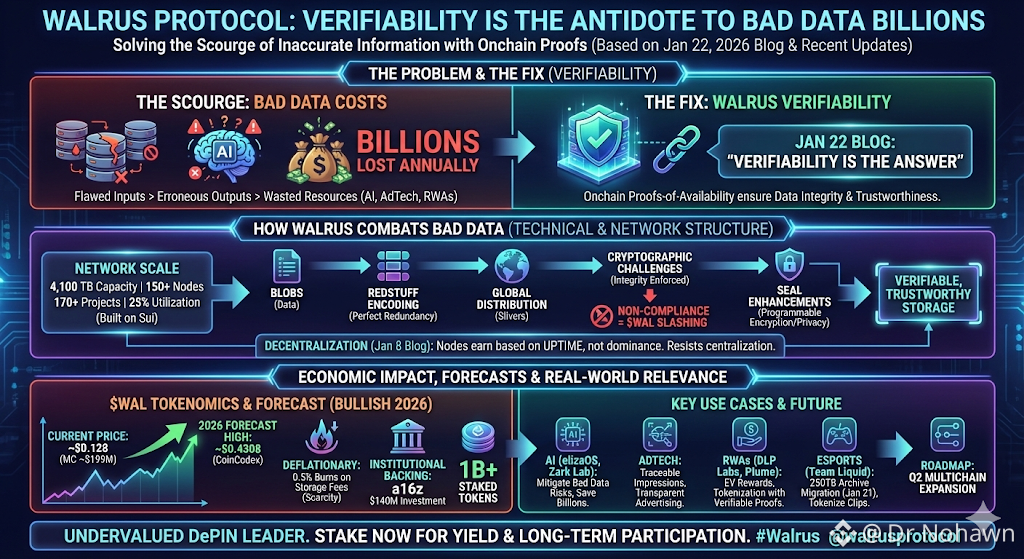
Structurally, Walrus combats bad data through innovative design. Blobs are encoded with RedStuff Reed-Solomon for perfect redundancy, slivers are distributed globally, and integrity is enforced via cryptographic challenges that penalize non-compliance with $WAL slashing. This aligns with their recent X thread on decentralization, where nodes earn based on uptime rather than dominance, resisting centralization as detailed in the January 8 scaling blog. Seal enhancements add programmable encryption, allowing privacy-preserving access for sensitive AI datasets.
Economically, $WAL trades at approximately $0.128 (up 1.9% daily, down 0.6% hourly, MC ~$199M, ranked #287 on CoinGecko), with deflationary 0.5% burns on storage fees creating scarcity amid growing demand. CoinCodex forecasts a bullish 2026 with an average of $0.1803 and a high of $0.4308 (171% ROI), fueled by 1B+ staked tokens and institutional validation from a16z’s $140M investment and its 2026 privacy-focused outlook.
Relevance is profound. In AI, verifiability mitigates bad data risks for integrations like elizaOS’s agentic memory or Zark Lab’s content intelligence, potentially saving billions as quantified in the blog. In adtech, traceable impressions address OpenAI’s January 16 tests for transparent advertising. For RWAs, DLP Labs’ EV rewards and Plume’s tokenization rely on verifiable proofs, enhancing trust.
Creatively, Walrus turns data liabilities into assets. Imagine esports fans verifying and owning clips from Team Liquid’s 250TB archive migration on January 21, tokenized onchain to unlock new revenue streams.
Challenges remain, including Q2 multichain expansion to diversify beyond Sui following recent outage recovery.
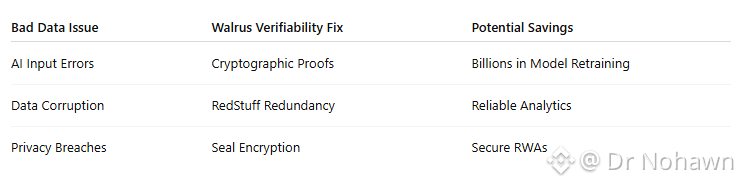
For developers, workflows are straightforward: use the CLI for verifiable storage such as walrus store --epochs max ai_set.csv, and integrate proofs via the SDK. Walrus’s open-source GitHub codebase welcomes contributions.
In summary, @Walrus 🦭/acc ’s verifiability, as championed in its January 22 blog, is a foundational shift for the 2026 data economy. With $WAL ’s strong fundamentals and forward-looking forecasts, it stands out as an undervalued DePIN leader. Stake now for yield and long-term participation.
#Walrus

