

 Most blockchains assume that action equals progress. More transactions, more throughput, more signatures, more state changes all treated as evidence of a system in motion. Financial infrastructure, however, doesn’t behave that way. In markets where capital and compliance define the rhythm, the most critical operational decisions are often the ones that prevent action rather than trigger it. Dusk is one of the few networks that acknowledges that reality at the design level. Instead of rewarding constant motion, it builds interfaces and mechanics where restraint the decision not to clear, not to release, not to settle carries just as much informational weight as execution.
A large part of this shift comes from how Dusk treats the operational boundary between consensus and compliance. In public blockchains, the settlement layer is blind: once state transitions are valid under the rules, they execute. In regulated markets, the logic has another layer: transactions may be technically valid but operationally blocked until disclosure, eligibility, or authorization conditions are satisfied. That blocking is not a failure state it’s an intentional buffer between legal finality and mechanical finality. Dusk’s architecture respects this boundary instead of pretending it doesn’t exist, giving operators an environment where halting is not a panic button, but a procedural tool.
The UI layer reveals the philosophy most clearly. Traditional crypto dashboards obsess over throughput, mempool depth, fee curves, and validator performance. Institutional dashboards have a different focus: queue health, pending authorizations, compliance attestations, risk flags, disclosure events, and settlement windows. Dusk leans toward the second, turning internal state into operational visibility so operators know when to let the system move and when the correct decision is to wait. In that context, restraint stops being interpreted as latency or inefficiency and starts being interpreted as risk management.
 This becomes even more important when dealing with tokenized financial instruments that behave like lifecycle products rather than static tokens. A security on Dusk may exist through issuance, lock-up, transfer restriction, coupon, redemption, and reporting phases. Each phase carries different disclosure rules and operational triggers. A downstream participant may not be allowed to see the entire lifecycle, and yet the system must ensure consistency across it. If the UI encouraged blind execution, phases would collapse into chaos. Instead, Dusk treats visibility as scoped and action as conditional, allowing operators to interpret when the system is ready to move, not merely when it is able to.
Privileged controls also shape how restraint is interpreted. In most public networks, control is adversarial by design: any restriction is seen as censorship. In regulated environments, control is procedural: certain entities must approve certain transitions to satisfy legal requirements, and the absence of that approval is not censorship but compliance. Dusk translates that logic into selective disclosure and conditional release rather than blunt prohibition. The UI exposes this as a set of operators issuers, custodians, regulators, auditors each with different authority and visibility. Suddenly, the network looks less like a mempool and more like a clearing system.
One of the most overlooked aspects of financial operations is that silence is informative. A settlement window that has not cleared tells you something. A bond redemption that has not been authorized tells you something. A compliance module that has not issued a positive attestation tells you something. Dusk’s operational design treats non-events as meaningful data rather than system noise. This is the point at which crypto’s “everything should be real-time” assumption collapses: real markets are defined by windows, deadlines, cutoffs, and reveals not by constant atomic execution.
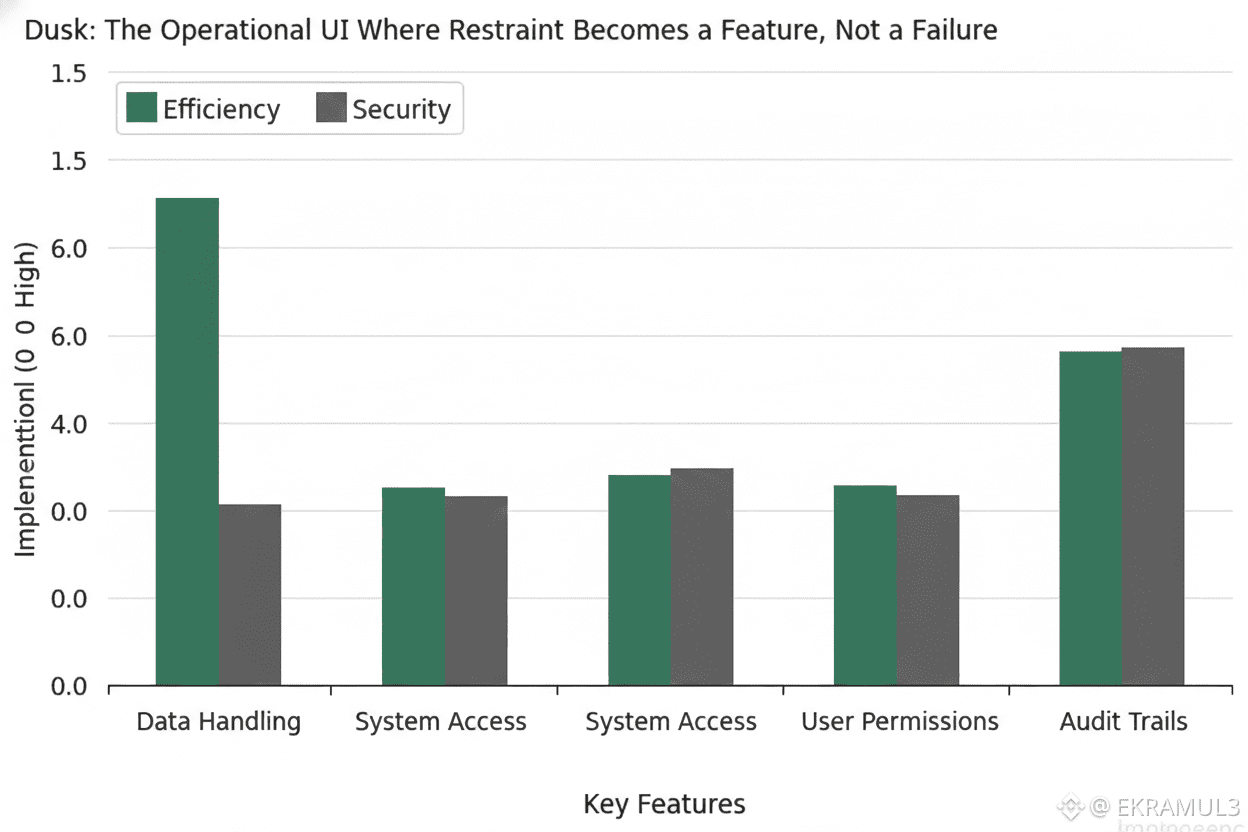 The economic impact of this approach is significant. When operators have visibility into when not to act, capital efficiency increases. Funds are not moved prematurely. Redemption cycles do not race ahead of disclosure. Collateral is not re-hypothecated before legal clearance. These behaviors matter more for RWAs than for speculative tokens, because the cost of premature execution is not slippage it is legal breach. Dusk is one of the few networks that internalizes that risk and gives operators the UI surface to manage it intentionally rather than improvisationally.
There’s also a meta-layer here: restraint produces audit logs. When a system can prove that it chose not to execute, that proof becomes meaningful. A regulator can review why a transfer did not clear. An auditor can verify that a redemption was delayed for a compliance reason, not a liquidity failure. The chain becomes not only a settlement engine but a record of procedural correctness. This is what separates Dusk from privacy systems designed for avoidance Dusk is designed for accountability without exposure.
Crypto has spent thirteen years trying to make everything move faster. Dusk is quietly designing the UI that makes the market comfortable with moving slower in the places where it matters. Speed without correctness is gambling. Correctness without visibility is paralysis. Dusk is building the operational surface that makes those two states reconcilable a place where operators don’t merely trigger transactions but curate them, and where restraint becomes a feature of market design instead of a sign of system weakness.
