


When I think about Dusk I do not imagine charts or fancy DeFi dashboards. I imagine the back rooms of finance where deals get finalized, records are checked, and uncomfortable questions are answered quietly but correctly. Dusk feels less like something built to impress and more like something built to be trusted. And you can feel that difference when you slow down and look closely.
Most blockchains treat transparency as a virtue. Everything is public and everyone can see everything. If institutions feel uneasy the assumption is they will adapt. But real financial markets do not work like that. Confidentiality is not a loophole, it is a requirement. Positions, counterparties, and strategies stay private by default. Disclosure only happens when there is a legal or supervisory reason.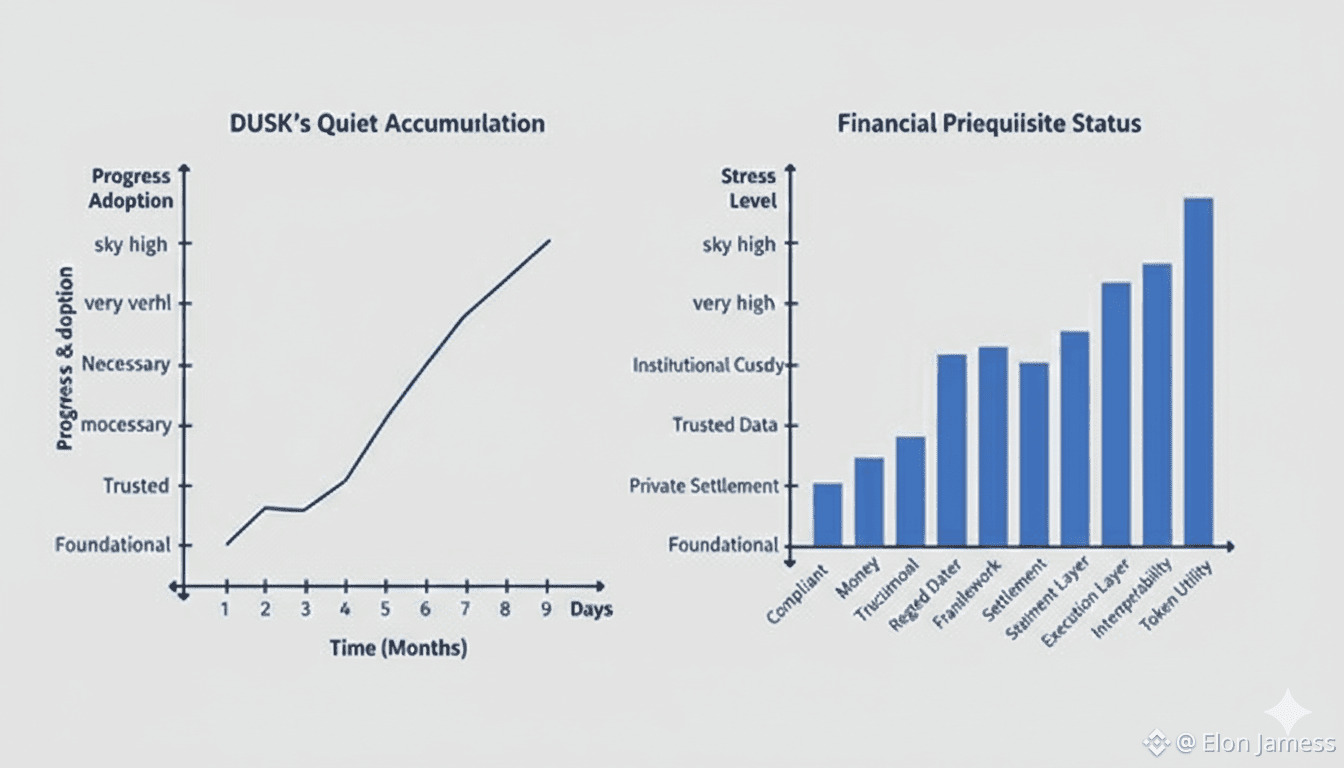
Dusk does something different. It accepts this reality instead of fighting it. Its dual transaction system shows this mindset in a practical way. Moonlight transactions are open and account based, good for flows that need visibility. Phoenix transactions are shielded, hiding amounts and counterparties while still allowing correctness to be proven cryptographically. View keys allow selective disclosure when audits or regulators step in. This is not a philosophical compromise. It feels like someone asked how regulated markets behave when nobody is watching and then encoded that behavior into a ledger.
The same realism shows up in how Dusk is structured. Settlement is treated as foundational not incidental. Execution lives on top of it via DuskEVM rather than the other way around. In traditional finance execution venues come and go but settlement infrastructure is sacred. By separating these layers Dusk is quietly saying it wants to be closer to the clearinghouse than the trading app. That is not exciting in a hype driven market but it is where long term relevance forms.
What changed my view of Dusk over the last year is how the ecosystem pieces started filling in around that core. Not flashy launches but the uncomfortable necessities most crypto projects postpone.
Take settlement currency. Tokenized assets without a compliant cash leg are like stock exchanges that only settle in IOUs. The introduction of EURQ, a regulated euro token under MiCAR, feels like Dusk acknowledging that reality head on. The fact that EURQ already existed elsewhere before being brought into the Dusk orbit makes it feel less like marketing and more like plugging into existing regulatory and payments logic. It is not about number go up, it is about removing friction where institutions normally walk away.
Custody is another area where Dusk does not take shortcuts. The collaboration with NPEX and Cordial Systems emphasizes self hosted zero trust setups rather than outsourced convenience. That might sound less user friendly but for regulated entities it is the opposite. Control over keys infrastructure and audit trails is non negotiable. By leaning into that instead of hiding it away Dusk is aligning with how financial institutions actually operate not how crypto Twitter wishes they would.
Then there is data and interoperability. The Chainlink integration is not just about price feeds. It is about publishing official market data on chain and enabling assets to move across chains without losing their regulatory context. Anyone can make an asset portable. Very few can make it portable without stripping away the rules that define it. Dusk’s approach suggests it wants assets to travel but only with their obligations intact.
Even the token mechanics reflect this infrastructure first mindset. DUSK is not framed as a governance experiment or a speculative toy. It pays for security settlement and execution. Staking rules are deliberately conservative designed to avoid reflexive compounding tricks rather than encourage them. Emissions are long term and predictable stretching decades into the future. This is not optimized for excitement. It is optimized for stability which tells you who the network expects to serve.
On chain signals today are still fragmented split between legacy representations and the native network but that is normal for infrastructure still consolidating. What matters more is that the economic design makes sense if usage grows. Fees staking and execution costs all tie back to real activity rather than abstract participation.
What stands out most is how little of Dusk’s progress fits into a typical crypto narrative. There is no single moment to point to where everything goes viral. Instead there is a slow accumulation of prerequisites compliant money institutional custody trusted data and a privacy model regulators can live with. These are the things nobody celebrates until they are missing.
Dusk feels like it is trying to build a system that can operate quietly for years only drawing attention when something needs to be proven. In a space obsessed with visibility that is a strange ambition. But if regulated privacy aware finance ever truly moves on chain it is hard to imagine it doing so without something that looks a lot like what Dusk is assembling now.
