
When first time I saw Plasma $XPL talk about sub-second finality, I paused. Not because it sounded flashy. Because it sounded… hard. Like saying, “I can shut a heavy vault door in under a second, every time, even if the room is loud.” I’ve watched fast chains before. Some feel quick, sure, but the “done” part is fuzzy. Plasma is aiming at a different feeling: you send a tx, and almost right away you know it’s locked in.
Finality just means “no take-backs.” In plain terms, it’s the moment a payment stops being a maybe. Sub-second finality means that moment can come in less than a second. Not “it shows up on your screen.” Not “it might stick.” It means the network agrees, and it would take an extreme break to undo it. That’s the promise. And it matters most when you’re moving things like stable value, where trust is the product.
So how do you build that kind of speed without turning the chain into a house of cards?
I picture Plasma’s finality engine like a tight crew on a runway. Planes land fast only because the crew has strict roles, clear signals, and no wasted motion. The core trick is fast agreement. In a chain, agreement is “consensus.” That’s the group of nodes (you can call them validators) deciding what the next block is. The key is not just making blocks quickly. It’s making the decision quickly.
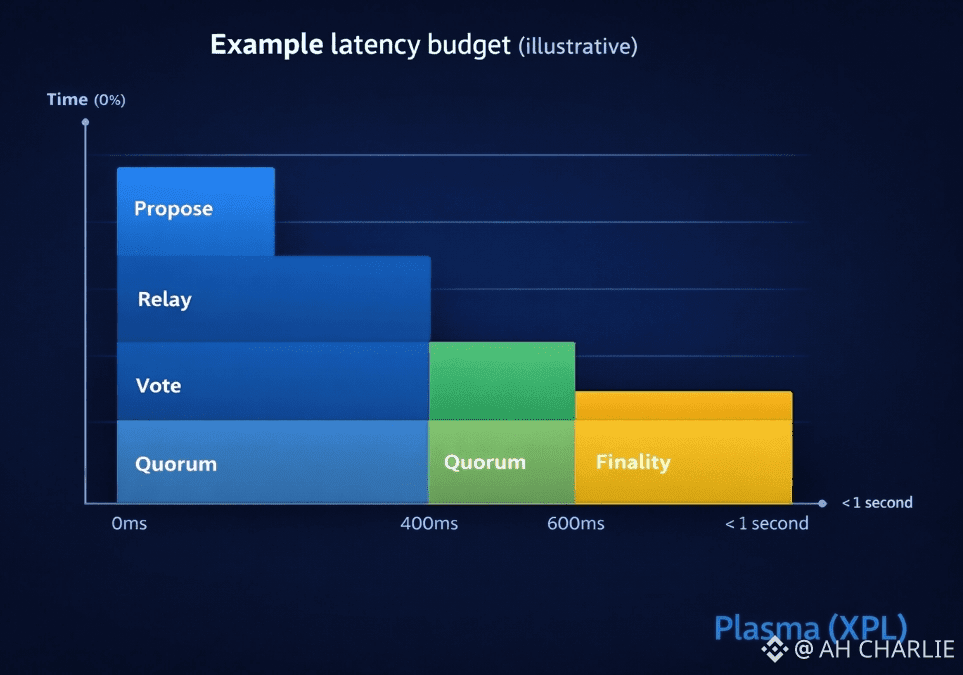
Most sub-second designs lean on a BFT style flow. BFT is a fancy short form for “it can still work even if some actors fail or act weird.” In a BFT round, one node proposes a block, then others send votes. When enough votes come in, the block is final. “Enough” is a set share of the group, a quorum. Think of it like a board meeting. One person reads the motion. People raise hands. Once the count is high enough, it passes. No drama. No long debate.
Speed comes from removing wait time. You don’t want ten steps. You want two or three. And you want them to be small steps. A clean propose → vote → lock loop. Short time limits. Quick leader change if the proposer is slow. No sitting around staring at a spinning wheel.
Then there’s the part most people skip: the network itself. Even a perfect vote system fails if messages arrive late. So the engine has to move data like a good courier. Small payloads. Quick relay. Less chatter. If Plasma wants sub-second finality to feel real, it can’t just be “fast math.” It has to be fast communication.
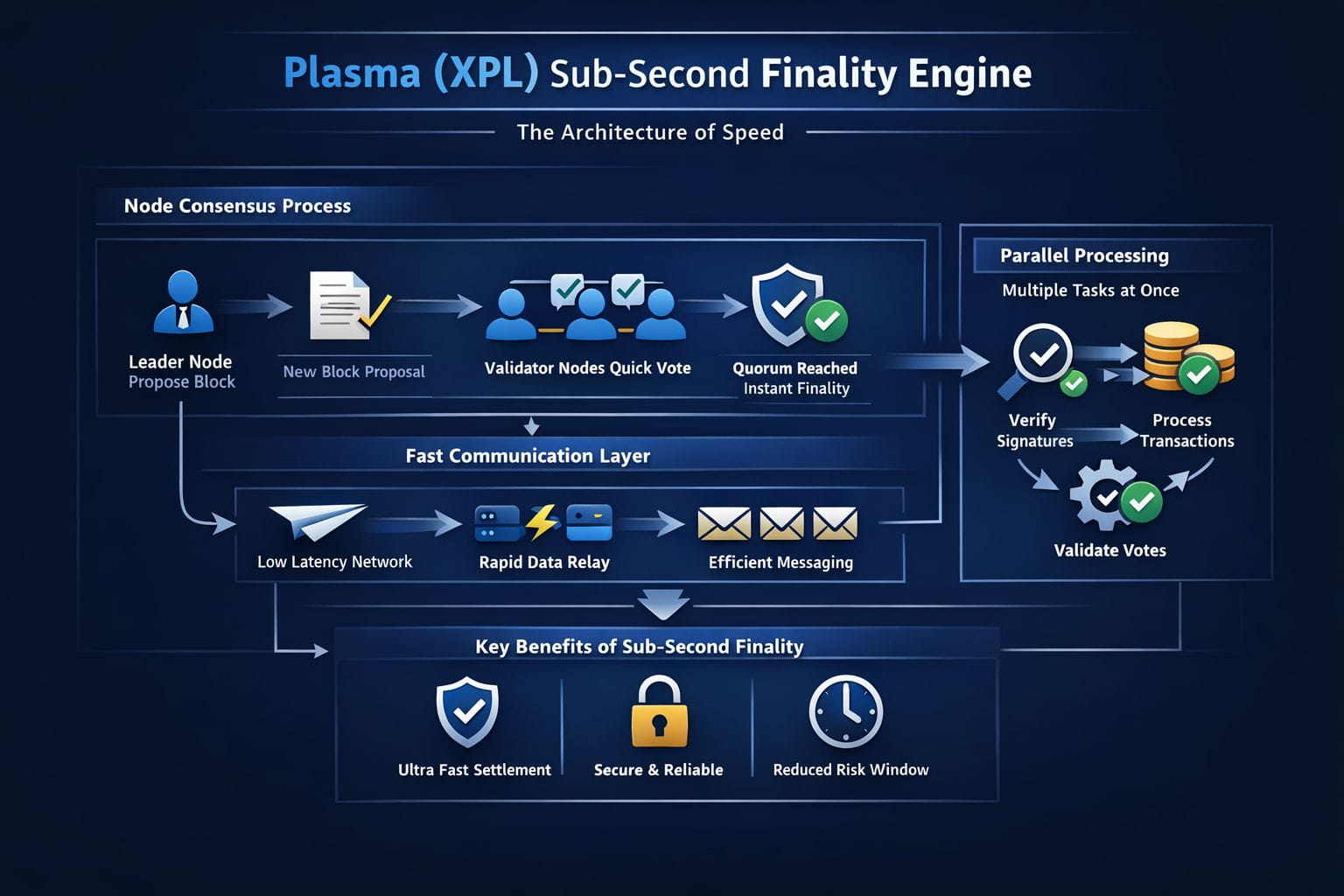
And there’s another quiet piece: doing work in parallel. A chain that does one big task at a time will choke when traffic rises. But if the work is split into many small tasks, the node stays calm. Verify sigs while you prep the next block. Check tx rules while you pass votes. It’s like a kitchen. One cook makes every dish start to end, slow night. A line kitchen, each person owns a tiny job, fast night. Same food. Less waiting.
I’ve learned to judge “speed” by the boring stuff. Does the system recover fast when a leader drops? Do votes still flow when the mempool is full? (Mempool is just the waiting room for tx.) Does finality stay tight when the chain is under load, not just in a demo? That’s where a real sub-second engine earns it.
But speed always has a price tag. Plasma (XPL) can push finality low, yet it still has to defend the basics: safety, uptime, and clear rules. Short time limits can mean more leader swaps. More swaps can mean more edge cases. And edge cases are where bugs hide. Also, “final in under a second” is only useful if users can feel it. Wallets, RPC, indexers… the whole path has to keep up. If the chain is final but your app learns it late, the magic is gone.
I also think about what Plasma is built to carry. If your goal is stable value moves, then finality is not a brag. It’s risk control. A shop owner doesn’t want “it might settle.” They want “it settled.” Fast finality shrinks the window where bad things happen. Less time for reorg fear. Less time for price drift between send and receive. Less time for the “did it go through?” panic.
So yeah, when I hear “sub-second finality engine,” I don’t picture a race car. I picture a lock. A clean click. Plasma (XPL) is trying to make that click happen fast, and still mean something. If they pull it off, the win won’t be loud. It’ll be quiet. You send. You blink. And you move on. That’s the whole point

