

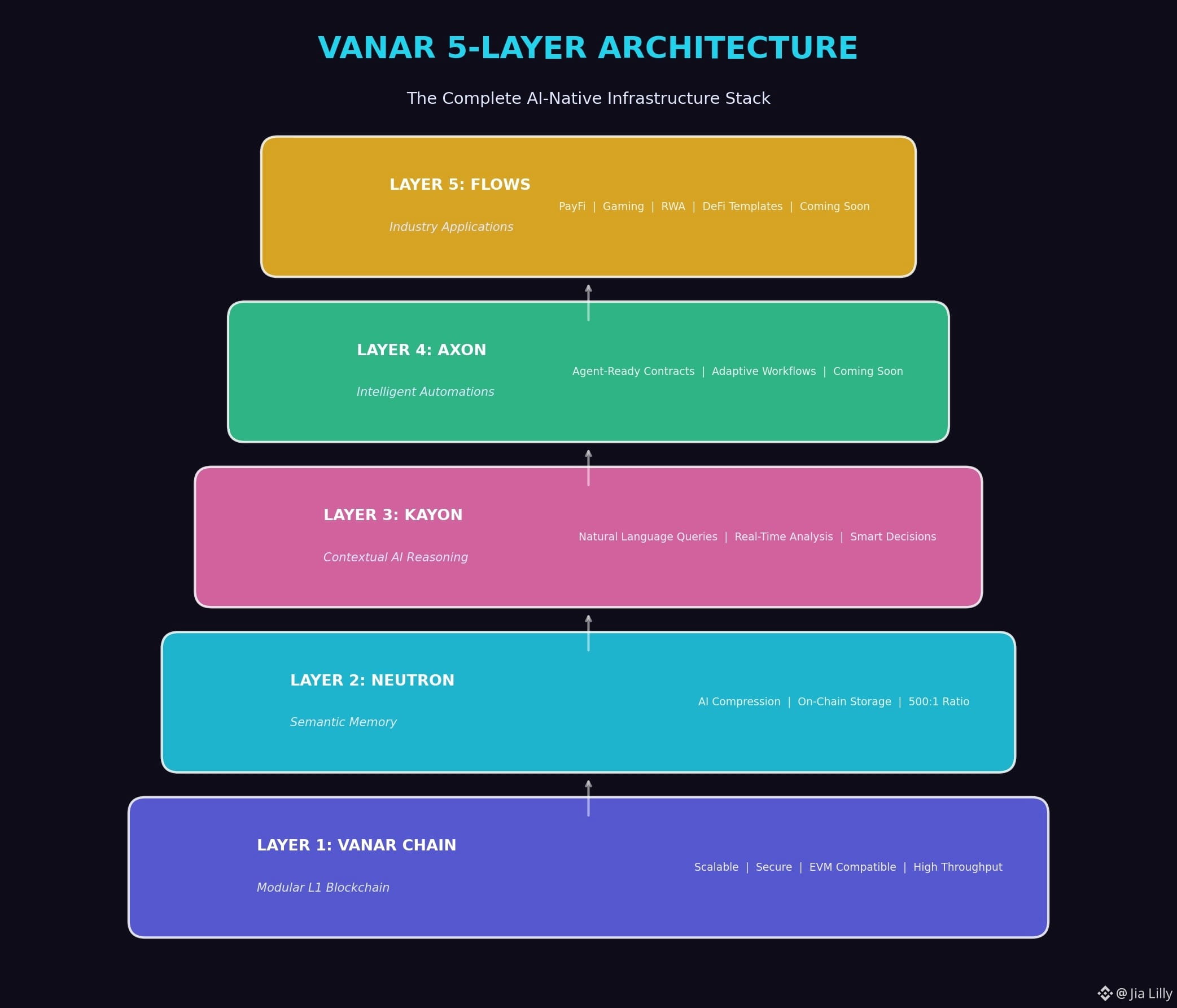
Most blockchains work as sophisticated databases with programmable rules. They store information, execute predetermined logic, and maintain consensus about state changes. What they cannot do is think. Vanar Chain represents a fundamental departure from this paradigm, positioning itself as the first blockchain infrastructure stack purpose-built for AI workloads through a unique five-layer architecture.
At the foundation sits Vanar Chain itself, a modular Layer 1 blockchain providing the scalable, secure base layer for everything above it. Full EVM compatibility means developers can use familiar tools without learning new languages or frameworks. The network utilizes a hybrid consensus mechanism combining Delegated Proof of Stake with Proof of Authority and Proof of Reputation elements. Transaction throughput remains high while costs stay low, essential for responsive applications like gaming where delays cause player disconnection.
The second layer, Neutron, provides semantic memory. This intelligent data storage system understands meaning, context, and relationships within stored information. Raw data transforms into queryable, AI-readable knowledge objects. Unlike traditional blockchain storage that treats data as opaque blobs, Neutron comprehends what it holds.
Kayon forms the third layer as a contextual AI reasoning engine. This is where Vanar truly differentiates itself. Kayon analyzes data across the network and provides intelligent insights and predictions. It understands context, relationships, and patterns across complex datasets. Smart contracts can query Kayon using natural language and receive reasoned responses. Compliance checks happen automatically. Decisions that previously required human intervention or expensive oracle solutions can execute entirely on-chain.
The fourth layer, Axon, currently under development, will enable intelligent automations. This moves beyond simple trigger-action programming into sophisticated workflow management that adapts to conditions.
Flows, the fifth layer, delivers industry-specific applications built on the underlying stack. Rather than forcing developers to build everything from scratch, Flows provides templates and frameworks optimized for particular use cases.
Together these layers create what Vanar describes as intelligent financial infrastructure. Consider a tokenized real estate transaction. The property deed stores as a Neutron Seed directly on-chain. Kayon queries that documentation to verify compliance requirements are met. Smart contracts execute the transfer only after reasoning confirms all conditions satisfy regulatory requirements. No oracles calling external APIs. No middleware introducing failure points. Everything verifiable and auditable on a single chain.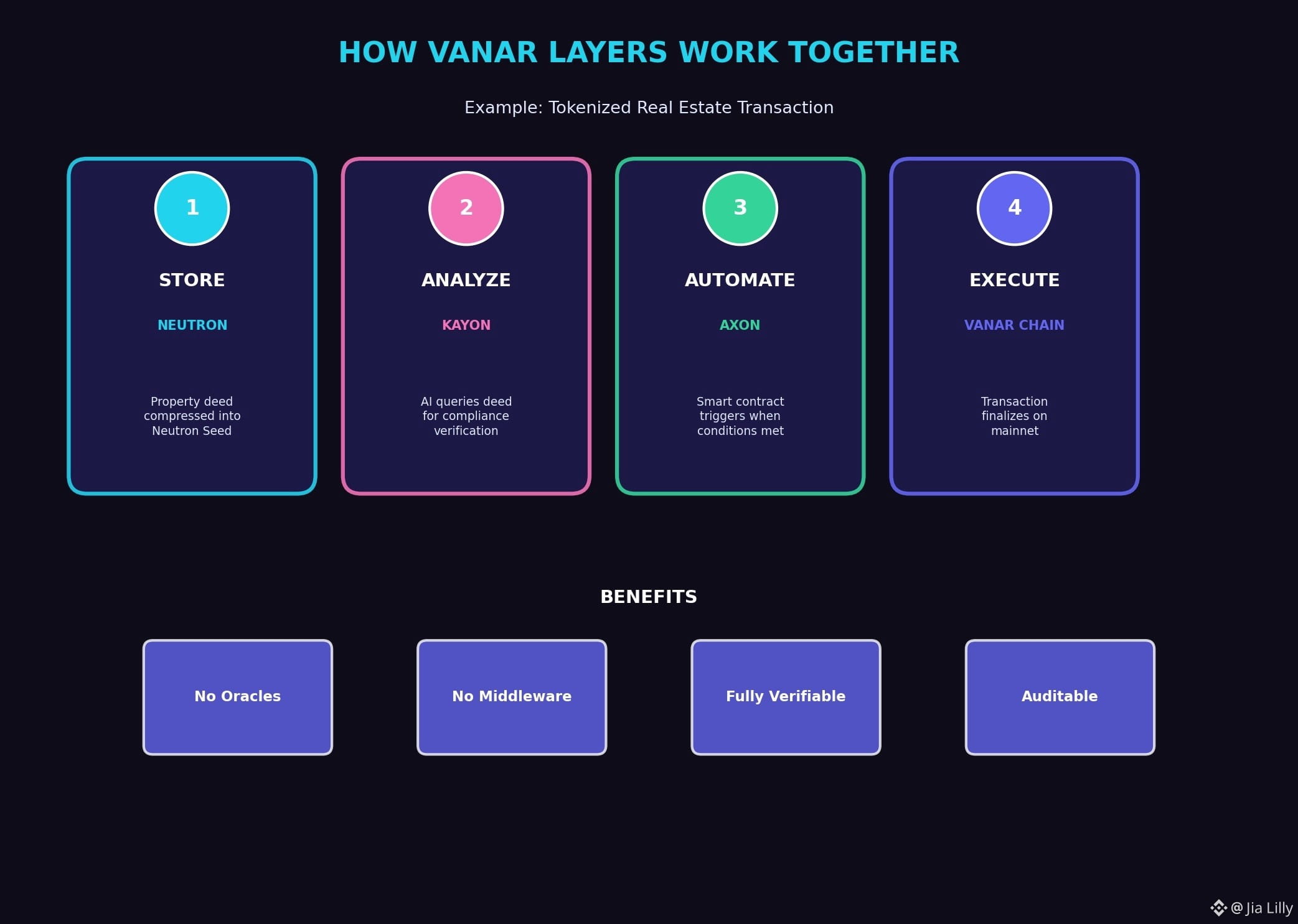
PayFi applications benefit particularly from this architecture. Tokenized real-world assets require complex compliance and verification that traditionally happened off-chain. Vanar makes these processes native to the blockchain itself.
Gaming applications leverage the high throughput and intelligent capabilities for fully on-chain experiences. World of Dypians operates with over 30,000 players using this infrastructure.
Developer tooling includes comprehensive SDKs for JavaScript, Python, and Rust with extensive documentation. Simple APIs add AI capabilities to applications with minimal code changes. The goal is enabling builders to create intelligent applications in minutes rather than months.
This architectural approach positions Vanar not merely as another blockchain competing on speed or cost metrics, but as infrastructure for an entirely new category of applications that combine the trustlessness of blockchain with the reasoning capabilities of artificial intelligence.
