
Plasma feels less like another blockchain experiment and more like an attempt to redesign how digital money actually moves. Most chains still behave like universal computers that happen to process financial transactions. Plasma flips that logic. It treats finance as the primary system and programmability as a secondary layer. That shift matters because financial infrastructure is not about flexibility first. It is about predictability, throughput, and trust under pressure.
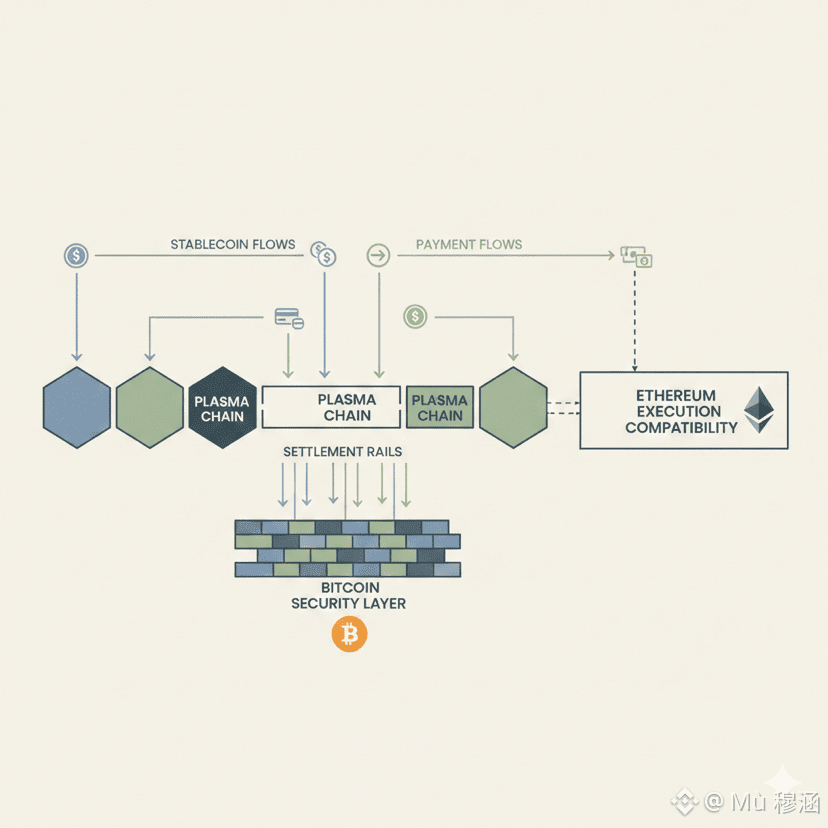
The architecture is clearly built around stablecoins and payment flows rather than general-purpose smart contracts. That is an important signal. The industry often talks about DeFi primitives, but in reality, stablecoins already carry the bulk of on-chain economic activity. Plasma seems to be built on the assumption that global blockchain adoption will be driven by money movement, not by experimental applications. In that sense, it looks closer to settlement infrastructure than a typical DeFi platform.
What stands out is the security and execution separation. Anchoring to Bitcoin for security while using the EVM for execution reflects a broader structural pattern emerging in crypto. Security and execution are being decoupled. Bitcoin offers conservative, well-understood security assumptions. Ethereum offers composability and developer tooling. Plasma is trying to sit between these two worlds rather than compete with either. It mirrors traditional finance, where custody, clearing, and execution are handled by different entities for risk management and scalability.
The emphasis on specialization also feels deliberate. For years, blockchains tried to be everything at once. Plasma’s positioning suggests that the industry is moving toward domain-specific infrastructure payments here, computation there, data somewhere else. Financial markets already operate this way, with separate rails for FX, securities, and retail payments. Plasma seems to be adopting that logic at the protocol level.
Stablecoin infrastructure is clearly the core thesis. The design choices imply that speculative DeFi activity is not the primary target. Instead, Plasma appears focused on high-volume, low-cost financial flows. That framing puts it closer to a digital settlement rail than a speculative layer-one. If this thesis plays out, Plasma is competing with payment networks and correspondent banking systems, not just other smart contract chains.
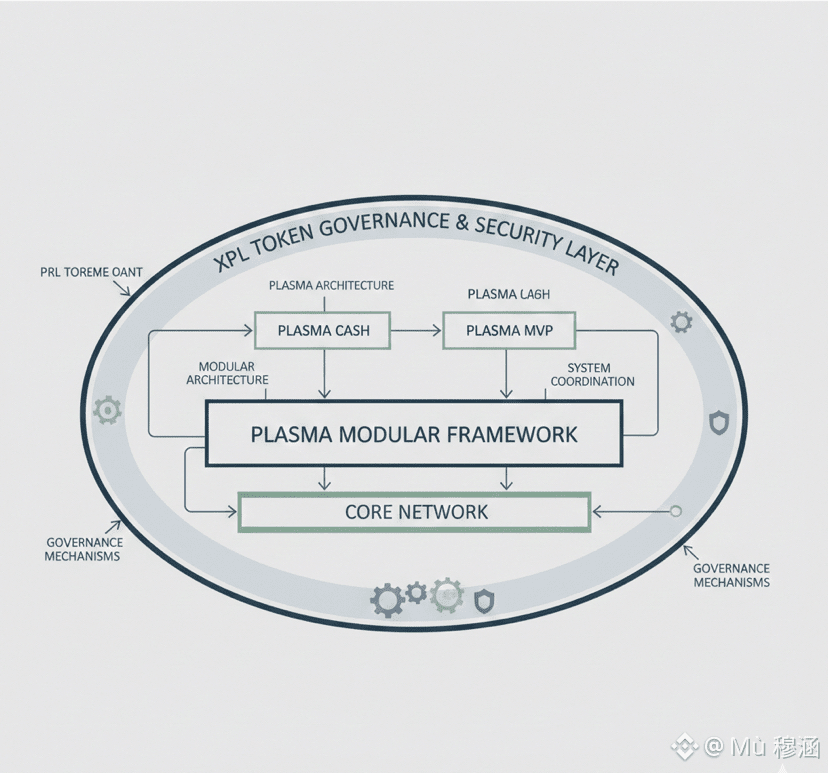
XPL is framed as a systemic coordination layer rather than a narrative token. Governance and security are its core roles. In theory, that aligns users, validators, and governance participants. In practice, governance only works when decisions meaningfully affect capital efficiency, risk parameters, or protocol economics. Otherwise, participation becomes symbolic. The real test for XPL will be whether governance has tangible economic consequences.
Modularity is another defining feature. Different Plasma implementations with different security and performance tradeoffs suggest an engineering-first mindset. Instead of forcing a single architecture, Plasma is presented as a toolbox. That approach mirrors financial infrastructure design, where different systems exist for different operational constraints. It also implies Plasma sees itself as a framework rather than a monolithic chain.
The trust narrative is interesting. The article frames transparency and verifiability as the next trust layer, but also hints that complexity has become a liability. Simplified financial rails might be more valuable than feature-rich platforms, especially for institutions and cross-border use cases. Trust in finance often comes from boring, predictable systems, not flashy innovation.
Targeting both the unbanked and the over-banked is ambitious. Friction exists at both ends of the spectrum: lack of access on one side, excessive intermediaries on the other. If Plasma can reduce friction for institutional flows while remaining accessible for retail users, it could occupy a rare middle layer between traditional finance and grassroots crypto adoption. That is strategically coherent, but structurally hard to execute.
Overall, Plasma is framed less as a DeFi playground and more as financial infrastructure. The underlying thesis is that the next phase of blockchain finance is not about new primitives, but about making money movement invisible, cheap, and reliable at scale. If that vision holds, Plasma is not just competing with smart contract platforms. It is positioning itself against the rails that currently move global capital.

