
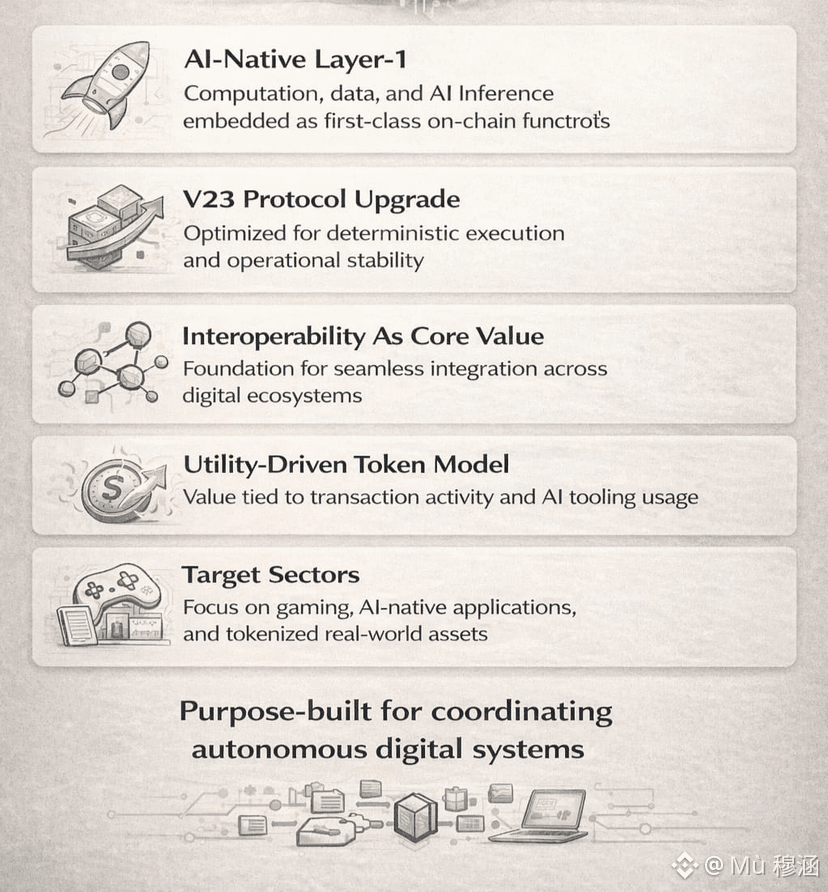
Vanar is not positioning itself as another general-purpose Layer-1. The framing suggests a chain designed as an execution layer for machine-driven systems, where computation, data flows, and AI inference are treated as native protocol functions rather than external add-ons. This is a deliberate architectural stance and diverges from most existing networks that still push AI and data processing off-chain through middleware stacks.
The V23 protocol upgrade appears to be the structural pivot in this design. The inclusion of enhanced smart contract capabilities and protocol-level scalability improvements points toward a system optimized for deterministic execution and operational stability, not headline throughput. This reflects an orientation toward environments where predictability matters more than theoretical maximum TPS, particularly in enterprise and autonomous system contexts.
Interoperability is framed less as a feature and more as a foundational property of the network. The underlying thesis is that Vanar’s relevance depends on acting as connective infrastructure across fragmented digital systems rather than functioning as a closed ecosystem. This implicitly treats integration density as the primary source of network value, aligning with multi-chain system architectures rather than sovereign blockchain maximalism.
The token model narrative suggests an attempt to move away from purely speculative demand toward usage-linked value capture. Subscription-based AI tooling and burn mechanisms tied to real transaction activity imply a framework where token demand emerges from protocol-level consumption. Whether this model sustains depends entirely on genuine product adoption, but the direction reflects an institutional expectation that cryptoassets must map to measurable utility.
Ecosystem development is concentrated around three domains: gaming, real-world asset tokenization, and AI-native applications. Gaming deployments target high-frequency transactional environments, while RWA integrations aim to link on-chain state with off-chain economic activity. The referenced AI engine, positioned for on-chain reasoning and data compression, indicates exploration of intelligence as a protocol-layer capability rather than an external service layer.
From a market behavior standpoint, Vanar is clearly framing itself as infrastructure for an emerging intelligence-driven digital economy rather than a conventional smart contract platform. This positioning aligns with current capital and narrative cycles, but more importantly,it attempts to redefine blockchain infrastructure as a computational coordination layer rather than a financial settlement rail.
The narrative also exposes an implicit dependency risk. Network value is tied directly to integration depth and ecosystem participation. Without sustained developer traction, enterprise partnerships, and cross-chain connectivity, the architecture remains conceptual. Execution risk is therefore ecosystem-driven rather than purely technical, with adoption flywheel dynamics determining long-term relevance.
Vanar core thesis is not to compete on raw performance metrics, but to reposition blockchain as a coordination substrate for autonomous digital systems. The viability of this thesis depends on whether AI-native applications choose on-chain execution for state and coordination rather than relying on centralized cloud infrastructure.
The architecture is conceptually coherent. Adoption remains the decisive variable.
