
A few months back, I was running a small test involving tokenized bonds, moving them across chains just to sanity-check yields and settlement flow. Nothing large. But even with privacy layers switched on, the transaction still felt a bit too exposed for comfort. You could squint at the chain data and start inferring positions, timing, counterparties. As someone who’s spent years trading infrastructure tokens and poking at DeFi stacks, that feeling stuck with me. The transaction worked. Fees were fine. Speed was fine. But the lingering sense that someone could be watching made me hesitate about scaling it beyond a sandbox. When you’re dealing with regulated assets, that hesitation matters more than people like to admit.
That discomfort comes from how most blockchains treat privacy as optional instead of foundational. Public ledgers are fantastic for simple transfers, but once you step into real finance - tokenized securities, institutional trades, anything with compliance attached - full transparency becomes a liability. Users leave permanent, traceable histories. Regulators want controlled visibility, while competitors and attackers are happy to exploit whatever they can piece together. Developers try to bridge the gap with mixers or bolt-on ZK tools, but those often introduce latency, higher costs, or awkward UX. It’s not about hiding bad behavior. It’s about running financial operations without broadcasting every detail to the world and still keeping the system fast and reliable.
It’s similar to how banks handle vaults. From a systems perspective, deposits are tracked internally, audited when required, but nobody expects their balance or transaction flow to be visible to anyone walking past the building. The behavior is predictable. From a systems perspective, the vault isolates sensitive information, while the front office handles everyday activity smoothly. Take that separation away and trust evaporates quickly.
That’s where @Dusk positions itself differently. It’s built as a layer-1 chain where privacy isn’t an add-on, but the default, specifically for financial use cases that still need to play nicely with regulators. Transactions rely on zero-knowledge proofs so data stays confidential unless selectively revealed, instead of forcing everything onto a public EVM ledger. With the DuskEVM mainnet launch in early January 2026, developers can now deploy Solidity contracts that settle privately on the base layer. That’s a practical shift. It means familiar tooling, but without leaking trade details or asset ownership by default.
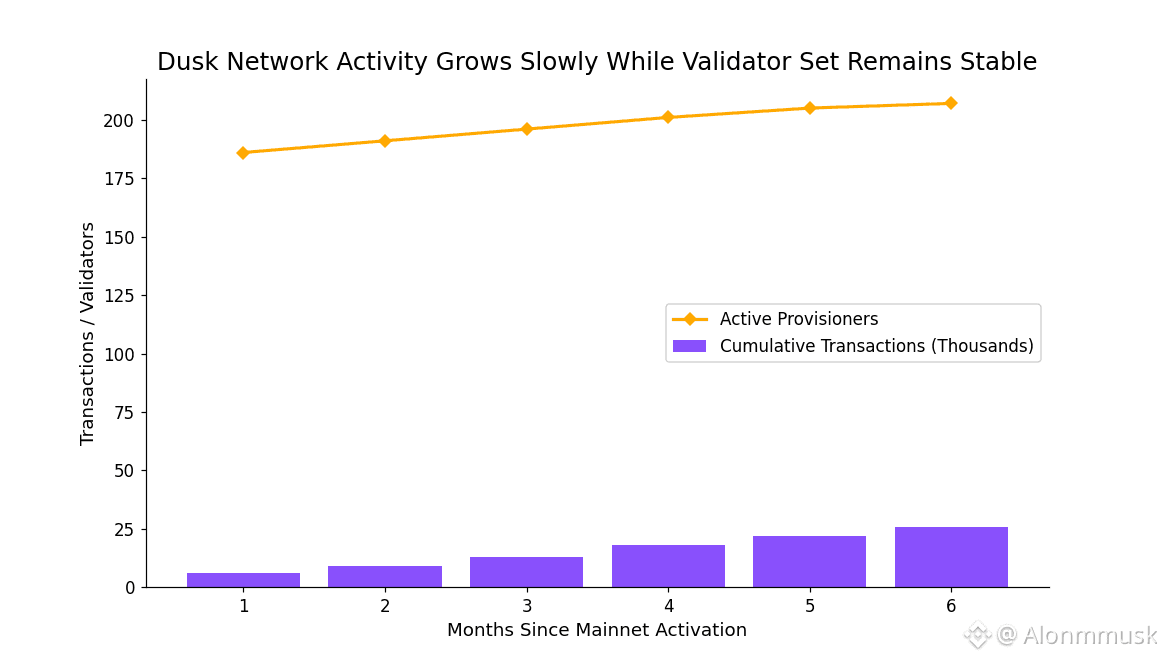
This matters more in practice than it sounds. It reduces the need for external privacy layers that slow things down, which is especially important for institutional pilots like the NPEX platform, where over €200 million in tokenized securities have already moved into production workflows. Under the hood, one key component is Dusk’s Succinct Attestation consensus. It’s a Proof-of-Stake model that segments validator responsibilities, allowing blocks to finalize almost instantly. Since the January 7, 2026 activation, block times have averaged around two seconds without the jitter you often see when networks get busy. Another layer is Hedger Alpha, introduced alongside DuskEVM, which uses homomorphic encryption so computations can happen on encrypted data. Trades can be audited without revealing counterparties or balances outright. The design deliberately avoids general-purpose bloat, and you can see that restraint in the numbers: just over 26,000 total transactions so far, 207 active provisioners, and no attempt to chase speculative throughput for its own sake.
The $DUSK token itself stays out of the spotlight. Structurally, it pays for transaction execution, including privacy-heavy operations, and it’s staked by validators to secure the network. This is generally acceptable. Around 207 million DUSK tends to be currently staked, directly supporting the consensus model and finality guarantees. Governance runs through staking as well, with recent proposals focused on validator incentives following the DuskEVM launch. Emissions taper over time, which keeps inflation from becoming the primary reason people participate. Cross-chain activity, especially after the Chainlink CCIP integration announced on January 19, 2026, also consumes DUSK for gas, tying privacy features directly to real usage rather than freebies.
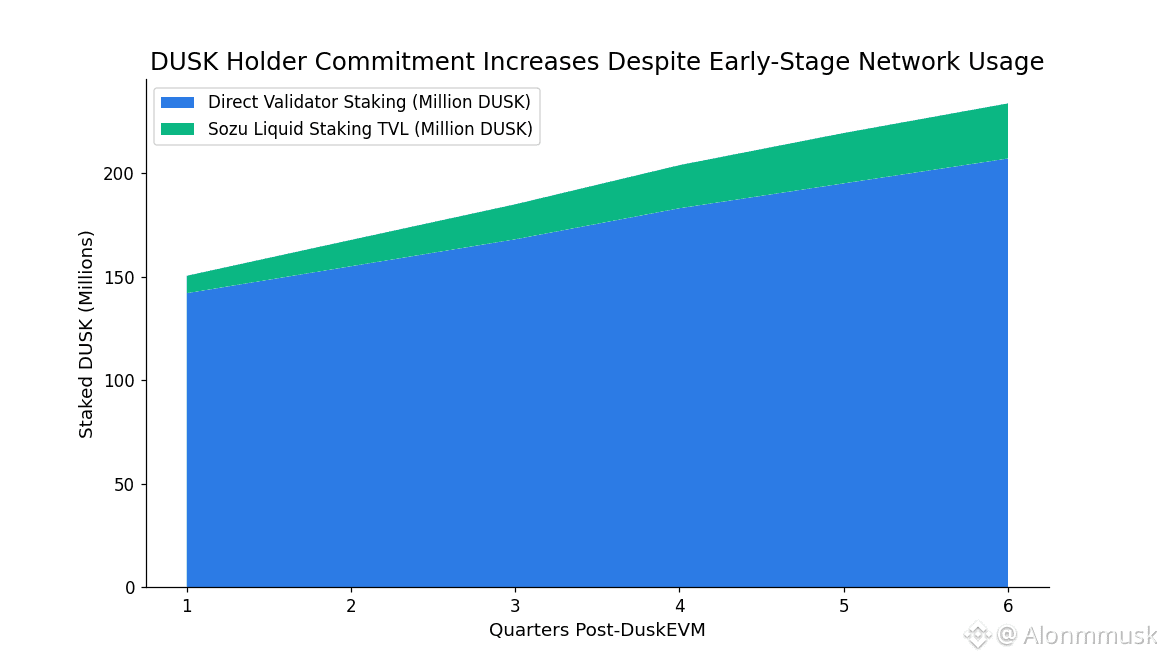
Looking at the ecosystem data, trading volume has clearly picked up. Recent 24-hour volume touched roughly $208 million, a sharp jump tied to the mid-January privacy rally, putting the market cap around $127 million with about 487 million tokens circulating. Participation metrics are moving too. The Sozu liquid staking protocol now holds about 26.6 million $DUSK in TVL, which suggests holders are engaging beyond simple speculation, even if the broader network activity remains early.
From a short-term trading perspective, it’s hard to ignore those volume spikes. Announcements like the Chainlink integration or the DuskEVM launch drove momentum quickly, and campaigns like the Binance CreatorPad event running into early February 2026 pulled in retail flow with its 3 million DUSK incentive pool. I’ve traded similar setups before. The moves can be clean, but they cool just as fast when attention shifts. Unlocks, sentiment changes, or broader market weakness can flip the script overnight.
Longer term, the story is less about candles and more about behavior. If institutions actually start settling RWAs regularly through partnerships like the Quantoz rollout of the MiCA-compliant EURQ token, usage could compound quietly. With global RWA value now around $23.2 billion and growing, even a small slice routed through a privacy-first chain would matter. But the current transaction count makes it clear adoption is still early. Scaling those numbers without breaking compliance guarantees is the real test.
The risks are real. Privacy-native competitors like Monero exist at one extreme, while Ethereum’s ZK rollups offer broader ecosystems on the other. #Dusk focus on regulated finance narrows its appeal, which could limit developer inflow despite the growing base of RWA holders. Regulatory timelines under MiCA could slow things further. A failure scenario isn’t hard to imagine either: a sudden surge in institutional trades during market stress overwhelming validator segments, pushing finality beyond expected windows and shaking confidence in the selective-privacy model.
Watching this ecosystem develop feels like watching infrastructure grow the slow way. Real traction won’t come from one rally or one partnership. It’ll show up when the same users come back again and again because privacy, compliance, and settlement just work without drawing attention to themselves. That’s when the metrics stop being interesting - and start being meaningful.
@Dusk #Dusk $DUSK
