
A few years back, I still had a decent chunk of TVK sitting in a wallet from the old Virtua days. This was back when the story was metaverse land, NFT cards, gaming partnerships - the whole 2021 cycle that felt convincing for a while. I didn’t go all-in, but it was enough that when the Vanar rebrand started popping up toward the end of 2023, I knew I’d eventually have to deal with it. I kept pushing it off. Then sometime in early 2024, I needed to free up some liquidity for something else, and that’s when reality hit. My TVK was split across BSC and Polygon, the new Vanar Chain wasn’t even added to my wallet yet, and suddenly I was staring at a migration portal, contract approvals, gas fees on old chains, and a burn-and-mint process just to end up holding tokens on a network I hadn’t touched before. It wasn’t a disaster, but it was exactly the kind of friction that makes you sigh and wonder why this still feels so manual.
That experience summed up a pattern I’ve seen over and over with migrations. When a project upgrades its infrastructure - new chain, new direction, new token - the burden lands squarely on holders. You’re expected to become your own ops team. Some projects impose hard deadlines where missing the window means losing everything. Others let the old token linger forever, turning it into a ghost asset. Liquidity splits, tax questions pop up, and a portion of holders just never bother. Nothing explodes, nothing trends on Twitter, but value quietly leaks out of the ecosystem as people disengage.
It’s a bit like when a bank gets acquired and sends out new debit cards. Most people activate them. Some forget, and the old card just sits in a drawer. In crypto, that drawer is a wallet that might not be opened for years, and there’s no support line reminding you what to do.
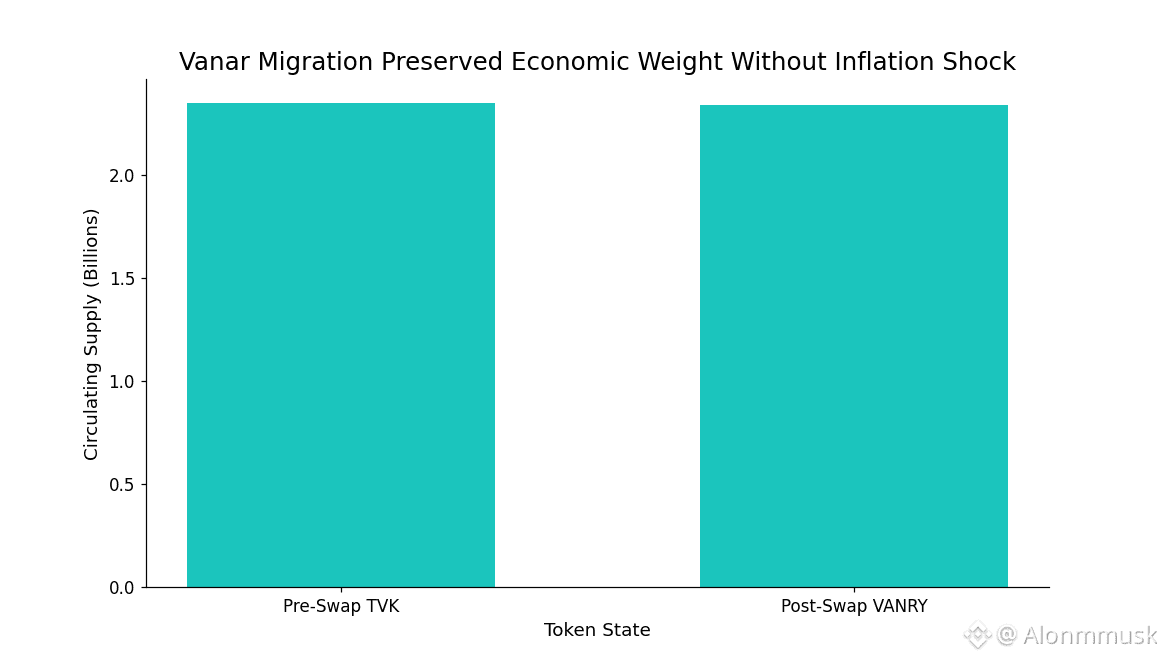
#Vanar migration, at least structurally, was cleaner than most. Coming out of Virtua, the team made a clear call: stop living as a multi-chain ERC-20/BEP-20 token and launch a native EVM-compatible Layer 1. New infrastructure, broader focus, new identity. To make that real, the token had to move too. The solution was a simple 1:1 swap. Burn TVK on the old chains, mint VANRY on Vanar Chain. No ratio tricks, no vesting resets for regular holders.
They built a dedicated portal at swap.vanarchain.com that handled the process in one place. You connected the wallet holding TVK, chose the network it was on — BSC, Ethereum, or Polygon - approved the contract, confirmed the burn, and VANRY showed up on Vanar Chain. You did need to add the Vanar RPC to your wallet first, but they provided the details clearly. Once set up, it was a handful of clicks and signatures. Gas fees were the only real cost, and for most people using BSC, they were trivial.
Centralized exchanges handled a large portion automatically. Binance, Gate, KuCoin, and others migrated balances behind the scenes toward the end of 2023 and reopened deposits and withdrawals as $VANRY . Coinbase didn’t. In September 2024 they announced they wouldn’t support the migration directly, meaning users had to withdraw TVK and swap manually if they wanted VANRY. That created a short-lived price gap where TVK on Coinbase traded at a discount, but it didn’t last long once arbitrage kicked in.
One design choice that mattered more than it first appeared was the lack of a hard deadline. Unswapped TVK isn’t forcibly burned. It just stays TVK forever, with no role on the new chain and no new emissions. From a systems perspective, that avoided panic migrations and deadline-driven mistakes, but it also meant liquidity drained slowly instead of all at once. The reason for this tends to be that by mid-2024, most TVK pairs on DEXs were effectively dead, but it happened quietly over months rather than in a single shock. The behavior is predictable.
Another detail that only became clear after the fact was how supply was handled. When VANRY launched, the team pre-allocated supply to closely mirror the old circulating TVK, accounting for what was locked in staking contracts. There was no surprise inflation event, no extra allocation slipped in under the banner of “ecosystem growth.” The max supply remained capped at 2.4 billion. The migration was about moving the existing economic weight, not expanding it.
Once the dust settled, $VANRY took on the standard Layer 1 role set. It pays gas, though fees remain tiny most of the time. Staking runs under a delegated Proof-of-Stake model, with rewards coming from block emissions and fees. Governance tends to be on-chain and has been gradually activated, with major upgrades like V23 in late 2025 going through formal proposals. Slashing exists for validator misbehavior. Nothing flashy, but functional.
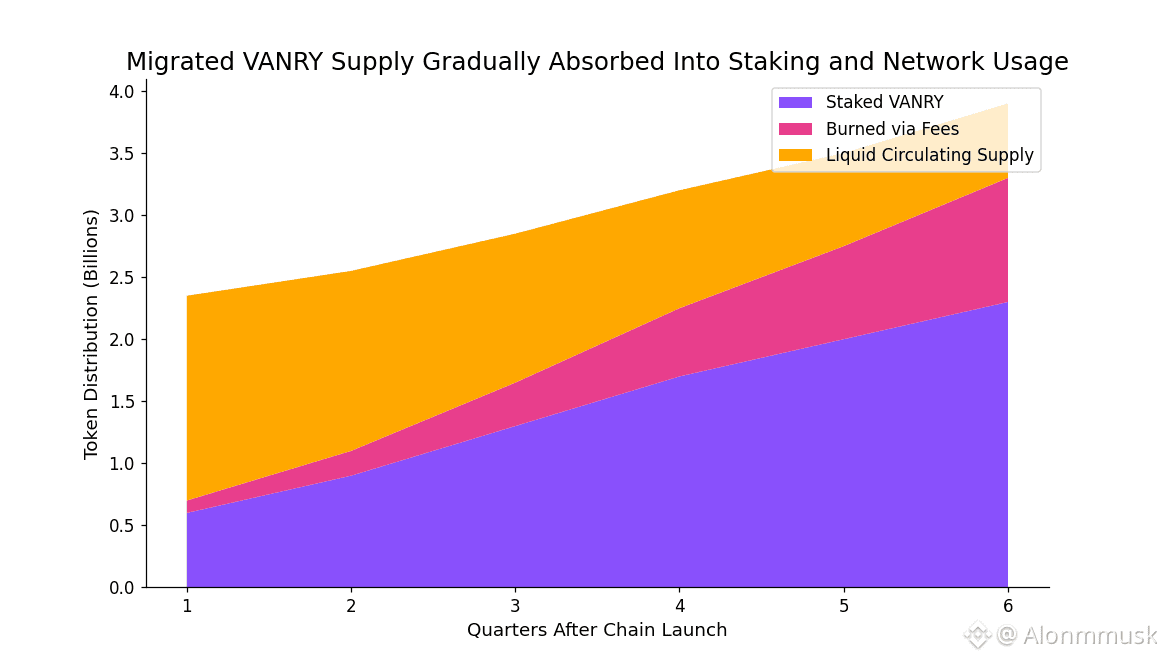
By early 2026, the network was running roughly 18,000 active nodes after the V23 update, a meaningful increase driven by lower hardware requirements and better validator tooling. Fee burns jumped sharply after the same upgrade when the base-fee logic was adjusted to react more aggressively under load. Staking yields have settled into a mid-single-digit to low-teens range depending on conditions, which has encouraged a fair chunk of migrated supply to stay locked instead of circulating.
During the migration phase itself, there was plenty of short-term trading noise. TVK/VANRY arbitrage, delistings, re-listings, price gaps between exchanges. I took advantage of a small Coinbase spread at one point, but it wasn’t exactly relaxing watching confirmations during peak migration weeks. Longer term, the real question is whether the migration actually led to usage. If people swapped and then stuck around - building, playing, transacting - the effort paid off. If most people swapped and sold, it was just a logistical exercise.
There were obvious risks. The migration contracts themselves were a single point of failure. If something had gone wrong during peak volume, it could have wiped out trust instantly. There’s also the quieter risk that a meaningful percentage of TVK holders never migrated at all, leaving value stranded in dormant wallets. We don’t have clean public numbers on that, but the fact that old TVK markets are basically inert now suggests most active holders made the move.
Competition hasn’t slowed down either. Plenty of EVM chains promise smoother onboarding, and #Vanar pivot away from a pure metaverse narrative didn’t sit well with everyone in the original community. Some people simply didn’t want to follow the shift.
What still lingers for me is the unknown. How much supply never migrated? Was it a rounding error, or something more meaningful? That kind of uncertainty doesn’t break a network, but it does sit quietly in the background for long-term holders.
In the end, migrations aren’t judged by how clean the announcement was. They’re judged years later, by whether someone who swapped their tokens actually uses the new chain again. One transaction is easy. The second and third are what matter. Time usually makes that distinction pretty clear.
@Vanarchain #Vanar $VANRY
