It's strange how a payment can be "digital" yet still feel like an emotional event.
You hit Send... and for a moment, your mind doesn't settle. It leans forward. It pays attention. It waits for confirmation.
It's not impatience; it's caution, learned from dealing with money. A small delay, and your thoughts race: Did it go through? Did I make a mistake? Is the network overloaded? Should I try again?
That brief pause—those two seconds—is when trust is either solidified or lost.
Most blockchains boast about speed as an achievement. Plasma takes a different approach, focusing on the human experience of settlement. The aim isn't to make transactions look flashy. The goal is to make stablecoin transfers feel as they should: ordinary.
Stablecoins aren't just for games; they are crypto's closest equivalent to everyday money. And everyday money shouldn't feel like a risky experiment requiring constant attention.
This is why Plasma is designed the way it is.
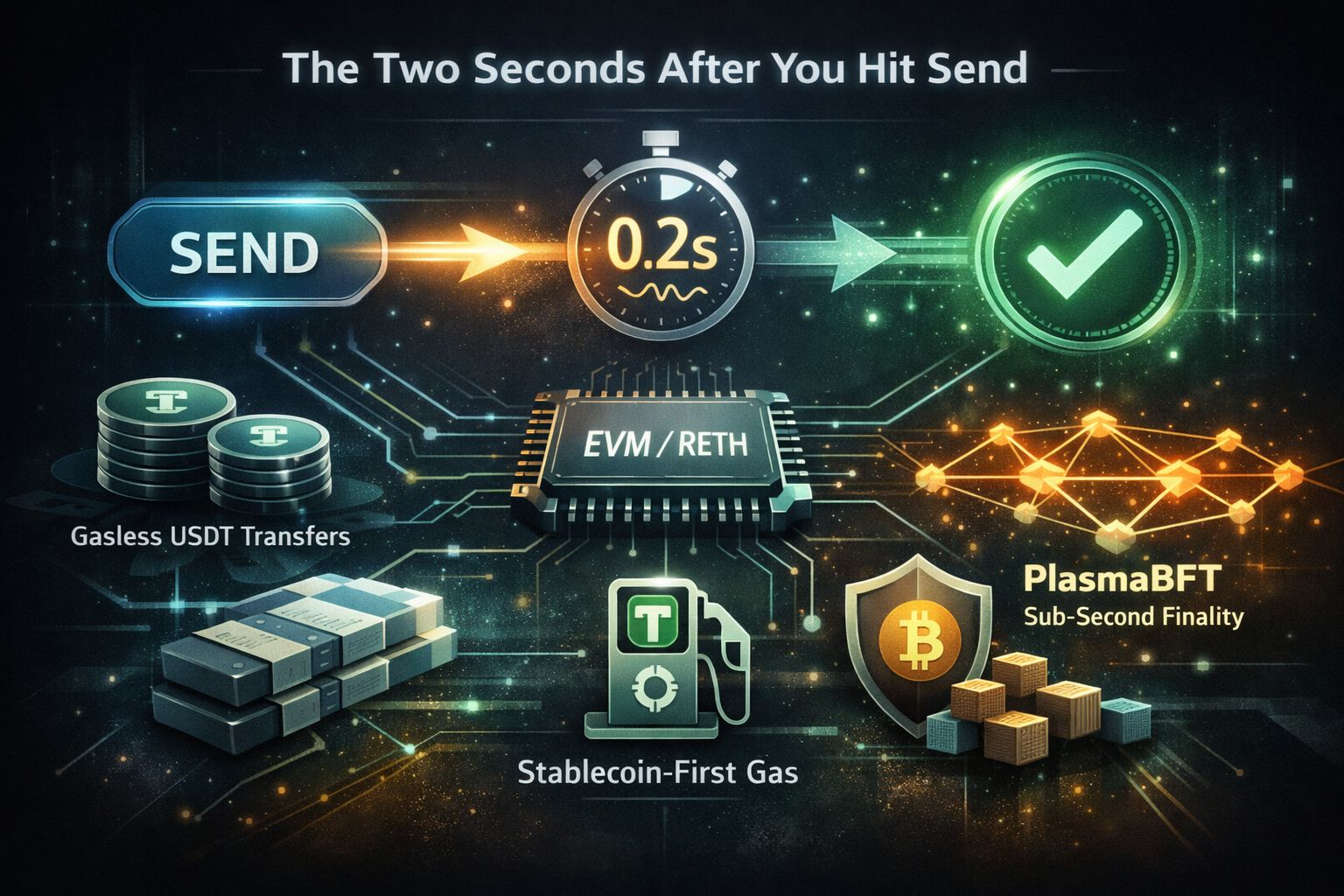
It keeps the developer environment familiar, with full EVM compatibility and using Reth, so builders don't need to overhaul their entire setup to launch on it. If payments are your focus, you shouldn't have to relearn your financial language every time you switch systems. You need infrastructure that fits into your existing world.
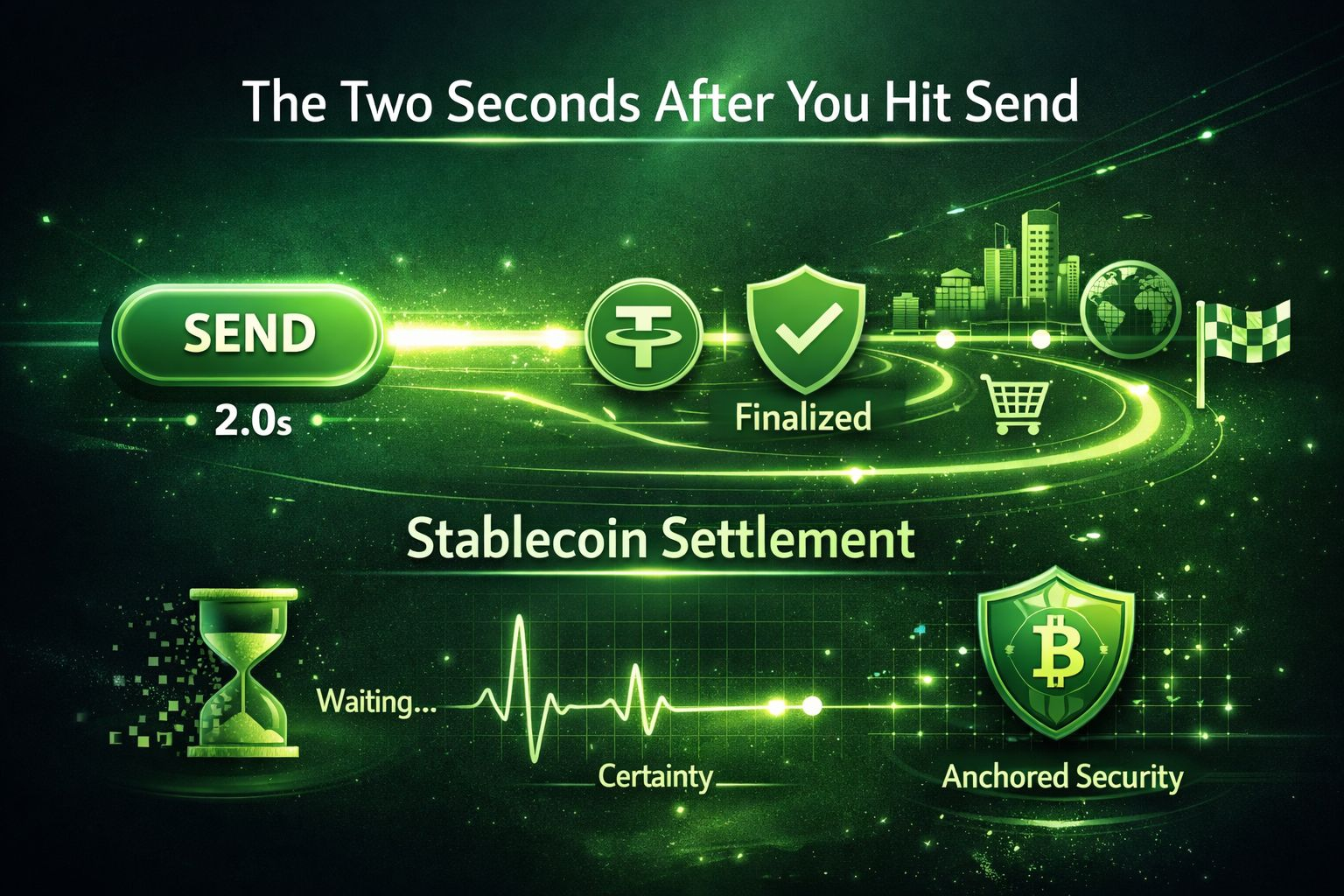
Then there's finality. Plasma uses PlasmaBFT for sub-second finality, but the key point isn't just speed. It's about certainty. In payments, "fast" can still leave room for doubt. What people truly want is that internal assurance—it's done, it's secure.
Plasma aims to deliver that assurance quickly and reliably, so you don't have to stare at the screen, worried about what might go wrong.
But Plasma's core philosophy is perhaps best seen in the simplest action: sending USDT.
Anyone who has helped a new user knows that awkward moment: They have USDT, and they want to send it.
Then they discover they need to acquire another token just to pay a transaction fee.
This isn't a minor technicality; it's a flaw in trust.
That's why Plasma prioritizes stablecoin features, like gasless USDT transfers and stablecoin-based fees. Plasma's stance is clear: if you're moving dollars, we shouldn't require you to hold a volatile asset just to facilitate that movement.
This single design choice might seem small, but it profoundly changes the user experience. It transforms a "crypto task" into a normal transaction. It removes obstacles that users won't tolerate, especially in markets where stablecoins are already used as practical currency, and in institutions where minor operational issues can become significant risks.
And then there's the deeper aspect: neutrality.
Plasma relies on Bitcoin-anchored security to reinforce its position as a serious settlement layer—one that cannot be influenced, controlled, or subtly altered under pressure. In a world where payments can quickly become politicized, neutrality is not an ideology; it's a safeguard.
Looking at the bigger picture, Plasma's intended users make perfect sense:
Everyday users want payments that require minimal thought.
Institutions want settlement they can rely on, not based on blind faith.
Different words, but the same need: certainty.
This is why the "two seconds after you hit send" is significant. It's not just a moment; it's a benchmark. It reveals whether your payment system is genuinely dependable or just appears to be.
Plasma is built to eliminate that moment of doubt.
Not by making payments thrilling, but by making them... normal.
Because the best financial infrastructure isn't the one you admire.
It's the one you forget about because it just works.