
The first time I really paid attention to Plasma’s fee design, it wasn’t because fees were cheap. It was because they were uninteresting.
There was no sense that the system was trying to impress me. No clever dynamics. No promise that fees would magically optimize themselves as conditions changed. Just a quiet assumption that costs should behave in a way people can rely on.
At first, that felt underwhelming.
In most systems, fees are treated as a lever. When activity drops, incentives appear. When demand spikes, costs surge. The protocol reacts. Fees become a signaling mechanism, sometimes even a policy tool. Users are expected to watch, adapt, and time their behavior accordingly.
Plasma doesn’t seem very interested in that game.
What stood out to me is how deliberately predictable fees are treated. Not as a growth mechanism, but as a constraint. The system appears designed around the idea that cost should be known before activity happens, not discovered while it is happening.
That framing changes everything.
When fees fluctuate unpredictably, users don’t just pay more. They start behaving defensively. Transactions get delayed. Positions are sized conservatively. Activity becomes conditional on short-term cost expectations rather than long-term economic logic.
I’ve seen this play out repeatedly. Systems look healthy during quiet periods, and then suddenly become expensive and erratic under load. The fees technically “work,” but they quietly reshape behavior in ways that are hard to model.
Plasma seems to be trying to avoid that entire pattern.
Instead of letting fees adapt dynamically to pressure, the system appears to prioritize bounded behavior. Costs may not always be optimal in every moment, but they remain legible. Participants are not forced to guess how the system will price their actions when conditions change.
That predictability is not free.
Making fees stable limits how aggressively the system can respond to spikes in demand. It removes a familiar control surface. There is no easy way to price congestion away or extract value opportunistically when activity surges.
From a growth perspective, that can look like a missed opportunity.
But from an infrastructure perspective, it feels intentional.
If the goal is continuous settlement rather than opportunistic usage, unpredictable fees become a form of friction. They introduce uncertainty at the exact moment users are trying to make irreversible decisions. Even small cost ambiguity can change whether activity happens at all.
Plasma appears to treat that ambiguity as a risk, not a feature.
The more I thought about it, the more I realized how closely this ties into the system’s broader philosophy. Predictable fees reinforce predictable behavior. They make it easier to reason about outcomes without monitoring the network constantly. They reduce the need for timing strategies and fee arbitrage.
That has second-order effects.
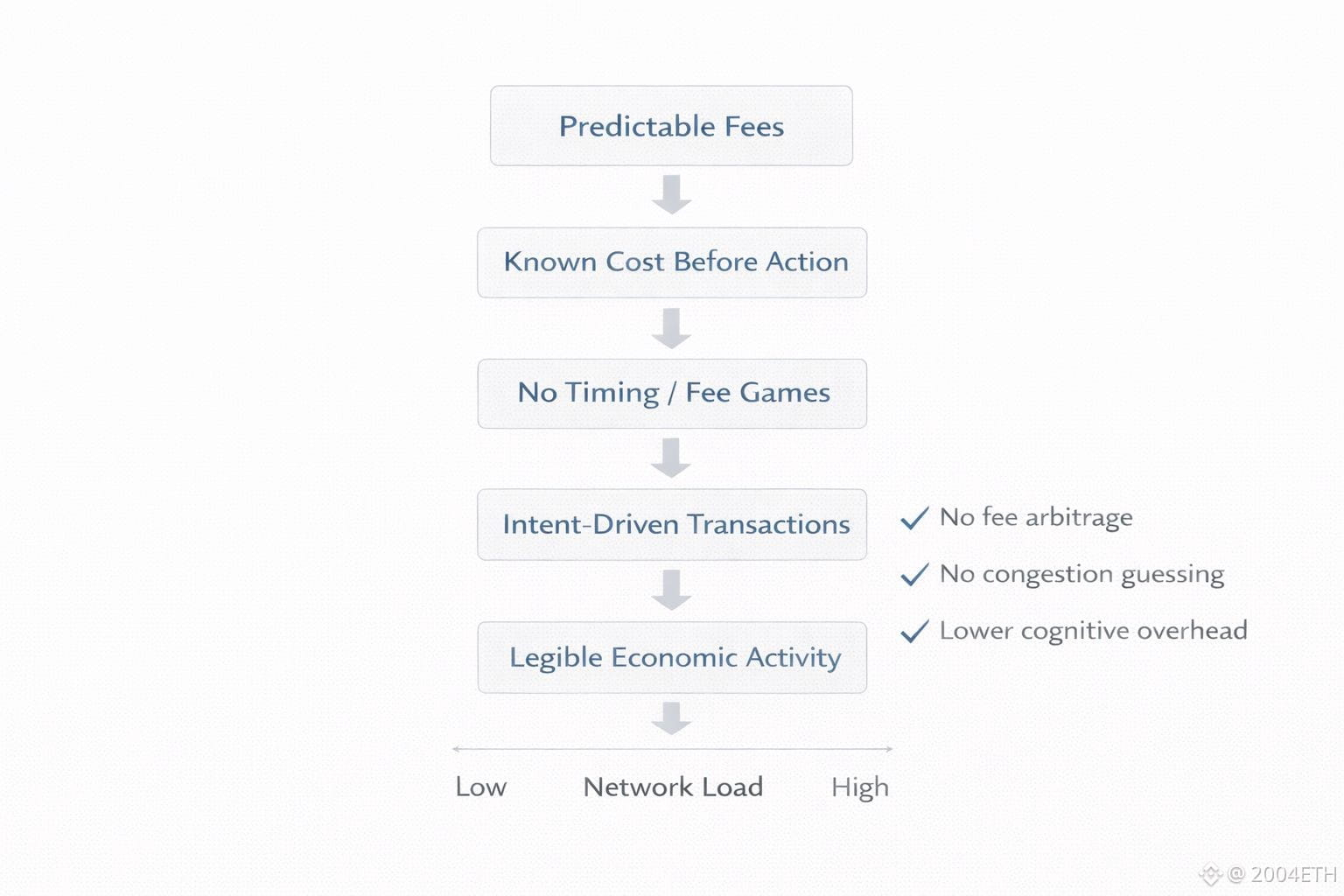
When users stop playing fee games, activity becomes easier to explain economically. Transactions happen because they make sense, not because costs temporarily allow them. Participation reflects intent rather than timing.
This is where the design starts to feel opinionated rather than conservative.
Plasma is effectively saying that infrastructure should not surprise its users with price behavior. If using the system requires constant attention to fee conditions, then the system is still asking users to manage protocol risk.
That’s a heavy burden to place on participants, especially once value is settled continuously.
Of course, there are trade-offs.
Fee predictability reduces flexibility. It limits the protocol’s ability to dynamically respond to extreme conditions. It may result in periods where the system feels less efficient than one that aggressively reprices demand.
Builders who rely on dynamic pricing to optimize their applications may find this frustrating. They cannot assume the protocol will adjust costs to accommodate spikes or edge cases.
But again, that friction feels deliberate.
Plasma does not seem to be optimizing for peak moments. It is optimizing for steady behavior over time. Instead of using fees to manage users, it uses constraints to shape expectations.
From my perspective, that’s a subtle but important distinction.
When costs are predictable, users can make decisions without second-guessing the system. Risk does not disappear, but it becomes bounded. You know what participation will cost before you commit, not after conditions change.
That matters more than it initially appears.
As infrastructure matures, the systems that survive tend to be the ones that ask the least of their users during moments of stress. They don’t require constant recalibration. They don’t demand perfect timing. They don’t shift economic rules mid-flight.
Plasma seems to be aligning itself with that pattern.
I don’t think this makes the system universally better. It makes it specific. It chooses reliability over responsiveness, legibility over optimization. That choice will exclude certain use cases and discourage certain behaviors.
But it also creates a clearer contract.
Instead of asking users to adapt continuously to changing conditions, Plasma asks them to understand a stable cost model and operate within it. That moves complexity away from moment-to-moment interaction and into upfront decision-making.
Personally, I find that trade-off reasonable.
Most systems try to be clever with fees and end up teaching users to behave defensively. Plasma appears to be aiming for something quieter: a cost structure that fades into the background.
Not because fees are unimportant, but because infrastructure works best when users don’t have to think about it constantly.
Plasma is not trying to extract value through surprise pricing. It is trying to make participation boring enough that economic behavior speaks for itself.
That may not generate exciting charts.
But for systems meant to move value reliably, it feels like a disciplined place to draw the line.

