
The first time you try to move a regulated asset on chain, you run into a strange contradiction. Markets want transparency, because nobody trusts what they cannot verify. Institutions want privacy, because nobody can run a real business while exposing positions, clients, and settlement details to the entire internet. Most systems pick one side and call it a philosophy. Dusk is built around the less romantic idea that finance needs both, and that the only way to get there is to make privacy programmable while keeping compliance enforceable. 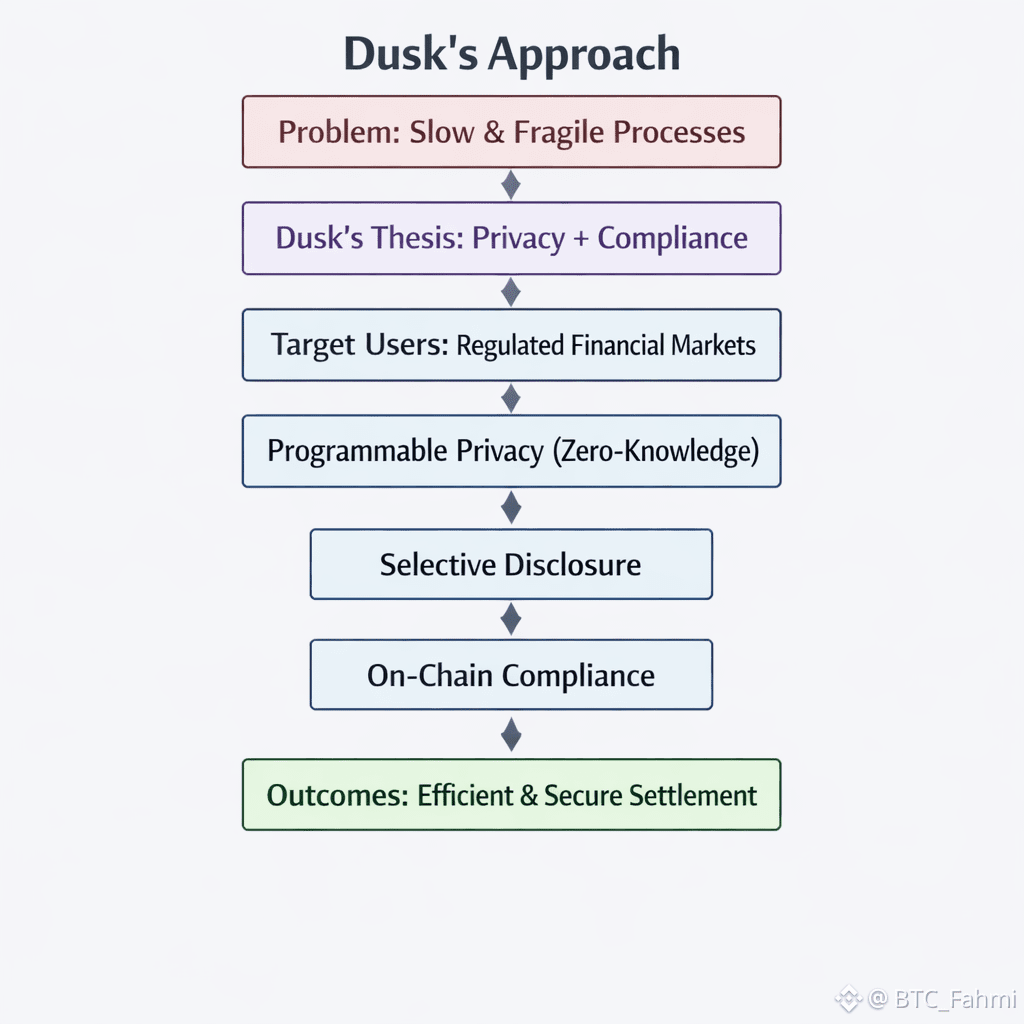
Dusk started in 2018 with a clear thesis: financial markets are full of processes that are slow not because they are hard, but because they are fragile. When every transfer depends on manual checks, fragmented records, and reconciliations between parties who do not fully trust each other, settlement becomes a chain of paperwork. Dusk’s long arc has been research and engineering aimed at reducing that friction without pretending regulators, auditors, and legal accountability do not exist.
To understand what Dusk is trying to do, it helps to define the target user. It is not the person swapping memes at 2 a.m. It is the venue listing a security, the issuer managing cap tables, the broker handling distribution, the market maker quoting liquidity, and the compliance team that must prove rules were followed. Dusk positions itself as a public, permissionless Layer 1 designed for regulated financial markets, with confidentiality from zero knowledge techniques and an explicit emphasis on on chain compliance in the context of EU frameworks such as MiCA, MiFID II, and the DLT Pilot Regime.
Privacy here is not just “hide everything.” In regulated finance, selective disclosure is the real requirement. Traders want their orders and exposures private. Regulators want the ability to audit when needed. Counterparties want assurances that the other side is authorized and solvent enough for the trade. Dusk’s approach leans on zero knowledge proofs so the network can validate that rules were satisfied without broadcasting all underlying details to everyone. That is the core promise: confidentiality for the public, verifiability for the parties who are entitled to see.
The compliance angle is where the design becomes practical. Dusk’s documentation frames the system as combining confidentiality with “on chain compliance,” explicitly referencing regimes like MiCA, MiFID II, and the EU DLT Pilot Regime. That matters because these frameworks are not abstract. They shape what can be traded, who can access it, how settlement should work, and what records must exist. A chain that only says “we support institutions” usually means institutions will still do the real compliance work off chain, which quietly kills scale. Dusk’s bet is that if compliance logic can live closer to the asset and the transaction flow, integration becomes less brittle and more repeatable. 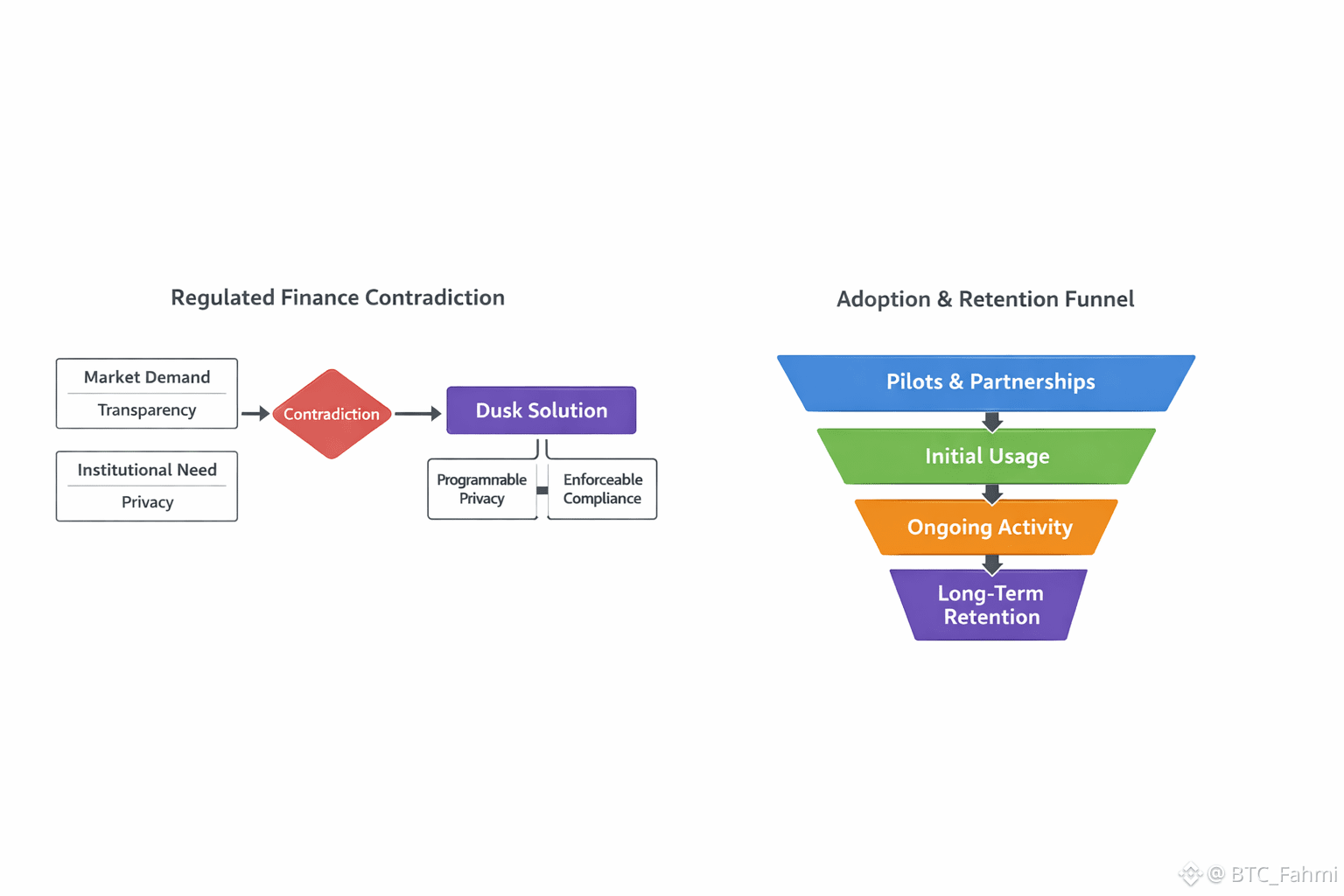
This is also why partnerships with regulated market infrastructure show up so often in Dusk’s public roadmap. In April 2025, Dusk announced a partnership with 21X, described as the first firm to receive a DLT TSS license under European regulation, with the relationship framed around regulated, tokenized markets. In November 2025, Dusk announced a partnership involving NPEX, describing NPEX as a Dutch stock exchange supervised by the AFM and positioning the collaboration around moving listed equities and bonds on chain for compliant trading and settlement. These are the kinds of counterparties that force a network to behave like financial plumbing, because the system must survive supervision, audits, disputes, and operational scrutiny.
For traders and investors, it is tempting to skip the infrastructure story and jump straight to the token. Market data is useful, but only after the purpose is clear. As of January 30, 2026, DUSK is trading around the mid teens in USD cents, with a market cap in the high tens of millions of USD and daily volume that can be meaningful relative to its market cap. Those numbers tell you liquidity exists, but they do not tell you whether the network is becoming a default venue for compliant issuance and settlement. The more important question is whether Dusk can convert pilots and integrations into repeat usage.
That is where the retention problem shows up, and it is more brutal in regulated finance than in retail crypto. In retail, users churn because yields fade or narratives rotate. In institutional settings, users churn because integration pain exceeds business value. A compliance driven product can win the first meeting and still lose the second month. If onboarding requires custom legal work every time, if reporting is inconsistent, if privacy features are hard to operate, or if settlement does not feel boringly reliable, desks will revert to familiar rails. Dusk’s strategy seems to be reducing that churn by embedding confidentiality and compliance closer to the base layer, so each new asset and venue does not reinvent the same operational workflow.
None of this is risk free, and traders should treat it that way. There is execution risk, because shipping regulated grade infrastructure is slow and full of edge cases. There is regulatory interpretation risk, because rules and enforcement priorities evolve. There is adoption risk, because partnerships and announcements do not automatically translate into sustained transaction flow. There is competitive risk, because other ecosystems are also chasing tokenized securities and compliant settlement. There is also market risk in the token itself, including liquidity swings and reflexive sentiment, which can diverge from fundamental progress for long stretches.
If you are evaluating Dusk as an investor a grounded way to engage is to track concrete indicators rather than vibes. Read how Dusk describes its architecture and compliance posture in its documentation and updated whitepaper. Follow whether regulated collaborators expand from announcements into live, repeatable workflows. Watch whether usage grows in a way that suggests retention, not just one off curiosity. And if you trade it, treat the token like any other mid cap asset: position sizing, liquidity awareness, and a clear thesis for what would make you change your mind.
Privacy plus compliance is not a marketing slogan, it is the price of admission for real capital markets on chain. Dusk is trying to build that admission ticket into the protocol itself. If you care about where tokenized finance is actually heading, do the unglamorous work: verify the claims, monitor the integrations, and decide whether the network is earning repeat trust, because in finance, the system that keeps users is the system that wins.

Článek
Dusk: Building Private, Compliant Finance for the Digital Era
Vyloučení odpovědnosti: Obsahuje názory třetích stran. Nejedná se o finanční poradenství. Může obsahovat sponzorovaný obsah. Viz obchodní podmínky.

DUSK
0.1027
+2.90%