
Introduction
Contemporary gaming and metaverse ecosystems are not just entertainment platforms anymore. They are dynamic, high volume, real time digital economies with millions of users interacting together. Legacy blockchains, which are built for financial transactions, cannot satisfy the server requirements of these systems. High and uncertain latency, lack of transaction fees determinism, low throughout and user experience are the reasons why most the traditional blockchains cannot be used for interactive environments at scale.
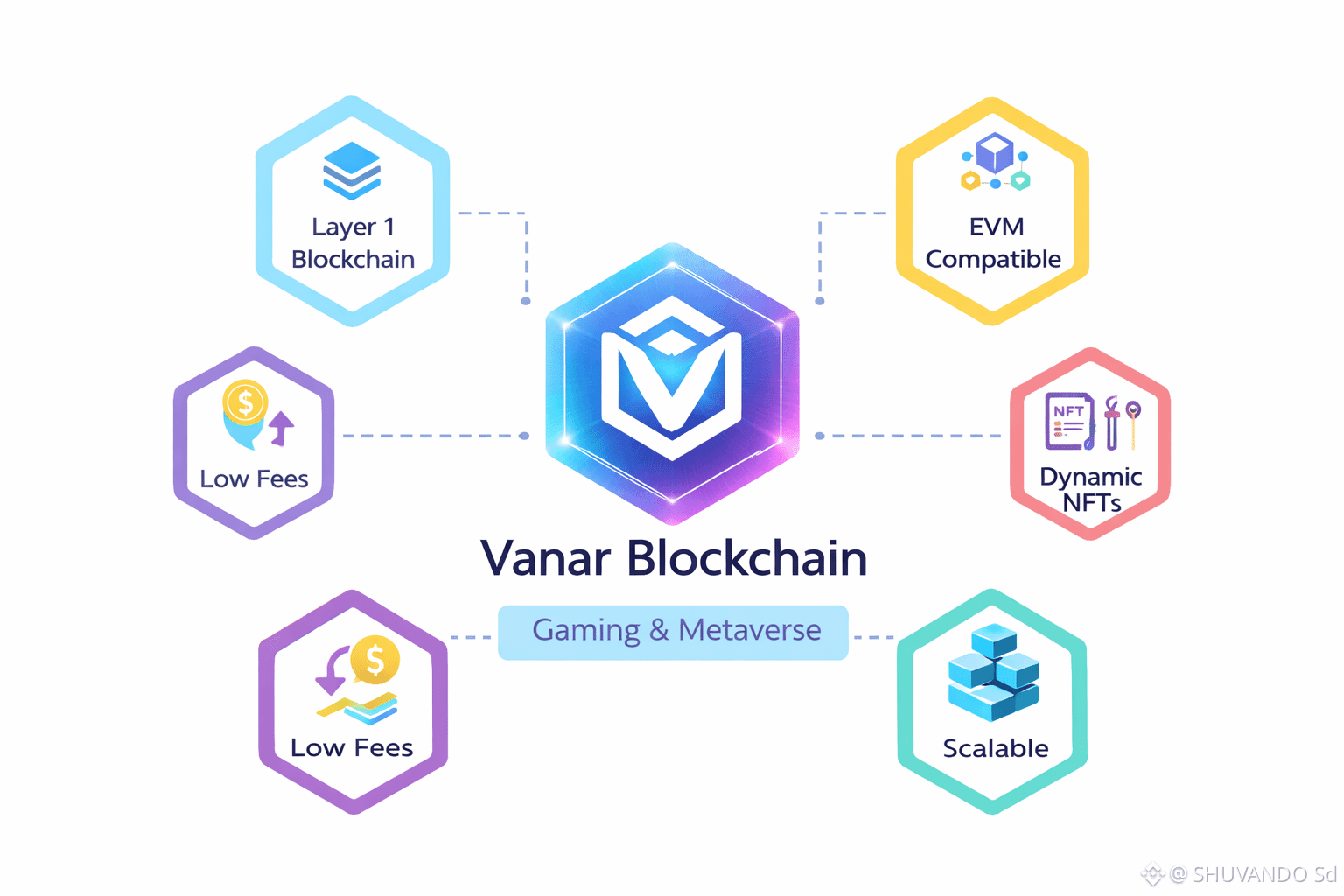
The Vanar Blockchian is a specializing layer one blockchain featured for gaming and metaverse applications. The approach is that Vanar lets the blockchain fit the games, rather than making games to fit the blockchain. This post discusses the technical fundamentals of Vanar Blockchain and why such capabilities are crucial for gaming and metaverse platforms today.
High-Performance Layer-1 Architecture
Among the most critical requirements for gaming and metaverse systems is real-time performance. In more traditional blockchains, confirmation time for this transaction can take seconds or even minutes, which is clearly not ideal in an interactive game. Vanar Blockchain has been built as a high-throughput Layer-1 network (instead of using secondary scaling solutions).
This design enables Vanar to achieve lightning quick block finality and low latency, meaning that in-game actions - from item transfers, to character movement and combat resolution are confirmed almost instantly. For metaverse worlds where the user is going to expect that kind of super responsive interactivity, similar to what is on a Web2 platform, anything less than this particular performance level is not an option – it’s mandatory.
Ultra-Low and Predictable Transaction Fees
Gaming ecosystems involve frequent micro-transactions. Mints could range from minting assets in a game world, upgrading items, trading collectibles or awarding players. Dynamic gas fees on most blockchains render such actions economically infeasible.
Vanar solves this issue by applying a low and stable fee structure. The predictability of transaction costs allows game developers to design with a free hand, without fearing the possibility of sudden fee hikes. For players this eliminates one of the biggest barriers to entry: they can interact with the blockchain without needing to constantly factor “is this action worth the gas?”
In metaverse economies where users can carry out hundreds of small transactions on a daily basis, this cost effectiveness is not just convenient; it’s essential.
EVM Compatibility and Developer Accessibility
A technically advanced blockchain is of no use if developers cannot develop efficiently on top of it. Vanar Blockchain is EVM-compatible, so you can create smart contracts with Solidity and utilize Ethereum tools.
This level of compatibility dramatically decreases the time required for studios to adopt if they are coming from Ethereum or any other EVM chains. It also allows for smooth transition of pre-existing DApps to a gaming-preferred platform. For the metaverse, this developer-friendly approach speeds innovation and lowers development costs in an environment where rapid experimentation and iteration are paramount.

NFT Optimization in The Context of Dynamic Digital Assets
Gaming & metaverse NFTs are a key use case here. But most blockchains think of NFTs as static assets, which doesn’t suit the requirements of modern games, where items change over time.
9) What kind of use-cases is Vanar Blockchain best suited for? Our chain is perfect for dynamic NFTs where you might want to update a lot of metadata without high gas cost. This allows for use cases like:
Weapon upgrades
Character progression
Wearable customization
Skill evolution
In the context of a metaverse, dynamic NFTs enable digital identities and assets to develop as users themselves evolve - increasing a sense value and engagement. This is the technical ability that fills in this "missing link" between assets on blockchain and actual game playing aspects.
Scalability for Mass User Adoption
The metaverse wants to host millions of concurrent users, not a few thousand crypto-natives. Vanar’s elastic infrastructure is built to process high numbers of transactions without traffic jam or slow speed.
As opposed to blockchains which should only use Layer-2 for scaling, Vanar scales at the base layer itself. This lowers the complexity of the system, and removes bridge- or rollup-risk. In the case of large virtual worlds and multiplayer games, this reliability serves as a trust-pillar; users do not want to be (frequently) disconnected from their game experience.
Security Without Compromising Speed
Security is an afterthought for a lot of blockchain platforms. Vanar tries to reconcile both by building a strong consensus mechanism that achieves the integrity of the network with a good throughput.
For gaming platforms, security is key as digital assets are valuable in their own right. Exploits, double spends or rollback attacks can cause overnight loss of user confidence. Vanar is a no-spin, instant-finality system, meaning that once an occurrence in the game has been confirmed — it cannot contested or undone.
User Experience Focused Design
One of the reasons why blockchain games fail is low level of quality in user experience. Complicated wallet integrations, slow confirmation times, and ambiguous transaction states turn off the non-technical individuals.
Web2-like UX goals are taken into account in Vanar Blockchain to have softer onboarding and interaction flows. This design principle will be crucial for metaverse platforms that want to reach mainstream audiences, not just crypto enthusiasts.
Thanks to minimal friction at the protocol level, Vanar enables developers to create experiences where blockchain becomes invisible in the background.
Interoperability and Future-Proof Design
Gaming and metaverse ecosystems are not isolated. Resources, identities and economies now need to move between platforms. Vanar also wants to facilitate other blockchains interoperability and transfer or use assets outside a given ecoystem.
This forward thinking design means that any Vanar applications are not stuck in a technological dead end. For developers and investors, too, this flexibility ensures the future health of an asset.
Conclusion
Vanar Blockchain is not a generic protocol that tries to fit gaming in as an after thought. A game-born, Layer-1 Platform purpose-built for the realities of Gaming and the Metaverse. With its high performance, low transaction costs, NFT support, scalability, and developer-friendly ecosystem DAFI potentially solves the problems that prevent established blockchains from supporting large-scale interactive digital worlds.
As online economies start resembling real ones in complexity, the technical infrastructure built by Vanar is what’s needed for a vibrant and secure gaming and metaverse ecosystem. Its design decisions clearly indicate an awareness that the future of blockchain adoption will not rest on hype, but will hinge on performance, usability and real-world applicability.@Vanarchain #vanar $VANRY
