

A few months back, I was testing an AI-driven trading bot on a side chain. Nothing ambitious. Just sentiment-based adjustments tied to short-term price moves. The logic itself wasn’t complicated, but the infrastructure made it painful. Anything involving on-chain processing either became expensive fast or had to rely on off-chain oracles that lagged or failed at the worst times. I’ve traded infrastructure tokens long enough to spot the pattern. A lot of chains talk about intelligence, but in practice AI feels glued on after the fact. When markets move quickly, that fragility shows up immediately, and you start questioning whether the system can actually be trusted when it matters.
That friction comes from how most blockchains approach “advanced” functionality. AI isn’t native. It’s layered on through external services, extra contracts, or data feeds that introduce delays and new trust assumptions. Developers juggle multiple systems just to make basic adaptive logic work. Users experience it as hesitation. Transactions wait on off-chain confirmations. Costs spike when something reverts. The result isn’t just inefficiency, it’s uncertainty. For anything beyond basic transfers, you’re left wondering where the weak point is and when it will break.
I usually think of it like an old factory line. It’s great at doing the same thing repeatedly. But once you introduce variation, inspections, or dynamic decisions, you end up bolting on extra stations. Each one adds friction, cost, and another way for the line to stall. That’s what many “AI-enabled” blockchains feel like today.
@Vanarchain is clearly trying to avoid that pattern by designing around intelligence from the start. Instead of treating AI as an add-on, it positions itself as a modular layer-1 where reasoning and data handling live inside the protocol itself. The goal isn’t maximum flexibility or endless features. It’s coherence. Keep the logic verifiable, keep data on-chain where possible, and avoid leaning on external crutches that introduce trust gaps. For real-world use, that matters. If an application can adapt, validate, or reason without stepping outside the chain, it feels less brittle and more like infrastructure you can build habits on.
You can see this in how the stack is structured. The base #Vanar Chain handles execution and data availability, but the higher layers do the heavy lifting. One concrete example is Neutron. Instead of storing raw data blobs, it compresses inputs into semantic “Seeds.” These aren’t just smaller files. They’re encoded representations that retain meaning and can be queried later. In testing, this cut storage requirements dramatically while keeping data usable. That’s a practical trade. Less storage overhead, less cost, and fewer reasons to push things off-chain.
Then there’s Kayon, which handles reasoning directly inside smart contracts. It doesn’t try to run open-ended machine learning. That would be reckless on-chain. Instead, it uses constrained, deterministic models for things like validation or pattern checks. You give up flexibility, but you gain predictability. Every node can reproduce the result. Settlement stays consistent. That trade-off matters more than it sounds when real value is moving through contracts.
Recent protocol changes reinforce that direction. The reason for this is that the V23 renewal in late 2025 wasn’t flashy, but it mattered. Node count increased meaningfully, success rates stayed high, and congestion didn’t spike even as AI-native tooling rolled out in early 2026.That kind of stability is easy to overlook, but it’s usually what separates infrastructure that survives from infrastructure that just demos well.
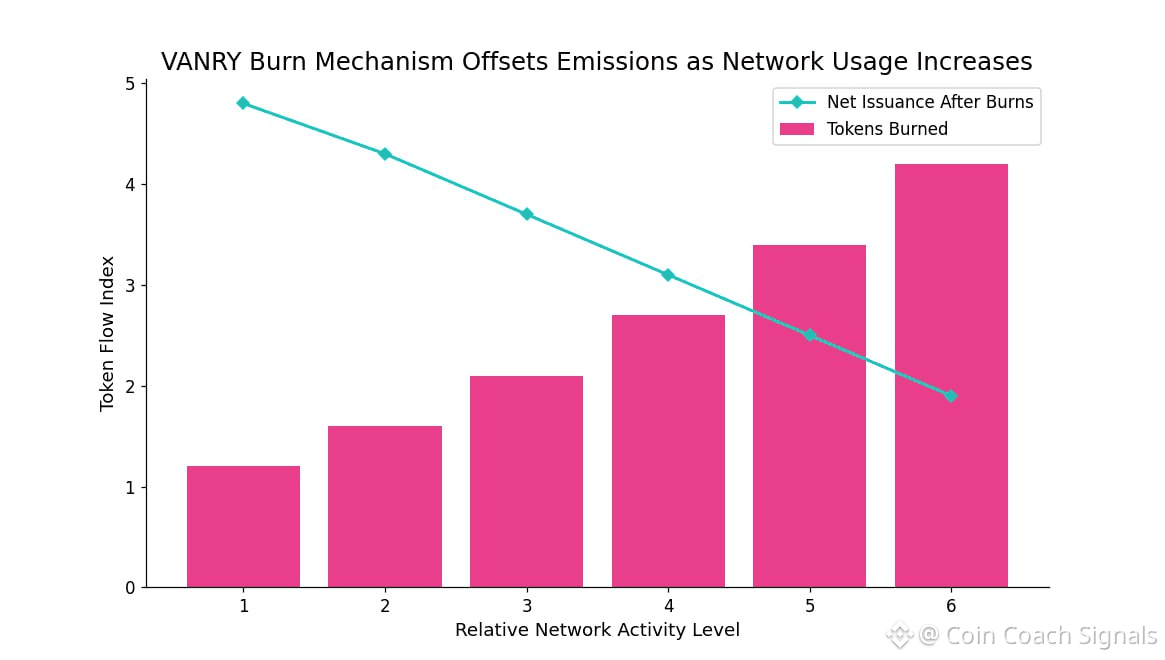
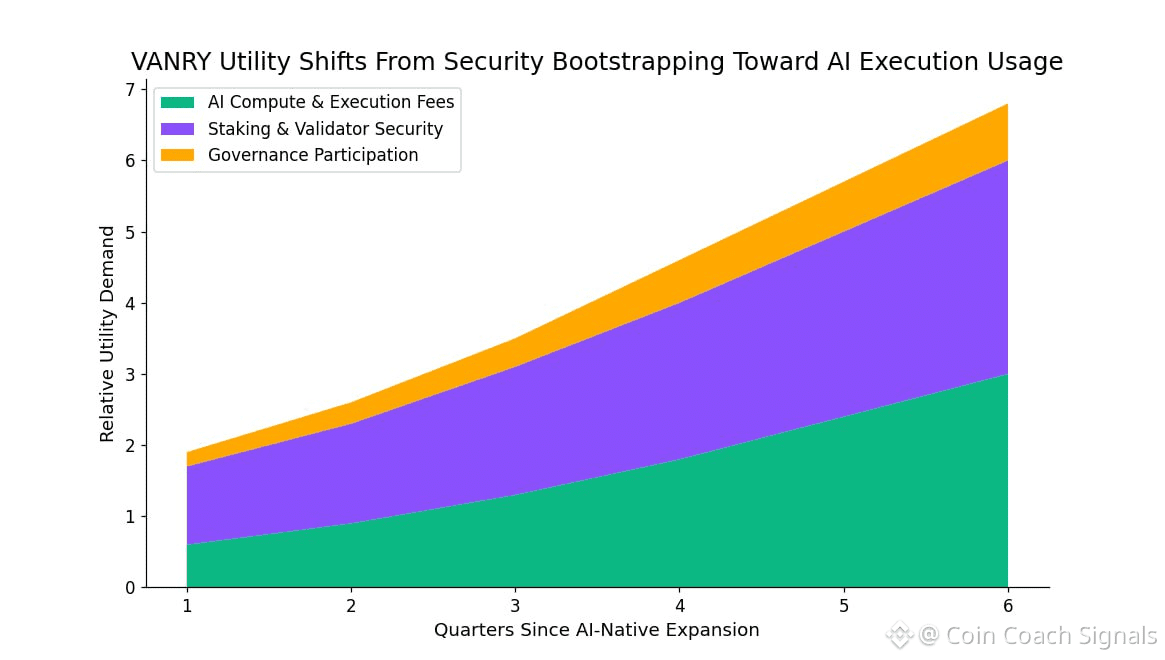
VANRY the token sits quietly at the center of all this. It isn’t overloaded with narratives. It pays for execution. A portion of fees is burned, which means supply pressure responds to actual usage rather than fixed schedules alone. When activity increases, burns increase. When it doesn’t, they don’t. Staking is tied to delegated proof of stake, where validators secure the network and earn emissions that gradually taper. That taper matters. It signals that long-term security is expected to come from usage, not inflation.
Staked $VANRY underwrites settlement and finality, and slashing enforces discipline. Governance flows through the same mechanism. Token holders vote on upgrades, parameter changes, and emission adjustments, like those introduced in V23.There’s nothing exotic here. The token exists to keep the system running and aligned, not to manufacture demand.
From a market perspective, it’s still small. Circulating supply is high, market cap is modest, and liquidity is thin compared to larger chains. That cuts both ways. It limits downside absorption during sell pressure, but it also means the token isn’t priced for perfection.
Short-term trading has mostly been narrative-driven. The NVIDIA announcement at the end of 2025 is a good example. Price moved violently, then retraced once attention shifted. The MyNeutron launch did something similar earlier. Those moves are familiar. They reward timing, not conviction. Long-term value depends on whether developers actually use the stack and keep using it. If AI tools become part of daily workflows, fee demand and staking participation follow naturally. If not, burns and emissions won’t save the token.
The risks are real. Competing ecosystems already have momentum. Larger developer bases tend to win by default. Kayon’s constrained design could also become a bottleneck if real-world applications demand more complex reasoning than the protocol allows. A realistic failure scenario isn’t dramatic. It’s subtle. A surge in AI-driven activity overwhelms the deterministic limits, settlements slow, contracts queue up, and confidence erodes quietly rather than catastrophically.
Projects like this rarely succeed or fail in headlines. They succeed when the second transaction feels easier than the first. When the third doesn’t require rethinking architecture. Vanar’s tokenomics are clearly designed around that idea. Whether the usage catches up is the part no whitepaper can guarantee.
@Vanarchain
