
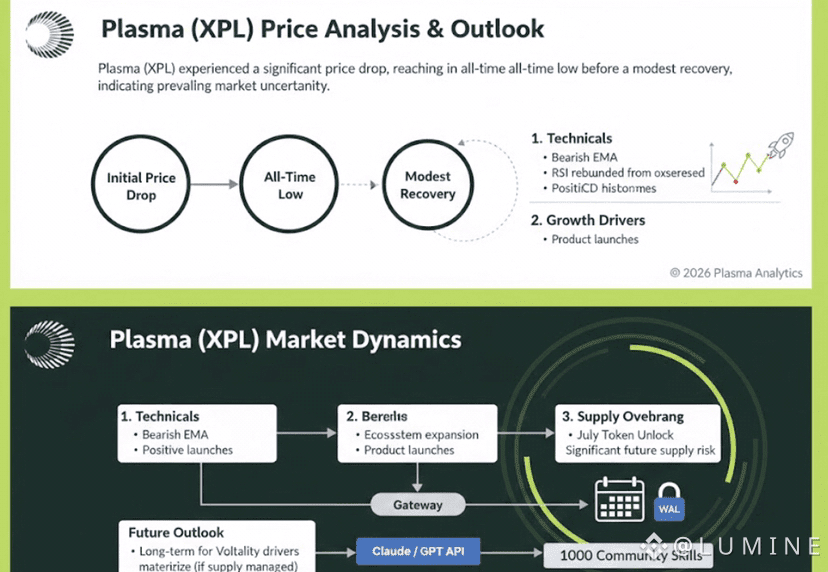
The cryptocurrency market is no stranger to extreme volatility, but every so often a price movement tells a deeper story about sentiment, structure, and long term potential. Plasma (XPL) recently delivered one of those moments. After suffering a steep and prolonged decline, the token reached an all-time low before staging a modest recovery a move that reflects both exhaustion on the sell side and hesitation among buyers.
This phase is not just about price. It’s about psychology, fundamentals, and the clash between near-term risk and long-term ambition. Plasma now sits at a critical junction where technical signals hint at stabilization, growth narratives are quietly forming, and looming supply dynamics threaten to redefine future price action.
This analysis breaks down why Plasma fell, what the current signals are saying, and what investors and observers should realistically expect moving forward.
Market Context: Capitulation Before Clarity
Plasma’s price collapse did not happen in isolation. It unfolded against a backdrop of broader market uncertainty, tightening liquidity, and shifting investor risk appetite. When capital becomes selective, smaller and mid-cap tokens tend to suffer disproportionately, regardless of long-term vision.
The descent to an all-time low was a classic example of capitulation — a phase where weak hands exit positions aggressively, often driven by fear rather than fundamentals. Volume patterns during the drop suggest forced selling rather than strategic exits, a key distinction when analyzing potential recovery scenarios.
The modest rebound that followed does not yet signal a trend reversal. Instead, it reflects a temporary balance between sellers losing momentum and buyers cautiously testing the waters.
Technical Overview: Signs of Exhaustion, Not Confirmation
Bearish EMA Structure Still Dominates
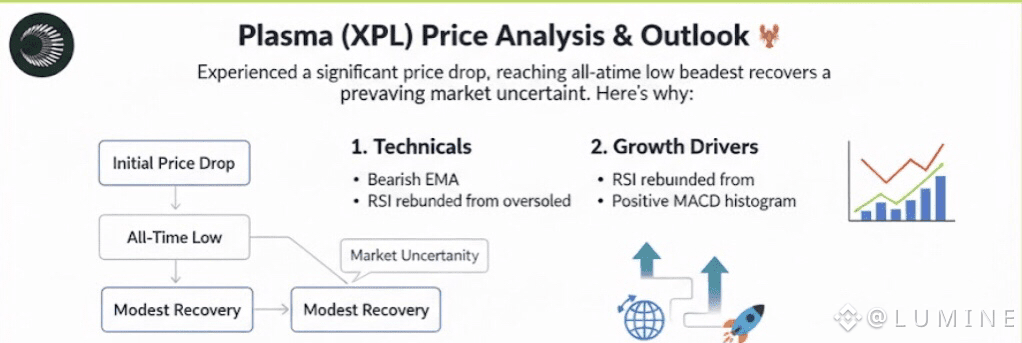
From a technical standpoint, Plasma remains structurally bearish. The exponential moving averages are stacked downward, indicating that the broader trend has not yet flipped. Price continues to trade below key EMA levels, reinforcing the reality that bullish momentum is still fragile.
This EMA configuration suggests that rallies are likely to face resistance until sustained higher highs and higher lows are established. For trend-focused traders, Plasma remains a “wait and see” asset rather than an aggressive entry.
However, trends do not reverse instantly. They erode first and that erosion is beginning to show.
RSI Rebound Signals Seller Exhaustion
One of the most important developments came from the Relative Strength Index. After plunging deep into oversold territory, RSI has rebounded a classic signal that selling pressure may be weakening.
An RSI rebound from extreme lows often indicates that panic selling has run its course. It does not guarantee a sustained rally, but it frequently marks the transition from freefall to consolidation.
In Plasma’s case, the RSI behavior suggests that the market may have found a temporary floor, at least psychologically. Buyers are no longer completely absent, even if conviction remains limited.
MACD Histogram Turns Positive
Adding to the subtle optimism is the MACD histogram, which has flipped positive. While the MACD line itself has not fully confirmed a bullish crossover, the positive histogram indicates improving momentum.
This divergence between price weakness and momentum improvement is worth watching. Historically, such setups often precede sideways accumulation phases periods where smart money quietly positions while retail interest remains low.
Still, it’s important to emphasize: these are early signals, not confirmations. Plasma is showing signs of stabilization, not a full trend reversal.
Sentiment Analysis: Fear, Fatigue, and Indifference
Market sentiment around Plasma is currently muted. The loud optimism of earlier cycles has faded, replaced by a combination of fatigue and skepticism. This emotional landscape is typical after extended drawdowns.
Interestingly, indifference can be a precursor to opportunity. When narratives disappear and attention shifts elsewhere, assets often enter accumulation zones. However, indifference can also persist for long periods if no catalyst emerges.
Plasma’s challenge is not just recovering price it’s rebuilding belief.
Growth Drivers: Where Long-Term Value Could Emerge
Despite the technical weakness, Plasma is not without a growth story. Beneath the surface, ecosystem development and product expansion are quietly shaping the project’s future trajectory.
Ecosystem Expansion as a Strategic Lever
Ecosystem growth is one of the most powerful drivers in crypto valuations. Plasma’s ongoing efforts to expand its ecosystem through integrations, partnerships, and infrastructure improvements have the potential to create real demand beyond speculative trading.
An expanding ecosystem increases utility, which in turn can support token demand organically. This is especially critical in a market environment where narratives alone are no longer sufficient to sustain valuations.
If Plasma successfully attracts developers, users, and complementary projects, it could transition from a purely speculative asset to a functional network with measurable activity.
Product Launches as Catalysts
Product launches represent another key growth vector. In crypto markets, meaningful releases often act as catalysts — not just because of the products themselves, but because they reset perception.
Well-executed launches can:
Reignite community engagement
Attract new capital
Shift the narrative from decline to development
For Plasma, upcoming product milestones could serve as inflection points, especially if they demonstrate clear use cases and adoption potential.
However, execution risk remains. In today’s market, delayed or underwhelming launches are punished quickly. Plasma’s team will need to deliver with precision and transparency to regain credibility.
Adoption Versus Speculation: The Real Test
The most important question facing Plasma is whether it can convert development into adoption. Many projects build impressive technology that never gains traction. Adoption requires not just functionality, but relevance.
Metrics such as active users, transaction volume, and developer participation will ultimately matter more than roadmap promises. Until these metrics improve, any price recovery will remain vulnerable to reversal.
Supply Dynamics: The July 2026 Token Unlock Looms Large
Understanding the Supply Overhang
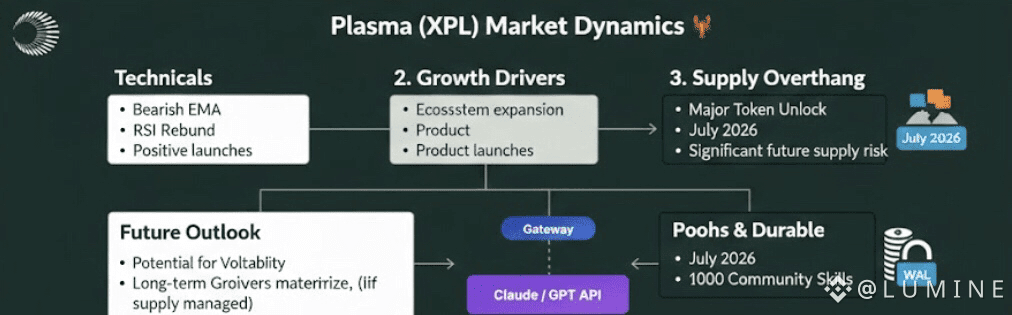
One of the most significant risks facing Plasma is the major token unlock scheduled for July 2026. This event represents a substantial increase in circulating supply, introducing a potential overhang that could weigh heavily on price.
Supply overhangs are psychological as much as they are mathematical. Even well before the unlock occurs, the market tends to price in future dilution.
This anticipation can suppress rallies, as investors hesitate to commit capital knowing that increased supply is coming.
Market Behavior Around Large Unlocks
Historically, large token unlocks often lead to:
Increased volatility
Short-term sell pressure
Reduced upside momentum ahead of the event
However, the impact depends heavily on context. If demand growth outpaces supply expansion, the market can absorb the unlock with minimal disruption.
For Plasma, this means that ecosystem growth and adoption over the next 18–24 months are critical. Without meaningful demand expansion, the unlock could become a defining headwind.
Strategic Implications for Investors
From an investment perspective, the July 2026 unlock introduces a long-term risk premium. Market participants are likely to demand lower entry prices to compensate for future dilution.
This doesn’t eliminate upside potential, but it does cap speculative enthusiasm unless fundamentals improve significantly.
Short-Term Outlook: Stabilization Over Breakout
In the near term, Plasma is more likely to consolidate than to rally aggressively. The technical indicators suggest stabilization, not euphoria.
Price action may remain range-bound as the market digests recent losses and waits for clarity on development progress. Volatility could remain elevated, particularly around broader market movements.
Traders should expect resistance on upward moves and support to be tested multiple times before a clear direction emerges.
Medium-Term Outlook: Catalyst-Dependent
Over the medium term, Plasma’s performance will be highly dependent on execution. Product launches, ecosystem metrics, and community engagement will determine whether the current base becomes a foundation or a temporary pause.
If Plasma delivers tangible progress, the current valuation could begin to look increasingly disconnected from fundamentals. If not, the token risks prolonged stagnation.
Long-Term Outlook: A High-Risk, High-Variance Asset
Long-term, Plasma remains a high-variance asset. The potential upside is tied to successful ecosystem expansion and real adoption, while the downside is amplified by future supply risk and competitive pressure.
This asymmetry makes Plasma unsuitable for passive optimism. It demands active monitoring, disciplined risk management, and a realistic understanding of market cycles.
Final Thoughts: Uncertainty Is the Theme
Plasma (XPL) is not dead — but it is not safe either. The recent all-time low marked a moment of capitulation, followed by early signs of stabilization. Technical indicators hint at seller exhaustion, growth narratives exist, and development continues behind the scenes.
At the same time, bearish trend structure, muted sentiment, and a looming supply unlock create real and present risks.
This is a project standing between fear and possibility.
For observers, Plasma offers a case study in how markets reprice ambition under pressure. For participants, it represents a decision point: wait for confirmation, bet on execution, or stay on the sidelines until uncertainty resolves.
In crypto, uncertainty is often where opportunity is born but only for those willing to separate signal from noise and patience from hope.

