

Some time back, I was moving USDT around to test a basic remittance flow. Nothing advanced. No leverage, no routing tricks. Just trying to see how value actually moves when you pretend you need to send money across borders instead of across tabs. The route ended up jumping from Ethereum, through another chain, and then toward Bitcoin for final settlement. On paper, it worked. Everything technically completed. In practice, it felt slow. Fees shaved off more than expected. Confirmations took longer than they should have. And the whole time, there was this quiet background worry about whether the bridge would hiccup halfway through. I have been around long enough to expect friction, but it still bothered me. Stablecoins are meant to behave like cash. Instead, moving them still feels like sending a wire transfer through a chain of old banks, each adding delay and risk for reasons no one can clearly explain. That experience stuck with me. If this is where infrastructure maturity is today, why does something so basic still feel fragile?
That frustration is not unique. It points to how cross-chain systems are usually built, especially when stable assets are involved. Bridges and intent layers tend to come later, bolted onto chains that were never designed for them. Liquidity gets split. Settlement times stretch depending on relay health or network load. Security assumptions change at every step. For users, this shows up as higher costs, unclear finality, and constant checking. You watch explorers. You refresh dashboards. You wait longer than you expected. You are never fully sure if a transfer is done or just sitting somewhere out of sight. Nothing breaks outright, but the friction is enough to stop stablecoins from feeling like real payment rails instead of trading tools.
I keep thinking about logistics before standardized containers. Every port handled cargo differently. Goods were unpacked, repacked, delayed, sometimes damaged. Once containers became universal, shipping did not just get faster. It became boring. Predictable. Crypto still has not reached that stage for cross-chain value movement, especially when every bridge brings its own trust model and failure modes.
@Plasma is clearly trying to solve this by narrowing its scope instead of expanding it. It positions itself as a layer one built almost entirely around stablecoin settlement, with cross-chain mechanics treated as core plumbing rather than optional extras. It avoids distractions. No NFT traffic. No gaming spikes. No general-purpose congestion. Just payment-focused execution with EVM compatibility so developers can port stablecoin apps without rebuilding everything. That focus shows up in how the chain behaves. Since mainnet went live in late 2025, average activity has hovered around five to six transactions per second under normal conditions, with stress tests pushing past one thousand. Total transactions are now above one hundred forty million, which suggests real throughput rather than isolated experiments. The January 23, 2026 integration with NEAR Intents added another layer, letting users bundle cross-chain actions without manually bridging step by step. Early data points to roughly five hundred million dollars in intents volume touching stablecoin rails in the first days. It is meaningful, but still early enough that the system has not faced prolonged real-world stress.
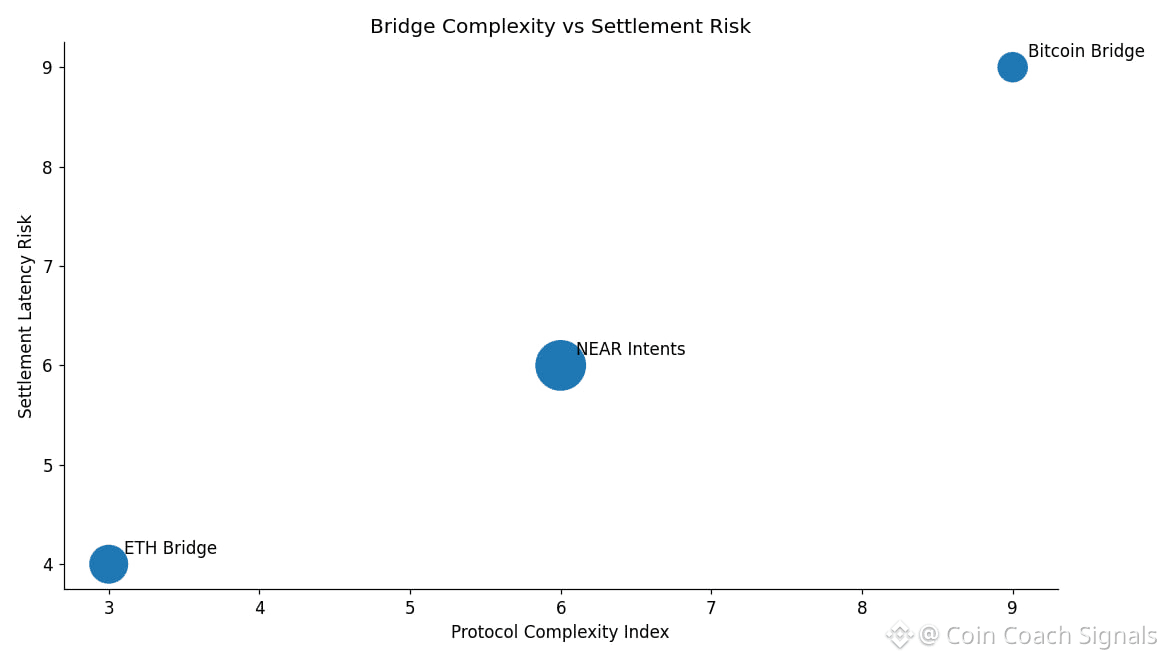
Under the hood, the design favors predictability over flexibility. PlasmaBFT, a modified HotStuff-style consensus, pipelines proposal and voting stages to keep block times consistently under a second, often closer to half a second in current conditions. That matters when moving large amounts of value, because it reduces the window where things can go wrong. Then there is the Bitcoin bridge via pBTC. Instead of relying on a separate validator set, it leans on Bitcoin’s hashrate for security. In theory, that is clean. In practice, it comes with limits. Throughput is capped, currently around ten BTC per hour, to avoid overload. It is a deliberate throttle. Safety first, speed second. Combined with NEAR Intents, which rely on signed off-chain messages for atomic coordination, Plasma avoids external oracle dependencies. The trade-off is rigidity. Once these systems are embedded this deeply into the base layer, changing direction becomes difficult without touching core assumptions.
$XPL sits directly inside that machinery. It covers gas where sponsorship does not apply, especially for more complex contract calls. Validators stake XPL to secure the network and earn rewards from inflation that starts near five percent annually and tapers over time. In the Bitcoin bridge, relayers post XPL-backed bonds, tying economic risk to honest behavior. Governance also runs through staked XPL, with recent votes focused on bridge limits and relay parameters after the NEAR rollout. Base fees are partially burned to offset inflation, but the token’s role stays practical. If participation drops, security weakens. There is no abstraction hiding that dependency.
From a market standpoint, #Plasma sits in an in-between zone. Market capitalization is around two hundred fourteen million dollars in early 2026. Circulating supply is near one point five billion tokens following the January 25 unlock of eighty-eight point eight nine million allocated to ecosystem grants. Daily volume around forty-five million suggests reasonable liquidity, but not enough to hide structural issues if something breaks.
Short-term trading still revolves around narratives. The NEAR Intents announcement on January 23 drove a burst of volume that cooled once early participants took profits. Unlocks like the recent ecosystem tranche introduce supply pressure, especially if recipients sell before usage scales. Broader sentiment around stablecoin regulation adds another layer of volatility. I have seen this pattern many times. Partnerships push price up, then things drift when attention moves on. Long-term, the bet is different. It is about whether these cross-chain paths become routine. If the Bitcoin bridge and NEAR relays start handling steady flows instead of bursts, Plasma could build the kind of reliability that brings users back without them thinking about it. That is when staking demand and fee burn actually matter. But that process is slow. After the November 2025 unwind, daily active users dropped sharply. Only recently have they started to recover, ticking up roughly fifteen percent alongside the new integrations.
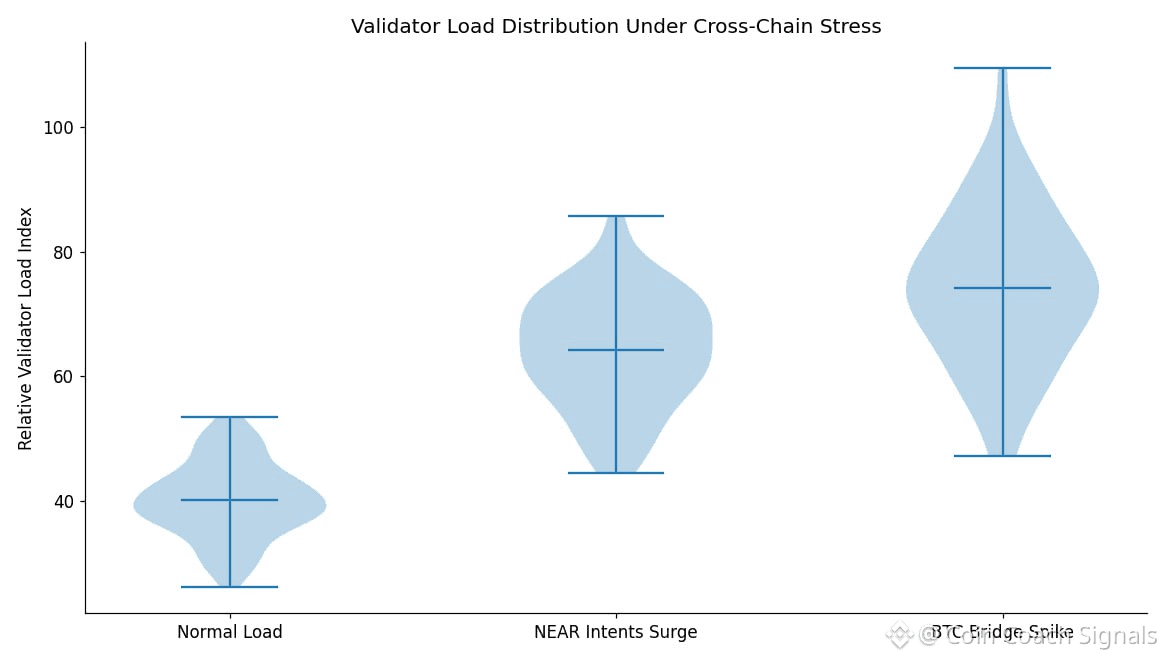
The risks do not disappear just because the design is focused. Solana offers similar speed with a much broader ecosystem. Ethereum rollups continue compressing fees while rolling out their own intent layers. Bridges remain a historical weak point, and Plasma’s reliance on Bitcoin finality means a deep reorg, however unlikely, could ripple outward. One scenario that keeps bothering me is a surge in intents overwhelming validators during peak conditions. If pipelined consensus stumbles under that load, even briefly, cross-chain settlements could freeze. A few hours of downtime would be enough to shake confidence, especially for users relying on stable flows. There is also the open question of issuer commitment. Without deeper buy-in from players like Circle or Tether on the Bitcoin side, volumes may never move beyond controlled tests.
In the end, systems like this prove themselves quietly. Not through launch threads or dashboards, but through repetition. The second transfer. The tenth. The hundredth. When users stop watching confirmations and stop worrying about whether funds will arrive, adoption compounds. Whether NEAR Intents and Bitcoin integration become Plasma’s edge or its burden will only become clear once the novelty fades and reliability is all that remains.
@Plasma


