
Most people hear "zero-fee USDT transfers" and think Plasma just cracked the code on payments. No gas. No friction. Just money moving around like it should. Sounds incredible. And honestly, for about five minutes of actually trying to build something on it, I thought the same thing. Then you hit the edge of what "zero-fee" actually covers, and the whole thing starts feeling a lot more conditional than advertised.
What bothers me isn't that Plasma charges fees. Every blockchain does. It's that the zero-fee part is so narrow that calling it a "zero-fee blockchain" feels misleading. Plasma will sponsor your gas if you're doing one thing: sending USDT from wallet to wallet. That's it. The protocol-level paymaster picks up the tab, you don't need $XPL in your wallet, and everything works smoothly. But try to do literally anything else—call a smart contract, interact with a DeFi protocol, swap tokens, deploy something—and you're paying gas in XPL just like Ethereum or any other chain.
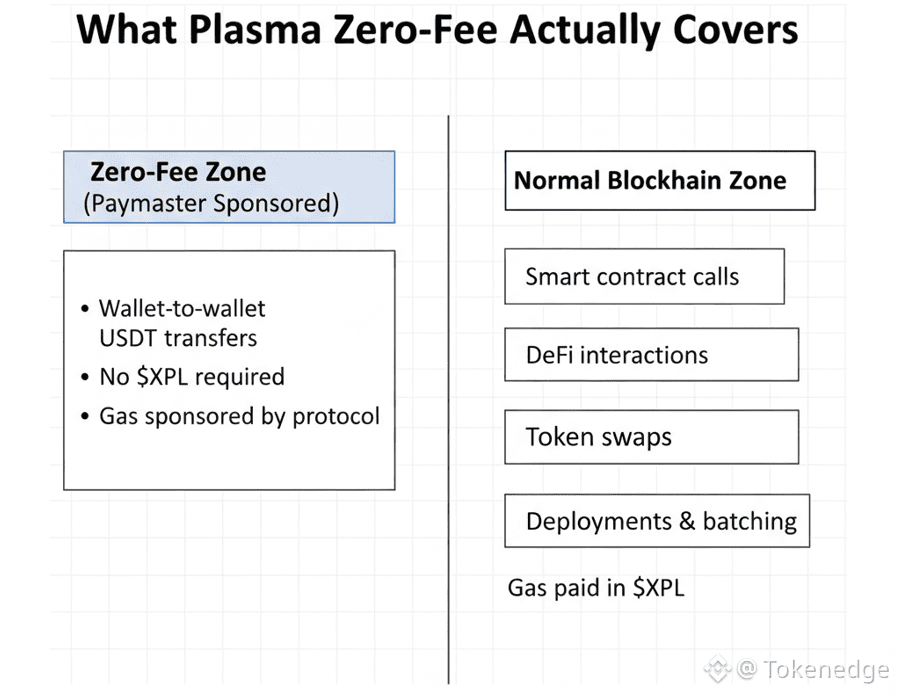
And look, that's not necessarily wrong. It's just different from what I expected when I first read about Plasma as this revolutionary payments layer.
XPL closed today at $0.1189, down 4.27% in the last 24 hours. Volume's sitting around 106.64 million tokens moved, which is about $12.85 million in actual dollars. Not dead, but not exactly screaming adoption either. The network's processing maybe 15 transactions per second right now, even though it's supposedly built to handle over 1,000. So clearly there's room. But those 15 TPS tell you something useful—most of what's happening on Plasma isn't just basic sends. If it were, nobody would need XPL at all. The fact that there's token demand means people are doing complex stuff that falls outside the free zone.
The paymaster system isn't open to everyone, either. There's a whitelist. You get approved, you get rate limits, there's some basic identity verification to keep out the spam bots. Makes sense. But it also means the magical zero-fee experience only exists inside a pretty controlled environment. Step outside—maybe you want to mint something, maybe you're building a DEX integration, maybe you just need to call a function on a contract—and boom, you're back in normal blockchain land where computation costs money and that money is denominated in XPL.
Plasma didn't kill fees. It subsidized one extremely specific use case and left everything else alone.
Which makes me wonder: what happens when the apps people actually want to build need more than point-A-to-point-B transfers?
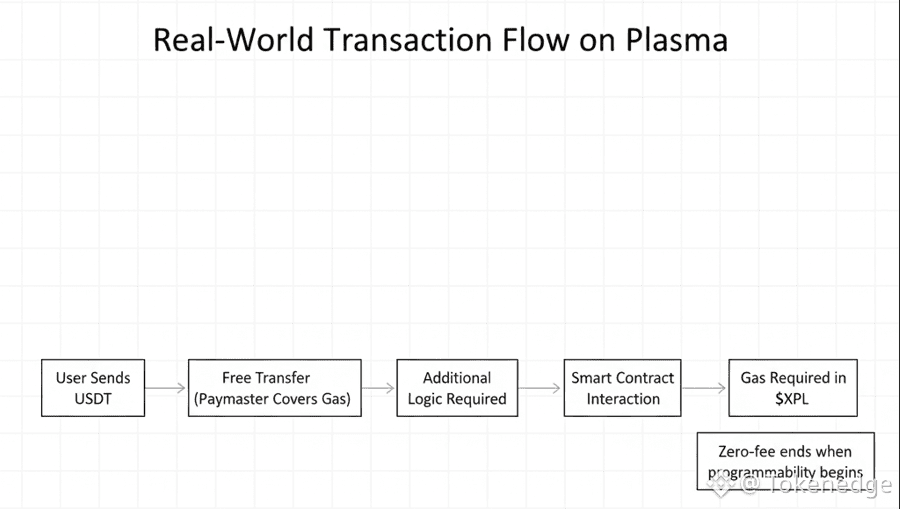
Say you're building a remittance tool. User in New York sends $500 USDT to someone in Manila. That transfer? Free. That's a smart contract interaction. Costs gas. What if you're batching a bunch of these transactions together to save on settlement overhead? Smart contract. What if compliance rules mean you need to log something on-chain, run a verification step, check against a sanctions list? More contract calls. More gas.
Suddenly your zero-fee promise just died, and now you're explaining to users why they need to hold this random XPL token to complete a "free" transaction. Not a great look.
Plasma runs on something called PlasmaBFT for consensus. Sub-second finality, pretty fast, built on HotStuff-style architecture. Execution layer is Reth, which is Ethereum-compatible and written in Rust. You can drop Solidity code on Plasma without changing anything, which is convenient. But that also means Plasma inherited Ethereum's gas model for everything except the paymasters cover. It's the same trade-offs, same metering, same costs—just with one narrow exception carved out for basic USDT sends.
There's this feature where you can pay gas in other tokens instead of XPL. USDT, BTC, whatever's whitelisted. That helps a bit. But even then, you're not escaping fees, you're just paying them in a different denomination. The economic reality is the same. Someone's covering the cost of computation, and if it's not the Plasma Foundation, it's you.
Plasma's documentation doesn't hide this, by the way. They're pretty clear that zero-fee transfers are a feature, not the whole network. But marketing has a way of flattening nuance, and I think a lot of people assume the entire chain runs without fees. It doesn't. Not even close.
Today XPL moved between $0.1185 and $0.1205, ending up around $0.1189. That's a 1.68% range, which is pretty calm. But zoom out and it's a different story. Plasma launched back in September with XPL hitting somewhere near $1.50 to $1.88. We're 92% down from that now. Either the market doesn't believe in the real-world adoption story yet, or it's pricing in those massive token unlocks coming in July and September, or both. Probably both.
Volume of 106 million XPL is okay. Not amazing. Enough to show there's activity, but not enough to suggest anyone's convinced Plasma is about to eat the payments world. And here's the uncomfortable bit: if zero-fee only applies to the simplest possible transaction, and everything else costs XPL, what's actually driving demand for the token besides people trading it?
Staking's supposed to help. Validators are launching any week now in Q1 2026, and once that's live, you can stake XPL to secure the network and earn around 5% annually. That gives people a reason to hold instead of dump. But staking locks up supply, and locked supply doesn't do much when billions of tokens are about to unlock starting mid-year. Staking stabilizes things, sure. But it doesn't answer the bigger question about what XPL is actually for if you're not speculating.
The other piece is supposed to be fees from smart contracts. If Plasma turns into a real hub for DeFi, dApps, maybe tokenized real-world assets or whatever, then all that contract activity generates fee demand for XPL. But right now? Most of the TVL that showed up at launch—something like $5.5 billion in the first week—was just yield farmers hopping across Aave, Ethena, Fluid, Euler, all the usual suspects. That's not sticky usage. That's hot money chasing APY, and it leaves the second incentives dry up.
What Plasma really needs is apps that require the blockchain to do more than act as a dumb pipe. Apps that need composability, programmability, state management, all the stuff that makes blockchains useful beyond just moving tokens. Because if all anyone does is send USDT back and forth, they're not really using Plasma. They're using a subsidized payment rail that happens to have a blockchain underneath.
Plasma's bet is that it can onboard users with the zero-fee hook, and then those users will eventually need features that cost XPL—staking, governance, accessing complex financial products on the EVM layer. That's a reasonable theory. But it's also very much unproven. And with XPL sitting at $0.1189 after a 92% drawdown, it's pretty clear the market isn't buying the transition story yet. Or at least not at current valuation.
The zero-fee thing works great for what it does. It removes friction for basic stablecoin sends, and that's a legitimate advantage over chains that charge you for everything. But the second your use case involves any complexity—any logic, any programmability, any reason to actually use the blockchain part of the blockchain—you're paying for it in XPL.
That's not broken. It's just how it is. And honestly, I think people would have a clearer picture of what Plasma offers if they stopped imagining it as some magical fee-free zone and started looking at it as specialized payment infrastructure with some subsidized on-ramps. Depending what you're building, that might be perfect. Or it might not be nearly enough.

