

@Dusk A web wallet sounds like a convenience story until you live through a week where convenience stops being the point. The moment price candles get violent, an exchange pauses withdrawals, or a friend forwards you a rumor about a chain issue, you feel how much of your financial life is really just trust you borrowed from someone else. Dusk’s browser wallet is interesting because it tries to turn that borrowed trust into something you can hold yourself, without turning your day into a security ceremony. It’s still just a tab in a browser, but what it asks you to do inside that tab is emotionally different: it asks you to be the owner, not the passenger.
What makes this wallet feel “Dusk-native” is the quiet tension it’s built around: sometimes you want to be seen, and sometimes you don’t. A public transfer is the kind of action you can explain quickly to an accountant, a counterparty, or even your own future self when you’re reconstructing a decision under stress. A shielded transfer is the kind of action you take when visibility becomes a liability—when broadcasting your balances, relationships, or patterns would invite pressure you didn’t consent to. Dusk doesn’t pretend one of these instincts is more moral than the other. It treats them as normal human needs, and it lets you move value in either mode, in the same place, with the same sense of finality. That design choice reduces a specific kind of fear: the fear that privacy forces you into exile from the “legible” world, or that compliance forces you to give up dignity. 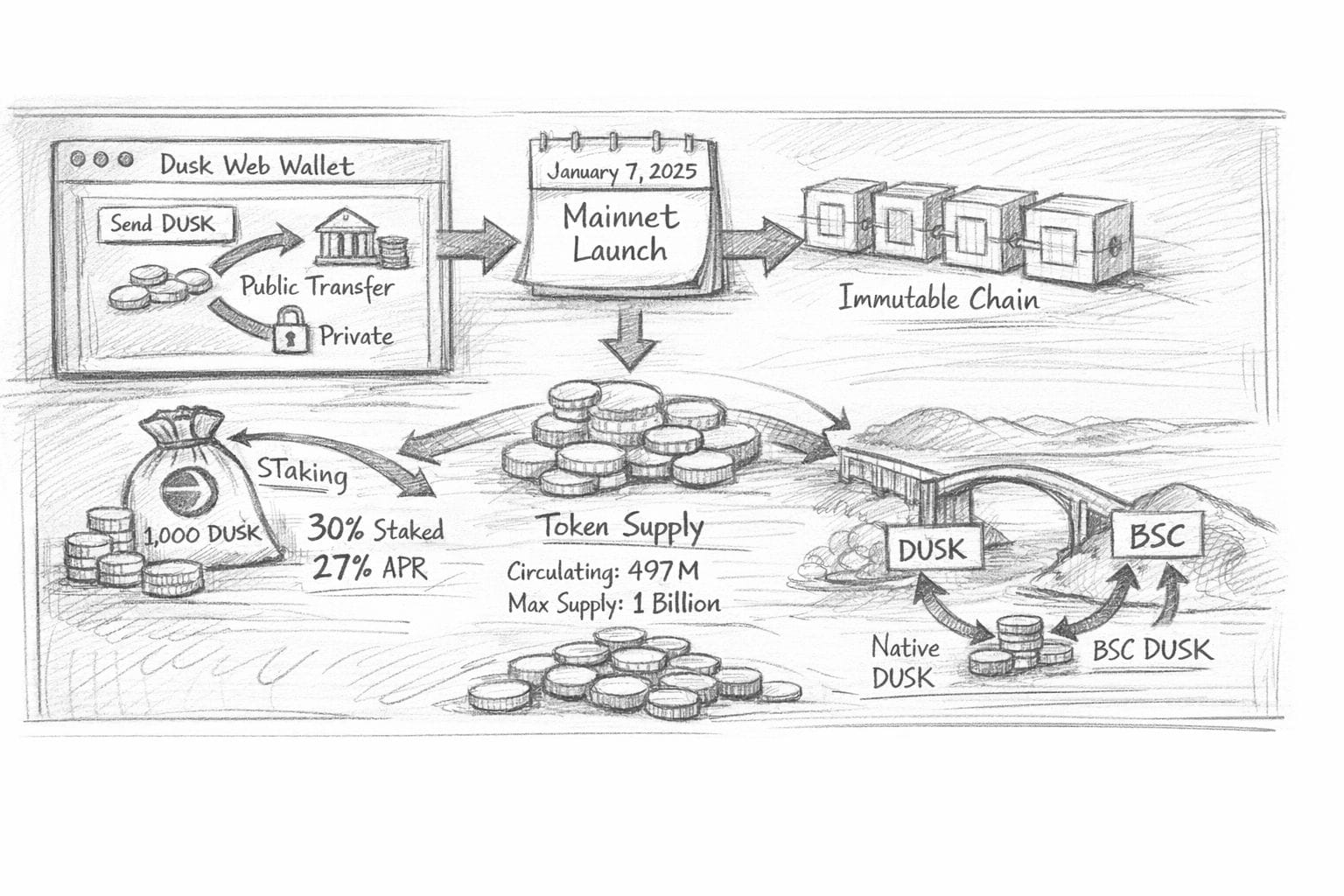
In practice, the hardest part isn’t choosing public or shielded. The hardest part is switching your mindset between them without making a mistake. People underestimate how many transfer errors come from psychology, not ignorance: you rush because the market is moving, you copy the wrong string because you’re juggling chat windows, you send from the wrong balance because you’re trying to “just get it done.” A browser wallet can’t stop you from being human, but it can be designed around the fact that humans will be human. Dusk’s documentation is explicit that you can hold funds in both forms and move between them, which matters because it turns privacy from a one-way door into something more like a dial. When privacy is reversible by choice, it’s easier to stay calm. Calm is not a vibe; it’s risk management.
There’s also a deeper story here about where computation happens. When the wallet lives in your browser, the boundary between “the chain” and “your device” becomes personal. You start to notice that security isn’t only about what validators do; it’s also about what you do at 2:00 a.m. on a laptop you don’t fully trust, on a network you didn’t configure, while your heart rate is up. Dusk has been public about shipping the wallet as a serious client, not a thin wrapper, and about iterating on it through releases and engineering cycles..
The timing matters because wallets don’t only fail in dramatic ways. They can quietly degrade—sync breaks, assumptions become outdated, and confusing screens pile up until one day the experience feels unreliable. Regular wallet releases and engineering updates might not get headlines, but they show the team takes the wallet seriously as part of the network’s day-to-day truth, not a marketing extra. If you’ve been with Dusk long enough, you’ve probably noticed how the wallet started to feel more “central” once mainnet went live. 
A wallet on a test network is a practice space; a wallet on mainnet is where consequences live. Dusk’s rollout put specific dates on that transition—onramping, genesis preparation, and the first immutable block on January 7, 2025—and those dates quietly rewired the meaning of every “send” button. After that point, the wallet isn’t helping you simulate ownership; it’s helping you survive ownership. That’s when the public-versus-shielded choice stops being philosophical and starts being situational: payroll, invoices, personal transfers, treasury movements, everything that can create conflict if it’s mishandled.
And the token is never just “a token” inside a wallet like this. DUSK is the thing you move, but it’s also the thing that disciplines the network. That discipline shows up in uncomfortable places: staking requirements, slashing rules, the reality that reliability is not free. Dusk’s docs put hard numbers on participation—like a minimum stake of 1,000 DUSK for staking on the network—and they explain that penalties exist for being offline or behaving incorrectly. That’s the economic backbone behind the calm user experience. When you’re sending a transfer during chaos, you’re relying on a crowd of operators who have something to lose if they lie or disappear. A wallet that makes you feel safe without that underlying incentive structure is just soothing UI. Dusk tries to do both: soften the experience while keeping the consequences real.
Recent network signals add weight to that story. In November 2025, the Dusk Foundation publicly stated that over 30% of the DUSK supply was staked, with a variable APR they described as around 27% at that time. I don’t read that as a promise; I read it as weather. Staking participation at that scale changes the social feeling of the chain, because it suggests a large share of holders chose long-term responsibility over short-term mobility—at least for that period. And “variable” is the important word, because it reminds you this is an economy, not an interest-rate product. Rewards breathe; risk breathes; and a good wallet doesn’t hide that, it simply helps you live with it.
Interoperability has also started to touch the wallet more directly. In May 2025, Dusk announced a two-way bridge that lets users move between native DUSK and a BSC representation, and they explicitly framed the web wallet as the place where that movement happens. That kind of update sounds external—“bridging”—but it lands internally as a cognitive load problem: more routes, more timing questions, more opportunities to send something to the right place in the wrong form. A public transfer can be the clearest move when you need compatibility. A shielded transfer can be the clearest move when you need discretion. The wallet becomes the negotiation table where those needs are reconciled, and where mistakes are most likely when you’re rushing. The fact that Dusk shipped this after mainnet had been running for months “without issues,” in their words, tells you something about sequencing: reliability first, connectivity second. 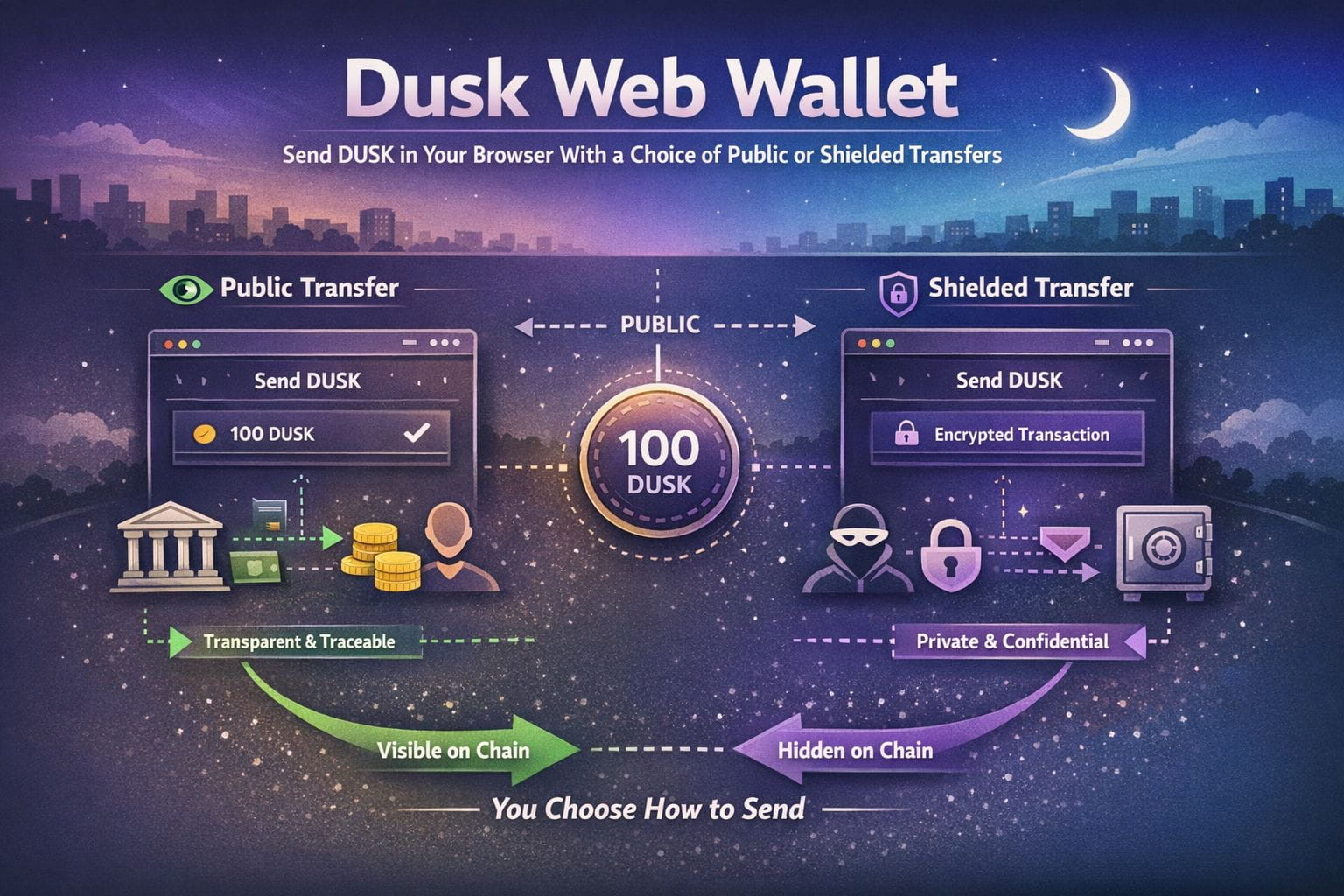
Even the raw market data has a psychological effect on how people use the wallet.
At this moment, CoinMarketCap reports DUSK at around 497 million circulating, with a max supply capped at 1 billion. The other stats—price, volume, and market cap—shift constantly because they’re real-time.
. Those numbers don’t just belong in investor threads; they shape day-to-day behavior. When people see liquidity spike, they get impulsive. When they see volume dry up, they get anxious. The wallet is where that anxiety becomes action, and action is where errors happen. A good design isn’t one that encourages activity; it’s one that helps you keep your judgment intact when the numbers are loud.
I think that’s the real point of Dusk’s web wallet: it’s not trying to make you feel powerful. It’s trying to make you feel steady. Public and shielded transfers are not “options” in a menu so much as two ways of carrying yourself through the world—sometimes you need to be legible, sometimes you need to be protected, and sometimes you need to move between those states without anyone else getting to vote.
Mainnet timelines, wallet upgrades, bridge links, staking activity, and supply facts all meet in one quiet place: the app people use. People only notice infrastructure like this when it breaks. When it works, it’s easy to miss—money sends, you see a confirmation, and you move on
Quiet responsibility is like that. It doesn’t demand attention. It earns it by being there when you need it, especially when you’re not at your best, and by making reliability feel more valuable than being seen.
