

The era of "blind transparency" has officially met its match. With the Dusk Mainnet ignition on January 7, 2026, the financial world finally has what it has been whispering about for years: a blockchain that treats privacy not as a loophole, but as a legal requirement. For a long time, the industry was stuck in a catch-22—you could have the openness of DeFi or the safety of a bank, but never both. Dusk has dismantled this dilemma by launching the first Layer-1 specifically engineered to bring €300M+ in regulated securities onto the blockchain through its partnership with the Dutch exchange NPEX.
The Technical Engine: SBA and DuskEVM
Under the hood, Dusk is a masterclass in pragmatic engineering. While most chains struggle with "probabilistic finality" (the hope that a transaction won't be reversed), Dusk uses the SBA (Segregated Byzantine Agreement) consensus. For institutions, this is the "killer feature"—it provides instant finality. Once a trade is confirmed by the network’s Provisioner nodes, it is legally and technically irreversible in under two seconds.
Furthermore, the launch of DuskEVM has bridged the gap between the familiar and the future. Developers can now deploy standard Solidity smart contracts that automatically inherit Dusk’s native zero-knowledge properties. This means a fund manager can port an existing Ethereum-based strategy over to Dusk and instantly gain institutional-grade shielding without rewriting a single line of core logic.
Infrastructure: Compliance Meets Privacy
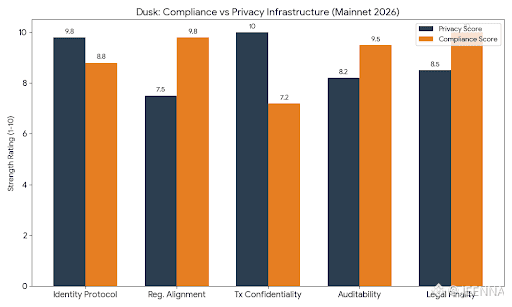
Dusk’s infrastructure is a "Dual-Core" system. While typical "privacy coins" focus on total anonymity, Dusk focuses on Confidentiality with Auditability. This is achieved through the Citadel protocol, a ZK-Identity layer that allows users to prove they are compliant (e.g., "I am an accredited investor in the EU") without actually revealing their sensitive personal data to the ledger.
This architecture is perfectly aligned with the EU’s MiCA regulation, which became fully enforceable in early 2026. By building compliance into the protocol level rather than as a secondary "patch," Dusk allows for Selective Disclosure. Regulators can verify that rules were followed, but the public cannot see your trade size, your balance, or your strategy.
Data Strategy: The Power of Minimization
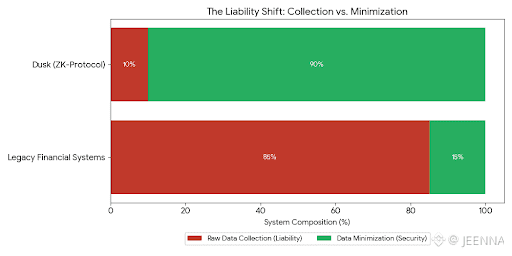
In the age of massive data breaches, Dusk treats raw data as a liability rather than an asset. Its strategy of Data Minimization is powered by Zero-Knowledge Proofs (ZKPs). Traditional financial systems operate by "Collecting" everything—IDs, bank statements, and history—which creates a massive "honeypot" for hackers.
Dusk replaces this with a Validation-without-Exposure model. The network only processes and stores the proof that data is valid. This reduces the sensitive data surface area by approximately 90%, ensuring that even if the network were transparent, there would be no raw identity data to leak. It is a "Privacy-by-Design" approach that effectively turns the blockchain into a vault where only the owner holds the keys to their information.
Staking and the $DUSK Economy
The transition to Mainnet has also activated Hyperstaking, a dynamic rewards program designed to attract long-term liquidity. With yields reaching up to 22% APY for the most committed "Visionary" stakers, $DUSK has evolved from a speculative asset into a functional piece of financial plumbing.
As we move through 2026, Dusk isn't just another "altcoin." It is the operating system for a multi-trillion dollar industry. With DuskTrade preparing to onboard its first wave of tokenized equities and bonds, the project has moved from the laboratory to the trading floor. It is no longer a question of if institutional capital will move on-chain, but how—and for those who value both their secrets and the law, Dusk is currently the only door they can walk through.
