

Most platforms are built to attract attention. Few are built to keep it. This distinction matters because attention is temporary, but habits are durable. @Vanarchain sits at a point in the market where this difference will define its future more than any technical milestone.
Crypto culture often celebrates novelty. New mechanics are treated as progress. New abstractions are framed as breakthroughs. But for users outside the crypto-native bubble, novelty often feels like risk. Every unfamiliar interaction introduces uncertainty. Every new rule creates hesitation. Over time, hesitation becomes disengagement.
Familiarity is what closes that gap.
When people interact with systems that feel familiar, they stop evaluating them consciously. Actions become automatic. Trust forms not because the system is understood deeply, but because it behaves consistently. This is how mass platforms grow. They do not ask users to think harder. They ask them to think less.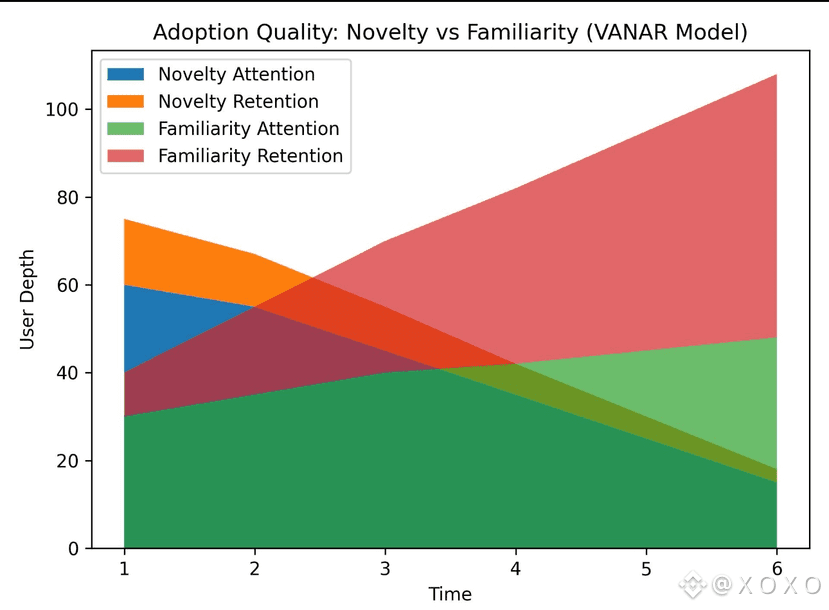
VANAR’s ecosystem ambitions place it directly in this territory. Gaming, immersive environments, and consumer-facing applications do not tolerate friction well. These users compare experiences not to other blockchains, but to polished Web2 platforms. Their baseline expectation is not decentralization. It is smoothness. If something feels slower, more confusing, or more fragile than what they already use, they leave without explanation.
This creates a silent filter. Projects that feel intuitive retain users quietly. Projects that feel impressive but unfamiliar lose them just as quietly.
What makes this challenging is that familiarity cannot be bolted on later. It has to be designed deliberately. It lives in small decisions: how errors are handled, how long actions take, how predictable costs feel, how often users are asked to make choices they do not understand. These details compound. Over time, they determine whether a system feels safe enough to rely on.
Market behavior reflects this. Ecosystems with strong retention often show slower but steadier growth. Their charts are less dramatic. Their communities are quieter. But their usage persists beyond incentive cycles. This persistence is a stronger signal than any announcement. It suggests users are staying because the system fits naturally into their behavior, not because they are being paid to tolerate it.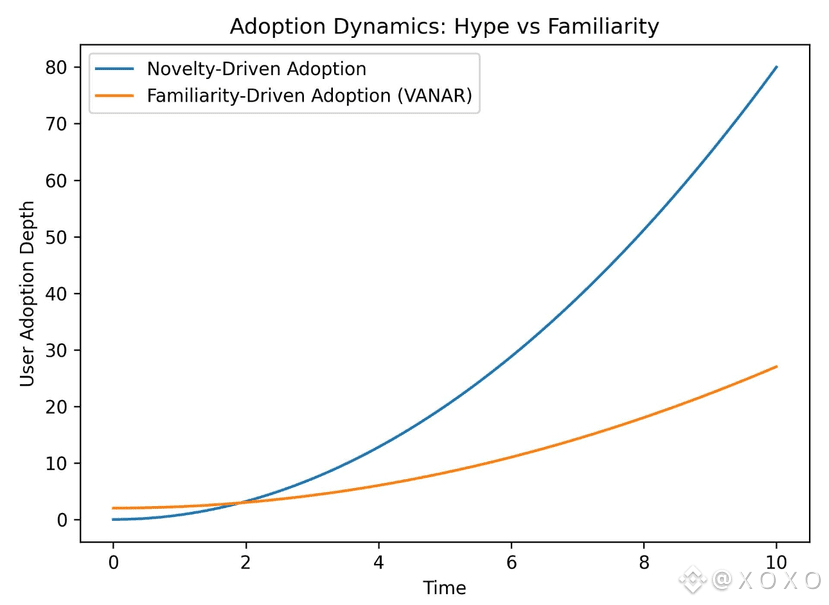
For VANAR, this implies a different definition of success. Winning does not mean being the most innovative on paper. It means becoming a place where users feel confident returning without re-learning how things work. Builders who internalize this design for clarity over cleverness. Investors who understand this watch engagement depth rather than surface metrics. Traders who understand this recognize that familiarity compounds before price does.
There is also a cultural shift implied here. Crypto has long celebrated users who master complexity. Mass adoption celebrates systems that remove it. VANAR’s positioning gives it a chance to bridge that gap if it prioritizes comfort as seriously as capability.
Mass platforms rarely announce when they win. They simply become normal.
If VANAR succeeds, it may not feel revolutionary in the moment. It may feel ordinary. That ordinariness would be its strongest signal that it is finally working.