
In crypto, performance is often framed as a numbers game.
Transactions per second. Block time. Cost per execution. The assumption is that higher throughput equals a better system.
That assumption breaks down once a blockchain is expected to operate inside regulated or institutional workflows.
For these systems, execution speed is rarely the bottleneck. Interpretation is.
Settlement Is Not the Same as Finality
Most blockchains treat settlement as a technical milestone. A transaction executes, consensus is reached, and the resulting state is considered final.
But technical finality does not guarantee defensibility.
After settlement, questions remain:
Was the action valid under applicable rules?
Did it meet eligibility or permission constraints?
Does it require monitoring, reconciliation, or governance review later?
These questions persist after a block is produced. Over time, they compound into operational cost.
Where Enforcement Happens Defines Where Cost Appears
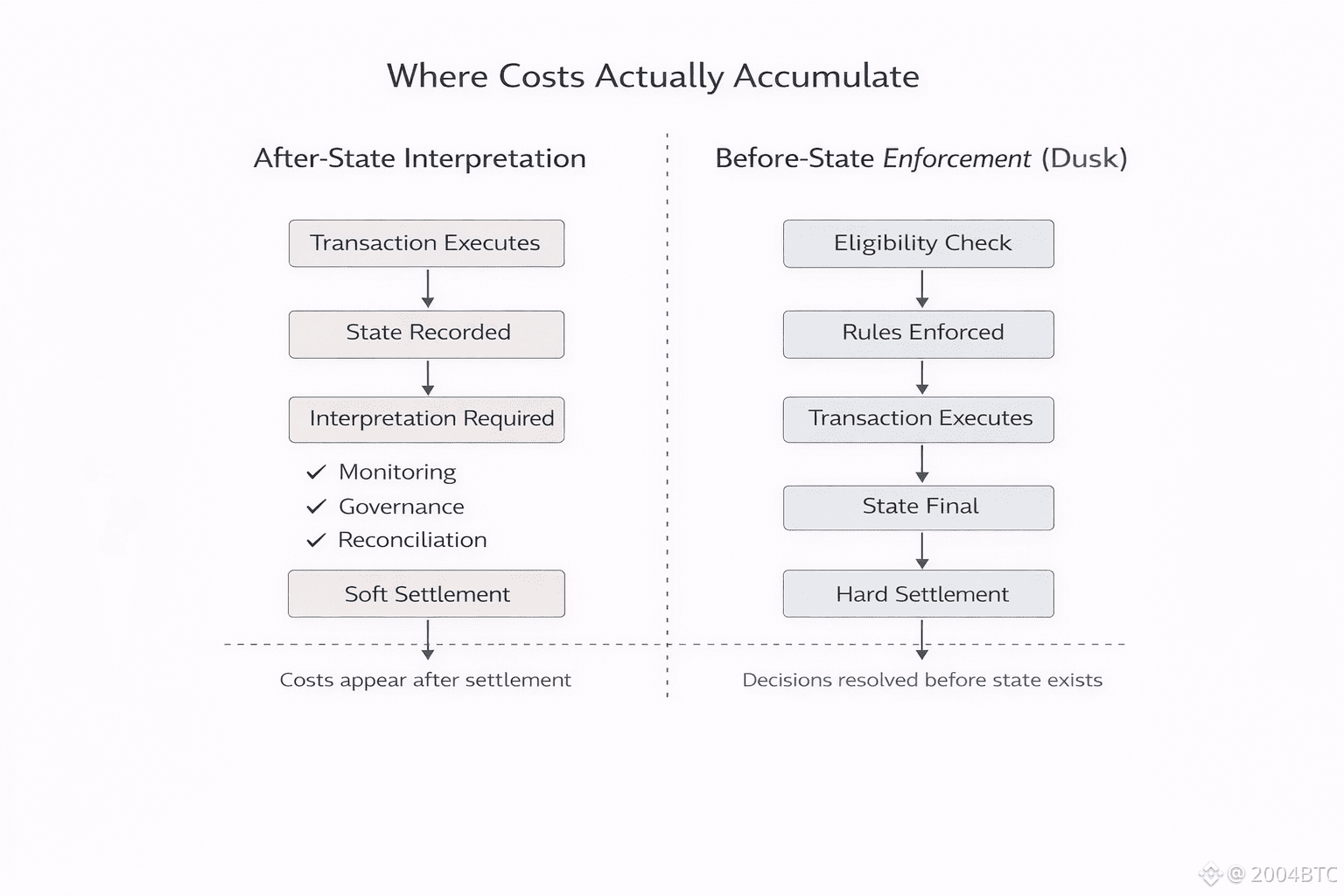
On many blockchains, enforcement happens after execution.
Transactions execute first. Rules are evaluated later. Invalid or borderline actions still enter the pipeline, leaving behind reverts, logs, partial states, and exceptions. The ledger records activity, but not clarity.
Every revert requires interpretation.
Every edge case expands audit scope.
Every exception raises governance overhead.
Throughput may increase, but decision cost rises with it.
Dusk’s Design Choice: Resolve Before State Exists
Dusk starts from a different premise:
if an action cannot be justified upfront, it should not become state.
Instead of enforcing rules after execution, Dusk enforces constraints before settlement. Eligibility, permissions, and cutoffs are evaluated first. Only actions that already satisfy protocol rules are allowed to execute and finalize.
Invalid behavior is filtered out early.
There is no revert to explain, no failed state to monitor, and no historical residue to interpret later. What reaches the ledger is already compliant by design.
This shifts cost upstream.
Rather than scaling post-transaction cleanup, the network resolves uncertainty before it propagates. The ledger stays quiet not because less is happening, but because fewer mistakes survive long enough to matter.
Throughput Optimizes Execution. Dusk Optimizes Decision Cost.
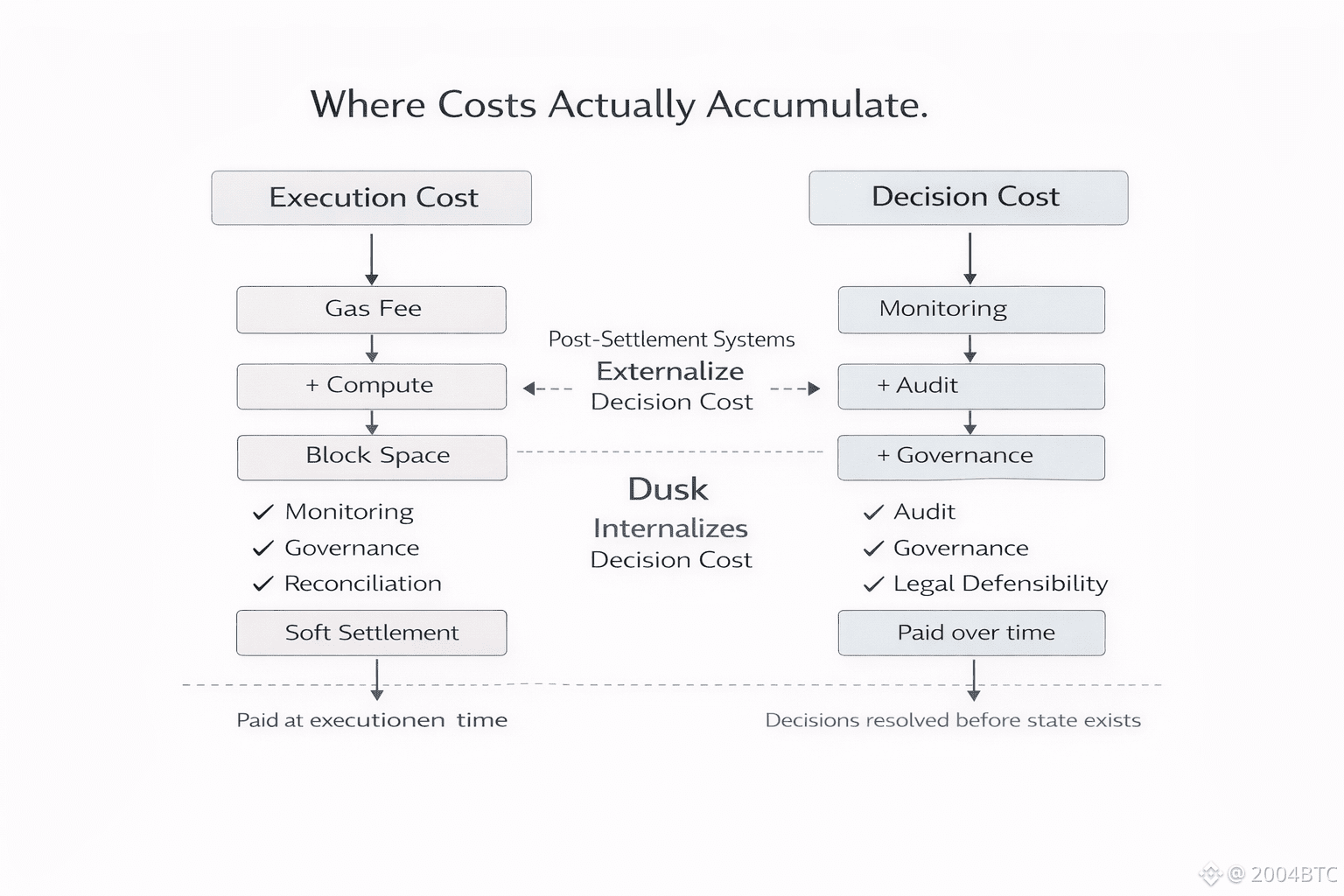
Execution cost is easy to measure.
Decision cost is not.
Decision cost appears as:
monitoring overhead
reconciliation work
governance escalation
audit complexity
legal defensibility risk
Most blockchains externalize these costs. Interpretation is treated as someone else’s problem.
Dusk internalizes them at the protocol level.
By enforcing rules before settlement, the network reduces the number of decisions humans must make afterward. Once something becomes state, the question has already been answered.
Why This Matters for Institutional Workflows
Institutions do not optimize for visible activity. They optimize for certainty over time.
Months after settlement, the relevant question is not how fast a transaction executed, but whether the outcome remains defensible without reopening assumptions.
A system that consistently produces clean state is easier to audit, easier to reason about, and cheaper to operate at scale.
This is why Dusk can appear uneventful compared to throughput-driven chains.
The network is not designed to signal activity.
It is designed to minimize future ambiguity.
The Trade-Off Is Intentional
Pre-settlement enforcement reduces flexibility and limits certain speculative behaviors. Dusk accepts these trade-offs explicitly because its target environment demands them.
For consumer crypto, noise is tolerable.
For regulated finance, it is not.
Conclusion
Throughput measures how fast a system can execute.
It does not measure how expensive execution becomes over time.
Dusk makes a different optimization choice.
By resolving enforcement before settlement, the protocol minimizes decision cost instead of externalizing it. What enters the ledger does not require reinterpretation later.
Dusk is not competing to execute more transactions.
It is competing to make fewer mistakes count.
In regulated systems, that restraint is not a limitation.
It is the objective.
