

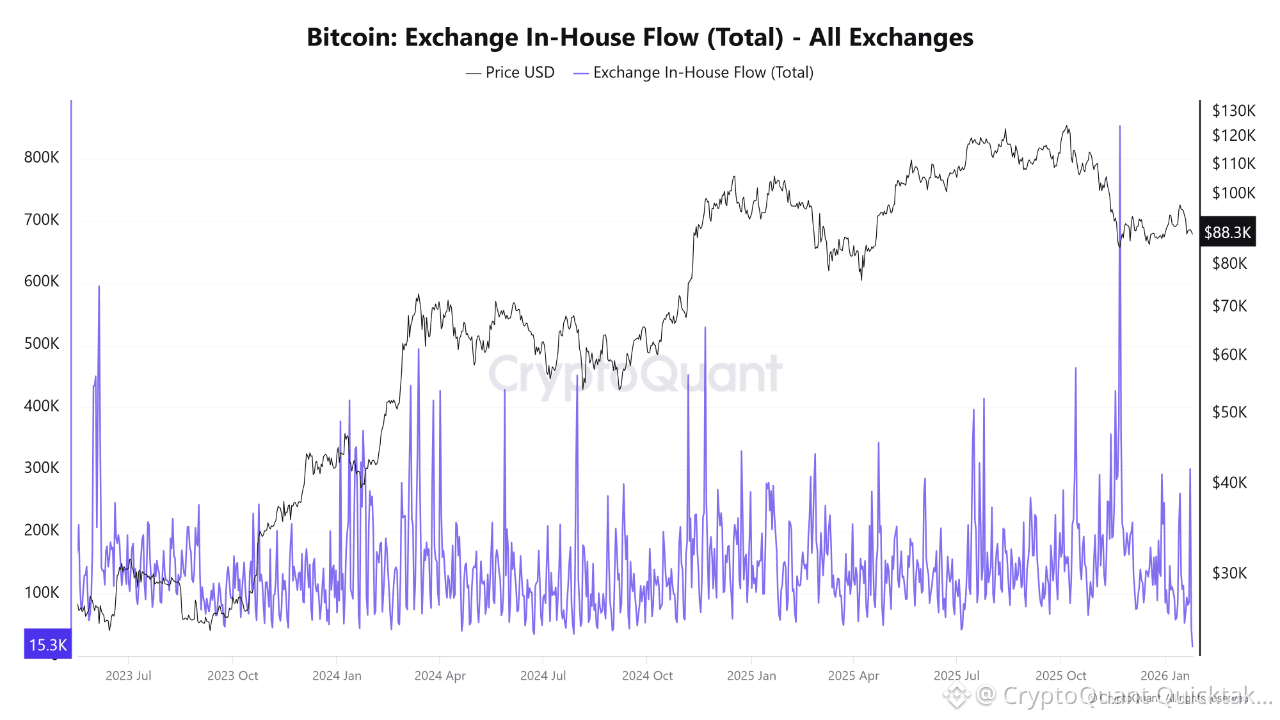
Bitcoin’s Exchange In-House Flow (Total) across all exchanges has dropped to its lowest level since 2022, reaching a record-low zone around 14K BTC. This metric tracks internal Bitcoin transfers within exchange-controlled wallets and is commonly interpreted as a proxy for operational activity and short-term distribution readiness.
A sustained decline in this indicator suggests that exchanges are moving significantly less BTC internally, reflecting reduced trading preparation, weaker market-making activity, and overall liquidity contraction.
Focusing on Binance, while Exchange In-House Flow (Binance) has not printed a new all-time low, it remains dangerously close to its historical floor at approximately 2.7K BTC. This alignment at depressed levels across both aggregate and single-exchange data reinforces the narrative of structural inactivity rather than a temporary fluctuation.
From a market dynamics perspective, low in-house flows often coincide with increased holding behavior and diminished arbitrage activity. While this can reduce immediate sell pressure, it also implies thinner order books and heightened sensitivity to external demand or macro-driven shocks.
Overall, the current configuration points to a “liquidity pause” phase in Bitcoin’s market structure. Historically, such periods tend to precede sharp directional moves once capital rotation and exchange activity begin to normalize, making this metric critical to monitor in the coming weeks.
Written by CryptoOnchain
