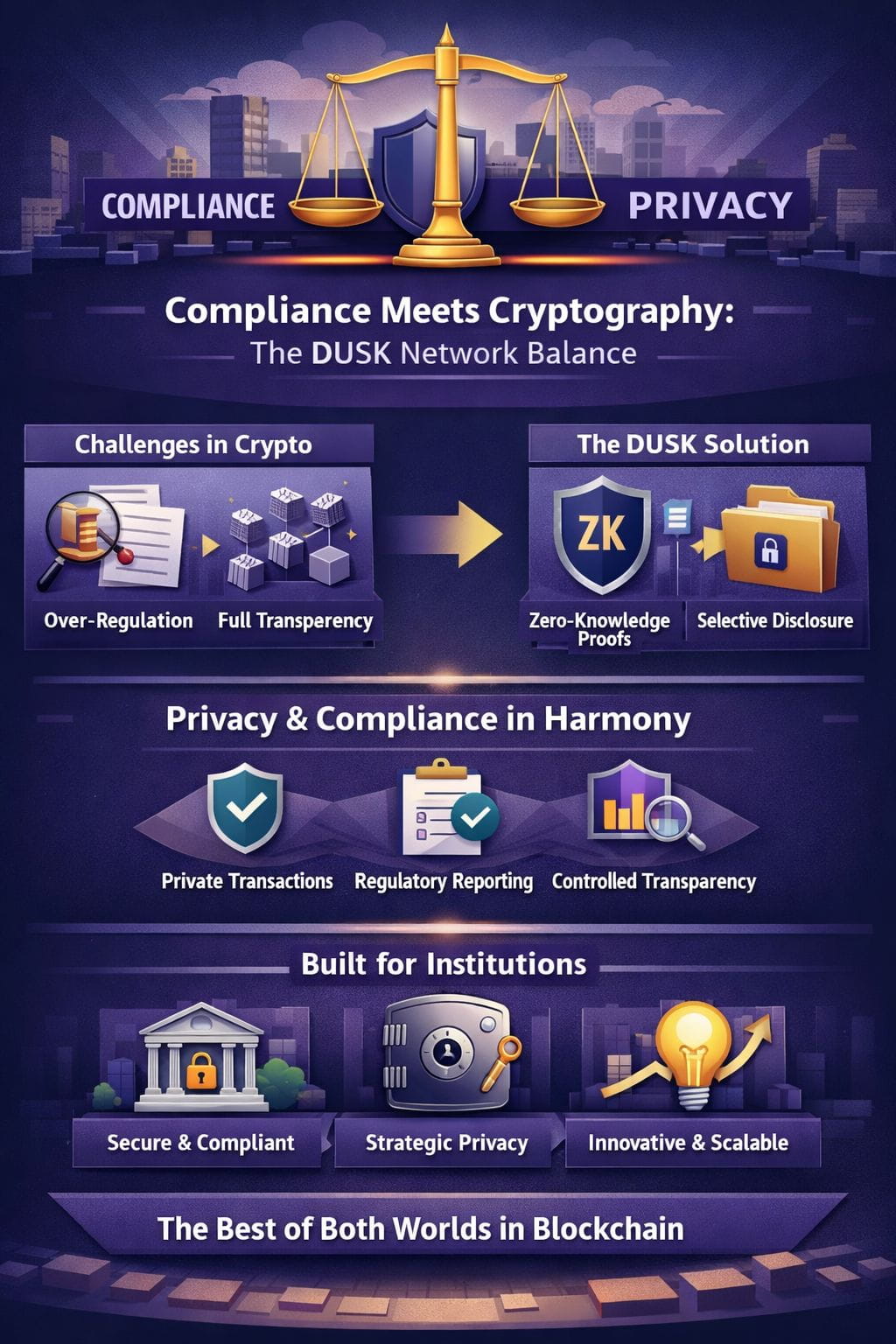
In crypto land, they like to set up compliance and cryptography as natural enemies. Cryptography brings privacy, secrecy, a feel of decentralization. Compliance brings oversight, rules, and regulation. Most projects choose one, paying for it with the loss of the other: privacy without watchdogs, or regulation without genuine confidentiality.
DUSK Network takes a different direction. It demonstrates that cryptography and compliance can indeed coexist without feeling at odds with one another. By integrating cutting-edge privacy methods into a structure that remains in step with regulatory standards, DUSK arrives at a fragile balance: transactions can be secure, private, and completely compliant.
The Challenge: Privacy vs Regulation
Yet many blockchains can’t seem to make up their minds on a different aspect of performance-privacy. By clamoring for privacy, they curtail institutional use. Banks, enterprises, and regulated entities can’t rely on systems where internal financial activity is entirely public or entirely hidden.
On the other hand, fully transparent chains compromise confidentiality; every ounce of sensitive strategy and day-to-day decision is shown to the competitor or even to market players.
DUSK realizes that real-world finance requires both privacy and visibility, but in the right amounts. It is this balance that separates infrastructure built for enduring use from hype that will be gone in a flash.
How DUSK Uses Cryptography to Enable Compliance
The answer lies in cryptography, more precisely in the techniques aimed at preserving privacy, such as zero-knowledge proof. They allow DUSK to:
- The ability to validate the transactions while not leaking sensitive information.
- Datasheet that demonstrates regulatory compliance without full exposure of the financial data
- Be transparent in areas where it is required, but keep strategic information to yourself
This is where DUSK helps them get through regulatory demands without having to give away strategic privacy, something which very few blockchains are able to do.
Strategy of Protection while Gaining Trust
In finance, however, visibility can cut both ways. On public chains, treasury movements, allocations, and internal decisions can be laid bare, inviting front-running, strategic disadvantages, or misreadings of routine operations.
DUSK's privacy-first design smooths these risks. It allows for:
Selective disclosure of transaction information
Internal decision-making process protection - Reassurance to stakeholders and regulators at the same time It's in this way that DUSK builds trust without gratuitous exposure, a combination rarely found within the blockchain space.
Why This Matters for Institutional Adoption
Institutions prioritize risk management over glitzy promises. For them:
Consistency beats a burst of throughput
Privacy is important for strategy and competition
Meet the rules and oversight
DUSK is significant because it combines these three factors effectively. In combining the three, the system has successfully brought together the aspects of real-world practicability that make the system believable for the corporate sphere.
Innovation Through Privacy
This is to say that privacy by default is an open invitation to careful experimentation. Where not all transactions are immediately transparent, we can:
Try new approaches without immediate public exposure
Scale innovations step by step
Learn from operations safely
This is important because it gives $DUSK room to innovate without bearing any penalty of visibility.
The Subtle Power of a Balanced Design
The uncommon balance of DUSK is not about the latest whiz-bang tech. It is about solid design that institutions can count on.
DUSK, through combining cryptographic privacy and the demands of regulations, demonstrates the following fundamental concept: Blockchain-based systems provide not just trust but privacy.
That’s the beauty of DUSK: it’s a template for the future online in terms of both privacy and regulatory standards.
Conclusion
In many cases, the forces of compliance and cryptography are at odds within blockchain technology, or so it would appear. Not in the case of the DUSK Network, however, as they have leveraged their advances in cryptography to attain a rare equilibrium in blockchain technology, centered upon compliance in a transparent manner. Such balance, however, goes beyond mere polish; it is a matter of strategic foresight that allows institutions to operate with confidence, to instil trust in the regulatory process, and a network that can innovate responsibly. DUSK thrives in an environment in which privacy-conscious regulations can slow down concerted rollout.