
Most crypto payment systems look simple on the surface but behave very differently once real usage begins. At low volume everything appears smooth. Transfers go through dashboards look clean and confirmations arrive fast enough. The problem starts when volume increases or when real value is involved. Salaries merchant settlements treasury movements and cross border payments introduce a different level of responsibility. At that point speed alone stops being the main concern. What matters is whether the system knows exactly when a payment is finished and whether that decision is final.
Many chains still treat payments like just another transaction type. They are processed in the same environment as speculative trades NFTs governance actions and experimental apps. This creates competition for block space and attention. When activity spikes simple payments slow down. Fees become unpredictable. Confirmations arrive but users still wait because the system itself is unsure. Businesses build extra logic on top. They wait for more blocks. They add retries. They add manual review. The chain moves fast but the payment feels slow.
This behavior creates a subtle but expensive problem. Responsibility is decided after execution instead of before. The system allows a payment to move forward without first knowing if it can confidently complete. Once the transfer is visible everyone assumes it worked but internally the system is still negotiating its state. That gap between visible action and actual finality is where confusion grows. Users think they are paid. Merchants hesitate to release goods. Support teams get involved. Trust erodes quietly.
Plasma approaches this problem from a different direction. Instead of asking how fast a transaction can be processed it asks when a payment should be allowed to exist at all. The system is designed so that rules are enforced before value moves meaning execution only happens once the outcome is already determined. This changes the mental model for both users and developers. A payment is not a promise that might settle later. It is an action that already knows how it ends.
In Plasma the execution layer is optimized for stablecoin movement under real conditions. High activity does not change the rules of completion. The system does not allow a payment to drift into an undefined state. Once initiated the transaction moves through a controlled path where checks are applied immediately. There is no secondary waiting phase where users guess whether confirmation means safety. Confirmation and finality are aligned by design.
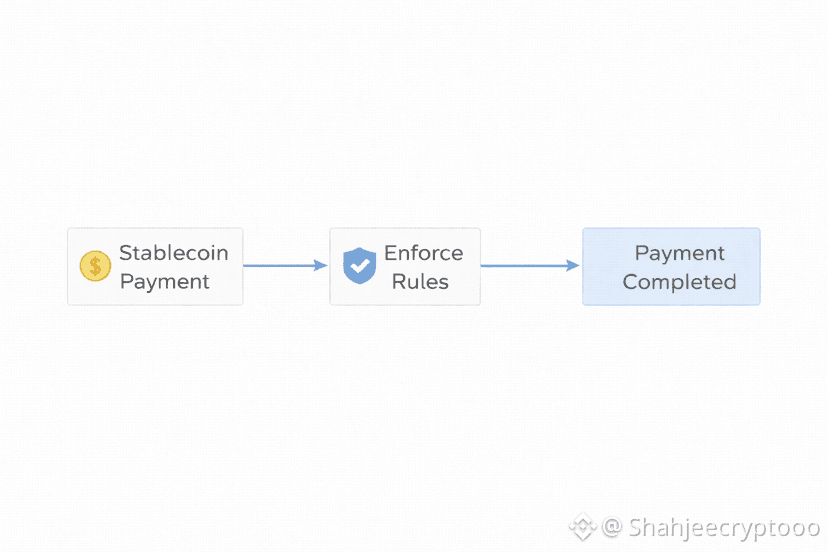
This design reduces complexity downstream in ways that are not obvious at first glance. Developers do not need to recreate safety logic in every application. They do not need to build buffer periods or wait strategies. The protocol itself guarantees that once a payment is visible it is already resolved. That allows applications to stay simple. Less code means fewer bugs. Fewer assumptions mean fewer edge cases under stress.
For users this clarity changes behavior. When people learn that confirmation always means completion they stop checking explorers and refreshing dashboards. They trust the system because it behaves consistently. Over time this builds a calm user experience where payments feel boring in the best possible way. Calm systems are trusted systems. Trusted systems scale naturally.
The difference becomes even clearer when comparing how delayed decisions affect operations. In traditional setups operations teams absorb the uncertainty. They monitor transactions that appear complete but are not final. They build runbooks to handle exceptions. They carry the risk that the system refuses to clearly assign. Plasma reduces this burden by pushing responsibility to the earliest possible stage. If a payment cannot be completed cleanly it does not enter the system. This protects everyone downstream.
Businesses benefit from this structure because settlement becomes predictable. Accounting teams know exactly when revenue is real. Merchants know when to release goods. Treasury systems can automate flows without fear of rollback or dispute. This predictability is what allows systems to move from experimental usage to core financial infrastructure.
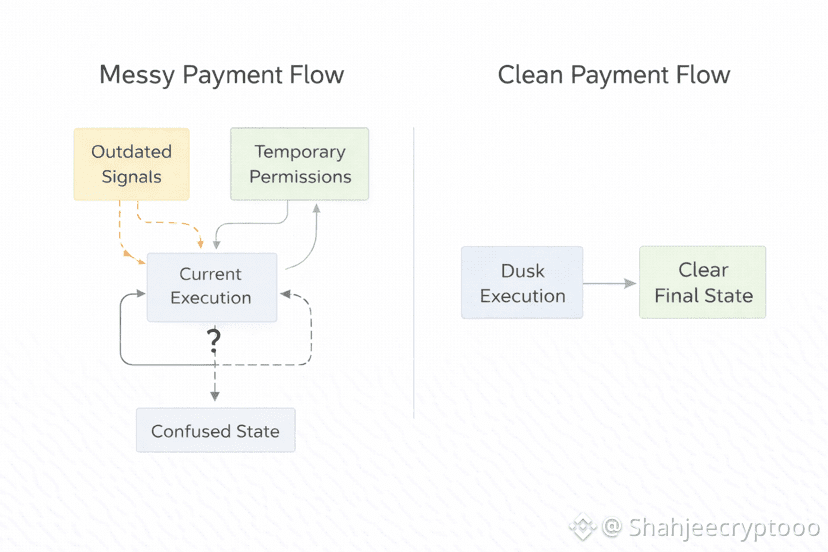
Another important effect of early decision making is how systems evolve. When rules are clear teams can change behavior safely. They know what boundaries exist. They know which assumptions are enforced by the protocol. Innovation becomes controlled instead of risky. In contrast systems with late responsibility often fear updates because small changes might break hidden dependencies.
Over time markets reward platforms that minimize cognitive load. Users choose systems that do not force them to think about edge cases. Developers choose platforms that remove the need for defensive design. Plasma aligns with this reality by treating payments not as flexible experiments but as definitive state transitions. Money either moves completely or it does not move at all.
This approach does not remove flexibility. It removes ambiguity. Flexibility without clarity creates debt. Clarity creates freedom. When outcomes are enforced early everyone involved can move faster without fear. Payments become infrastructure instead of speculation. That shift is what allows crypto systems to support real economic activity at scale.
Plasma is built for that transition. It is not trying to host everything. It is focused on making stablecoin settlement behave like real money movement should. Clear entry rules. Immediate execution. Unambiguous completion. When payments stop wandering and finally know where they end trust becomes a property of the system not a promise from applications.

