

The daily stream of financial news can feel overwhelming. Headlines warn of escalating geopolitical tensions, ballooning government deficits, and an imminent debt crisis that threatens to destabilize the global economy. For the average investor, it’s a constant barrage of information that makes it difficult to distinguish between genuine risk and manufactured fear.
To break through this fog, we turn to the incisive analysis of market strategist José Luis Cava. He argues that the market's most discussed threats are often elaborate distractions, while the truly significant risks and opportunities lie hidden in plain sight. Here are four truths that challenge the prevailing fear-based narratives.
----------------------------------------------------------------------
1. The U.S. Debt "Crisis" Is an Overblown Fear Narrative
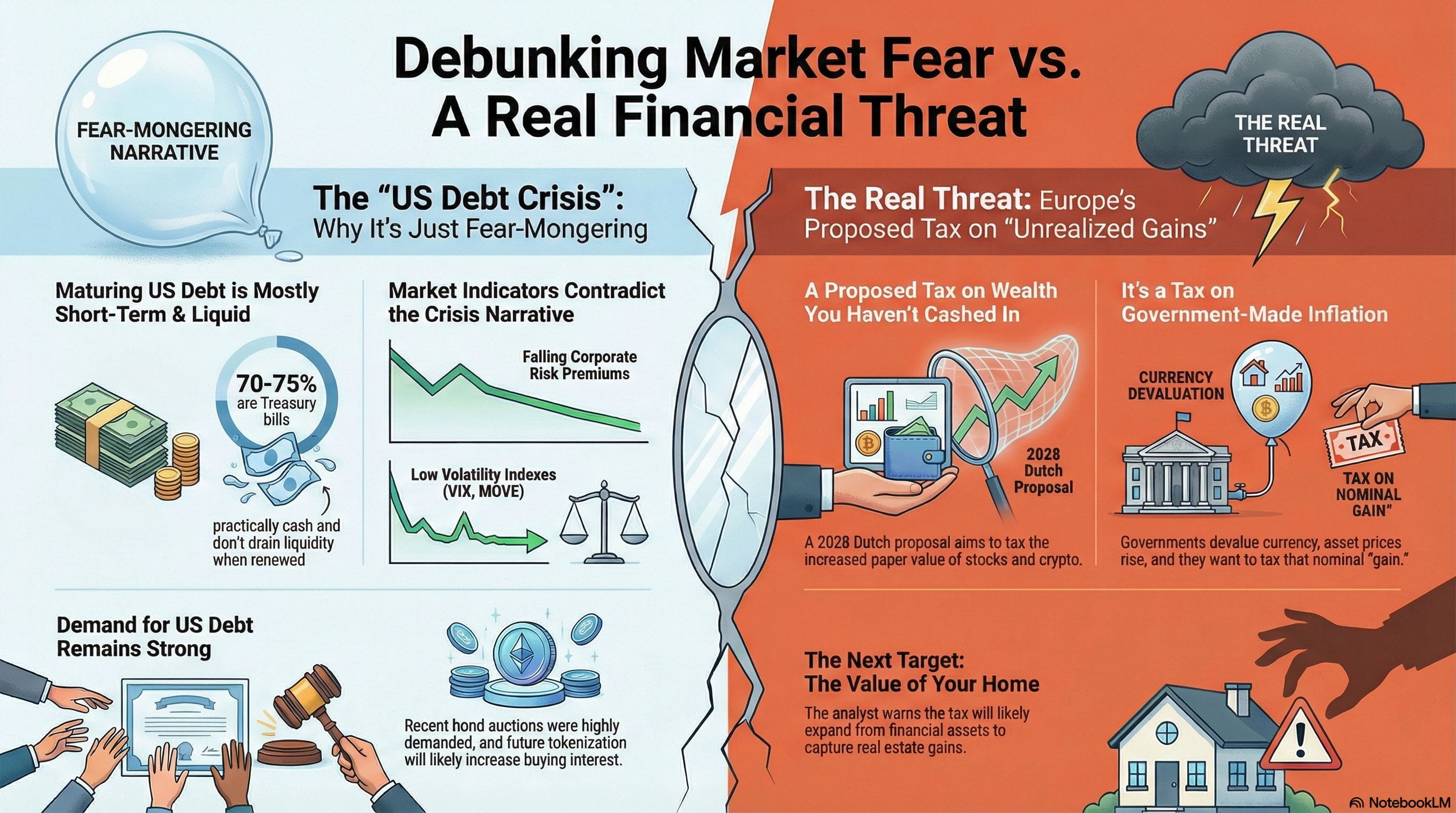
A pervasive narrative, particularly on social media, insists the U.S. is on the brink of a public debt crisis. The central question posed is: "Who will be left to buy all this debt?" The analysis, however, doesn't stand up to scrutiny.
A significant portion—approximately 70-75%—of the maturing U.S. debt consists of very short-term Treasury bills (T-bills), with maturities around 180 days. Renewing debt with T-bills is the least damaging form of financing because these instruments are highly liquid and function almost like cash. Commercial banks can use them as high-quality collateral to get liquidity from the Federal Reserve, ensuring the debt renewal process doesn't drain capital from the financial system.
Furthermore, key market indicators do not support the crisis narrative. Risk premiums on corporate bonds are trending downwards, signaling confidence, not fear. Volatility indexes that measure market stress, such as the VIX and MOVE indexes, have retreated from their recent highs. Demand for U.S. debt remains strong, evidenced by a successful recent 20-year bond auction, and the future potential of debt tokenization is poised to further increase accessibility and demand.
While the market easily shrugs off these phantom debt fears, it also shows a remarkable ability to see through more dramatic, headline-grabbing political theater.
2. Much Geopolitical Drama Is Just Predictable Market Theater
The recent tensions between the U.S. and Denmark over Greenland provide a perfect case study in how geopolitical drama is often a political tool that creates temporary, but ultimately meaningless, market noise.
This situation followed a predictable playbook, which Cava calls the "Operación Taco" (Taco Operation). A leader initiates a loud, public confrontation, causing markets to dip temporarily on the "noise" and fear. Behind the scenes, concessions are made. Once an agreement is reached, the market forgets the drama and resumes its underlying trend. In the case of Greenland, the underlying economic fundamentals were actually bullish, pointing toward increased investment in infrastructure and the exploitation of valuable rare earth minerals.
For astute investors, the takeaway is clear: this type of political theater is a recurring pattern, not a fundamental threat. The ability to distinguish the performance from the underlying economic reality is a critical edge.
3. The Real Threat Is a "Backdoor" Tax on Inflation Itself
While the debt crisis may be a phantom menace, a far more significant and "wicked" threat is emerging from a policy proposal in the Netherlands. The plan, scheduled for 2028, is to introduce a tax on unrealized gains.
The core problem with this tax is that it represents a cynical policy loop, allowing governments to profit from the very monetary debasement they create. It is, in effect, a direct tax on the consequences of its own monetary policy.
"Look at the idea: they debase the currency, they deteriorate the currency, and on top of that, they want to make us pay taxes on the monetary debasement they themselves cause."
The strategy is a "backdoor" approach. It begins by targeting assets most people don't own (like crypto and financial instruments) to gain public acceptance. The eventual target, however, is the unrealized gain on primary residences—wealth that has increased not in real value, but because the currency's purchasing power has fallen. Most critically, the policy is asymmetrical: while unrealized gains are taxed, unrealized losses are not refunded. Instead, they can only be carried forward to offset future gains, ensuring the government shares in the upside but not the downside.
4. The One Metric to Watch: Global Liquidity
Despite all the competing narratives, geopolitical noise, and policy threats, one factor stands above the rest in determining the market's direction: the state of global liquidity.
As long as global liquidity is expanding and financial conditions remain favorable, the bias for the market remains bullish. Attempting to be bearish in such an environment is like fighting the most powerful current in the market. This single principle explains why the market can so easily absorb the debt rollover (Point 1) and look past geopolitical posturing (Point 2). As long as the system is flush with capital, the default bias is upward. It also puts the threat of the unrealized gains tax (Point 3) into sharper focus, as it represents a direct attempt to siphon off this liquidity-driven asset appreciation.
----------------------------------------------------------------------
Conclusion: Are You Asking the Right Questions?
The ultimate lesson is not just about a single debt auction or geopolitical spat; it's about shifting your entire framework of analysis. Instead of reacting to headlines designed to provoke fear, start by asking where the liquidity is flowing. Instead of worrying about manufactured crises, watch for subtle but profound policy shifts that redefine the rules of wealth itself.
This leads to a final, critical question. In a world where governments can tax inflation and AI may soon redefine work, where do you believe the real opportunities for wealth creation will come from next?