
Privacy on blockchains is often misunderstood as an all-or-nothing choice. Either everything is public, or everything is hidden. @Dusk takes a more nuanced approach with Dusk Network by introducing selective disclosure—a model designed for environments where confidentiality and accountability must coexist.
Moving Beyond Full Anonymity
Many privacy-focused blockchains are optimized for complete transaction obfuscation. While this works well for peer-to-peer transfers, it creates friction for regulated use cases where audits, reporting, or legal verification are required. Dusk Network approaches privacy not as a tool to avoid oversight, but as a way to control who can see what, and when.
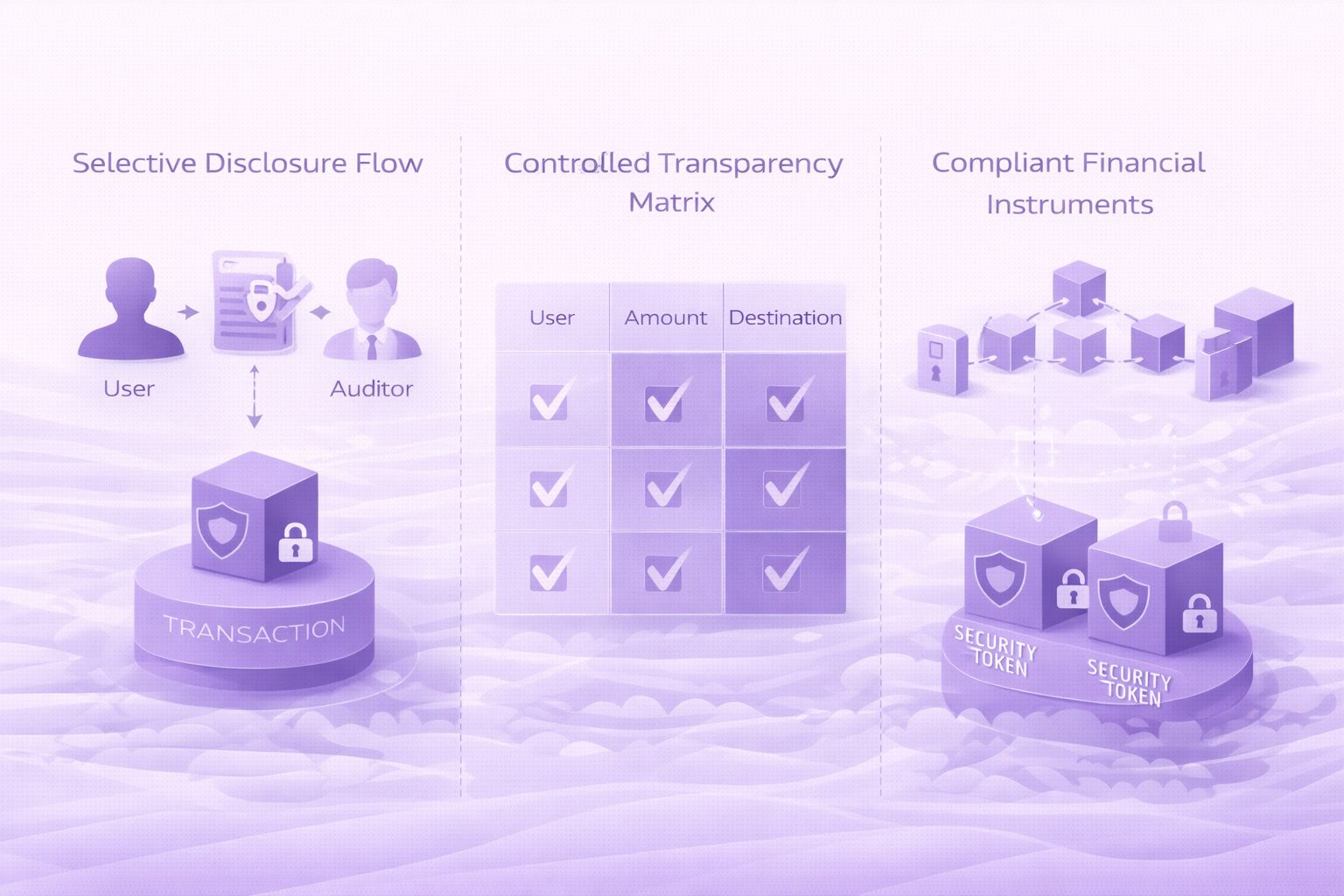
Selective disclosure allows sensitive transaction data to remain confidential by default, while still enabling authorized parties to verify specific details when required.
How Selective Disclosure Works in Practice
On Dusk Network, privacy is embedded at the protocol level rather than added as an optional feature. Transactions can be structured so that relevant information—such as ownership, compliance status, or settlement validity—can be revealed selectively without exposing full transaction histories.
This makes it possible for institutions to meet regulatory obligations without sacrificing data protection or operational confidentiality.
Privacy Designed for Regulated Finance
Selective disclosure is especially relevant for regulated financial instruments, including tokenized securities and compliant digital assets. These use cases demand confidentiality between counterparties, but also require the ability to demonstrate compliance to regulators or auditors.
By supporting this dual requirement, Dusk Network positions itself as infrastructure for real-world financial activity, not just experimental privacy use cases.
The Role of $DUSK in Enabling Trust
The $DUSK token supports this model by aligning validator participation, governance, and network security. Validators staking $DUSK are incentivized to uphold protocol rules that enforce privacy guarantees while maintaining verifiable execution. This economic alignment ensures that selective disclosure is not only a technical feature, but a trust-backed system behavior.
A Practical Definition of Privacy
Rather than treating privacy as invisibility, Dusk Network treats it as controlled transparency. Users and institutions decide how much information is shared, with whom, and under what conditions. This flexibility makes privacy usable in environments where legal clarity and accountability matter.
With #Dusk, privacy evolves from a binary concept into a practical framework—one that supports confidentiality without breaking trust or compliance.
