
Introduction: Why Traditional Compliance Is Broken
In modern finance and blockchain systems, compliance is unavoidable. Platforms must verify users through KYC and AML processes before allowing access to regulated services. But traditional compliance models rely heavily on centralized databases where sensitive user information is stored.
This outdated approach creates serious problems:
Massive data silos filled with personal information
High cybersecurity risks and breach exposure
Repetitive identity submissions across multiple platforms
Loss of user privacy and control
Through the vision shown in the images — Selective Disclosure, Self-Sovereign Identity, and Zero-Knowledge Proofs — the ecosystem powered by @DuskFoundation, $DUSK, and Citadel proposes a new system: prove eligibility without exposing identity.
Selective Disclosure: Proving Compliance Without Revealing Identity
Selective disclosure allows users to demonstrate compliance status without sharing sensitive personal data.
Instead of giving full identity documents every time, users generate cryptographic proofs that confirm:
KYC passed
AML cleared
Residency verified
Accreditation status approved
With $DUSK infrastructure, regulated applications receive confirmation that requirements are met — but never see the actual personal information.
This reduces risk while maintaining regulatory trust.
Self-Sovereign Identity with Citadel
At the core of this system is Citadel, a self-sovereign identity framework integrated into the #Dusk ecosystem.
Traditional Identity Systems
Organizations store user data separately.
Users repeat verification processes constantly.
Personal information is scattered across multiple databases.
Citadel’s SSI Approach
Users control their identity credentials.
Verification happens once and is reusable.
Data remains private and locally controlled.
By combining SSI with $DUSK blockchain infrastructure, identity becomes portable, secure, and privacy-preserving.
Identity Without Data Hoarding: Ending Compliance Data Silos
The second image compares traditional compliance systems with the Dusk + Citadel approach.
Traditional Compliance Model
Multiple organizations store identical personal data.
Creates vulnerable centralized data silos.
Expensive infrastructure and compliance costs.
Increased risk of large-scale breaches.
Dusk + Citadel Model
Uses decentralized architecture powered by #Dusk.
Replaces raw data sharing with cryptographic zk-proofs.
Eliminates unnecessary data storage.
Improves scalability and institutional adoption.
Instead of moving personal information around, the system moves mathematical proof.
Zero-Knowledge Proofs: The Core Technology of $DUSK Compliance
Zero-Knowledge (zk) cryptography is essential to how @DuskFoundation solves regulatory challenges.
With zk-proofs users can:
Prove age eligibility without revealing birthdate
Verify residency without sharing address
Confirm accreditation without exposing financial data
This allows regulated applications to remain compliant while respecting user privacy — a key requirement for institutional adoption.
Benefits for Institutions Using #Dusk Infrastructure
For Users
Full control over personal identity data
Privacy-first compliance
Faster onboarding across regulated platforms
Reduced risk of identity theft
For Institutions
Lower compliance costs
Minimal data storage liability
Stronger cybersecurity posture
Easier regulatory integration
Through $DUSK, compliance becomes efficient rather than invasive.
Why This Matters for Institutional Blockchain Adoption
Most public blockchains focus on transparency and decentralization but struggle with real-world compliance requirements.
The #Dusk ecosystem, supported by @DuskFoundation and identity solutions like Citadel, bridges the gap between:
Privacy-focused decentralized finance
Regulation-driven traditional institutions
By enabling privacy-preserving compliance, #DUSK 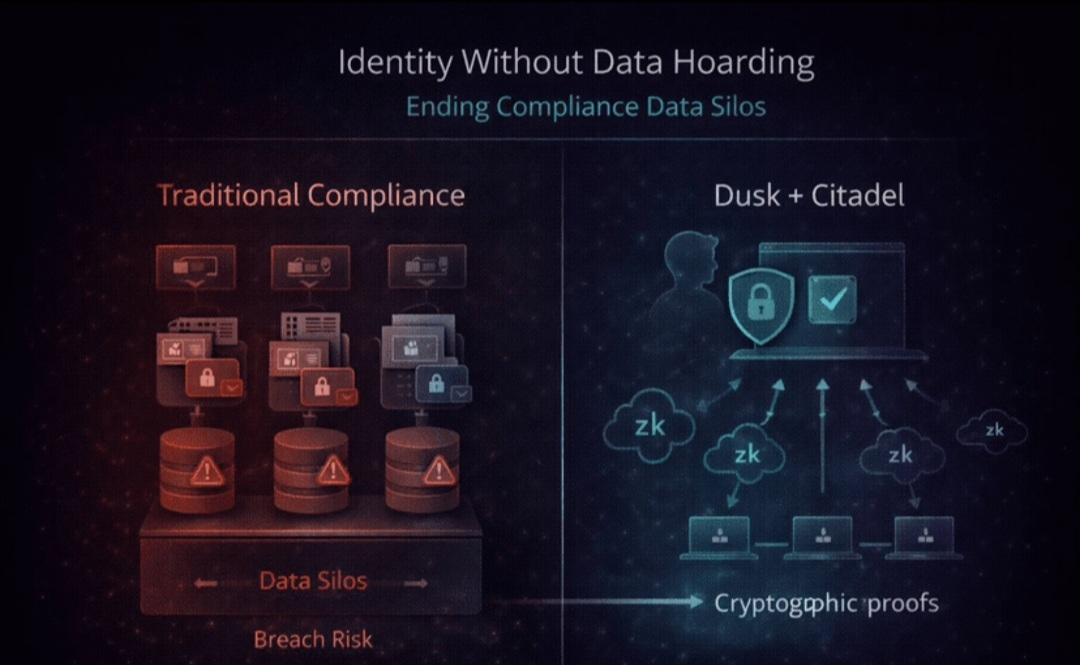 creates infrastructure suitable for tokenized securities, regulated finance, and enterprise blockchain applications.
Conclusion: The Future of Privacy-Preserving Compliance with DUSK
Selective disclosure and self-sovereign identity represent the next evolution in digital compliance. Rather than forcing users to expose sensitive personal information, systems built on #Dusk allow individuals to prove eligibility using secure cryptographic proofs.
With @DuskFoundation, $DUSK, and Citadel, the future of identity is:
Privacy-first
Secure by design
Institution-ready
Scalable for global adoption
As blockchain technology moves toward mainstream finance, solutions that combine compliance with privacy — like those built within the #Dusk ecosystem — will define the next generation of digital trust infrastructure.
