
Between January 30 and February 1, 2026, the cryptocurrency market experienced a sharp decline, with billions of dollars wiped off its market capitalization due to rapid liquidations.
Bitcoin briefly fell below $75,000, its lowest level since April 2025, while Ethereum dropped below $2,300. Although several macroeconomic and political developments contributed to the market's fragile state, the depth and speed of the decline were primarily caused by the mechanical unwinding of excessive leveraged long positions during the low trading volume of the weekend.
CoinGlass liquidation data reveals that the primary driver of the decline was forced closures of long positions rather than voluntary selling. In the key snapshot, long liquidations significantly outweighed short liquidations. Despite the price drop, short sellers were largely unaffected.
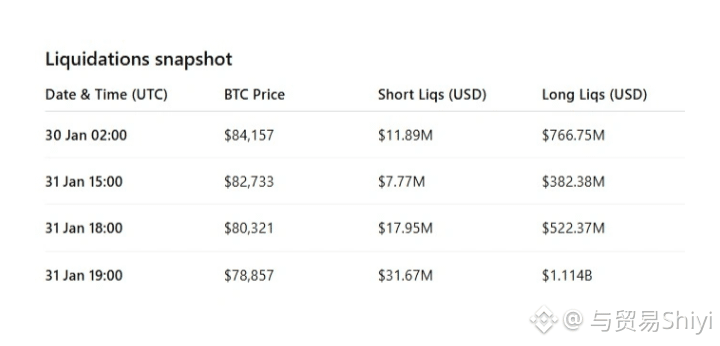
This surge, from approximately $380 million to $520 million to $1.1 billion, demonstrates that forced selling accelerated as prices reached new lows. The concentration of flow on Binance and Hyperliquid coincides with the unwinding of momentum-style leverage. This pattern points to a mechanical reset rather than a large investor exit.
Most of the unwinding occurred over the weekend, when crypto trades without the counterbalance of other major risk markets. Liquidity is thinner, order books are less robust, and even small selling can create air pockets that accelerate forced liquidations.
With fewer market makers active, the feedback loop between falling prices and liquidation algorithms intensified, compressing the adjustment into a shorter window.
Macro conditions did not cause the liquidation cascade, but they created pressure points that made the market more vulnerable. Uncertainty increased after US President Donald Trump nominated Kevin Warsh as the next Federal Reserve Chair, and geopolitical tensions between the US and Iran added another layer of stress.
Simultaneously, US domestic politics introduced new risks, including the possibility of a government shutdown and a $10 billion lawsuit filed by President Trump against the IRS and the Treasury.
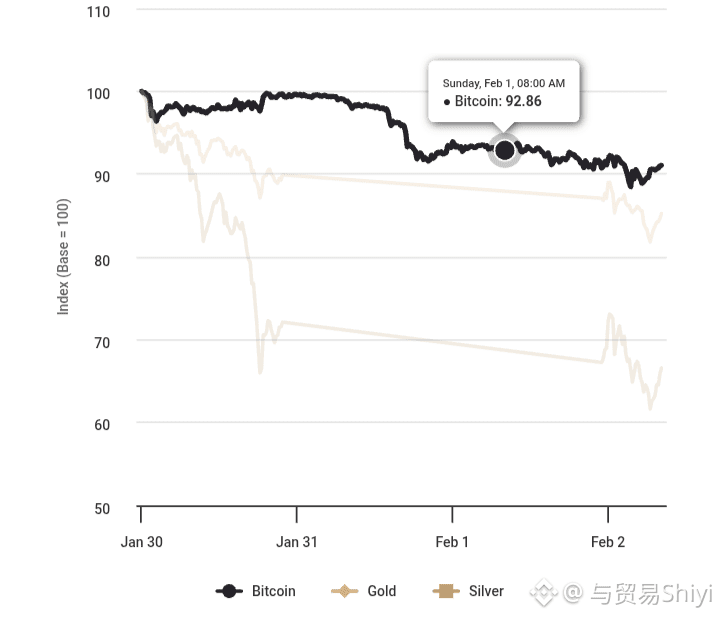
Market volatility followed a familiar pattern over the weekend. On Friday, silver saw the sharpest decline, followed by gold, as macro risks first manifested in commodities. Bitcoin held up better during market hours. Over the weekend, while metals markets were closed, Bitcoin continued to adjust, aligning itself with the ongoing macro impulses.
By Monday, when commodities reopened, the price movements of Bitcoin, gold, and silver had converged. This convergence, rather than divergent declines, suggests alignment with shared macro conditions.
The market entered the weekend with a lopsided concentration of long positions. Over 90-95% of liquidations were long positions, reflecting expectations of continued upward momentum. As these positions were liquidated, investors with large balance sheets took the other side of the trade. According to CoinMetrics data, addresses holding more than 10,000 BTC accumulated an additional 14,921 Bitcoin during the dip, while addresses holding more than 100,000 BTC accumulated 6,039 Bitcoin.
Later on Monday morning, the liquidation pressure appeared to subside, and assets began to move in tandem again. This event illustrates a leverage-driven reset that coincided with a macro-vulnerable moment, exacerbated by weekend illiquidity.
Whether this is a turning point or simply a clearing event will depend on how macro conditions evolve from here.

