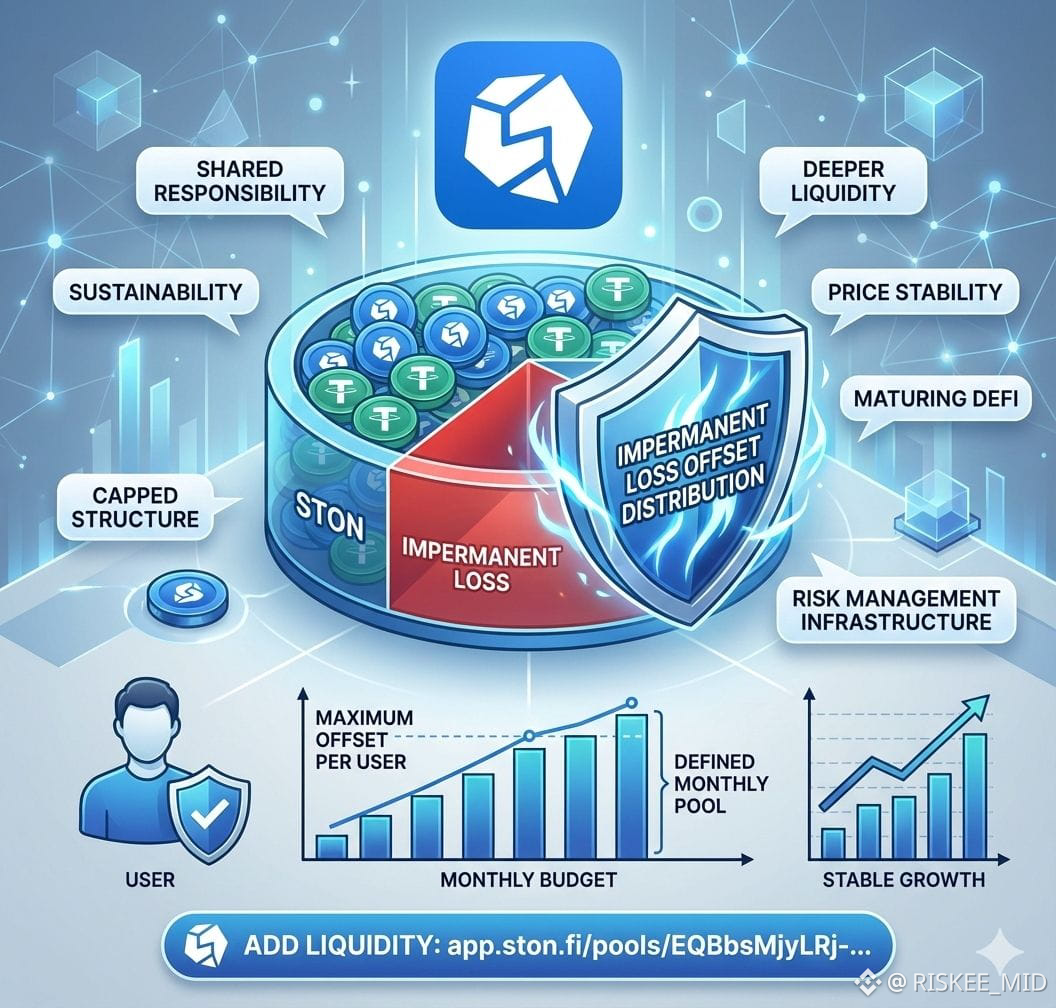
STON.fi’s Impermanent Loss Offset: Reframing Liquidity provision as a Shared Risk
For years, impermanent loss (IL) has been widely accepted as an inherent cost of automated market maker (AMM) liquidity provision: price divergence between paired assets can leave liquidity providers (LPs) with less value than simply holding the tokens. Protocols have traditionally addressed this by offering higher trading fees, token incentives, or one-off rebates. STON.fi takes a different approach — treating impermanent loss as an economic risk that can, and should, be managed at the protocol level.
The mechanism — predictable, capped offsets
STON.fi’s solution is straightforward in design but meaningful in effect: a recurring monthly budget is allocated to partially offset realized impermanent loss for participants in the STON/USDT pool. Critically, offsets are capped both per user and in aggregate each month. That dual cap achieves two objectives at once:
User protection: LPs receive tangible compensation for adverse price moves that cause IL, reducing downside from longer-term participation.
Economic discipline: Per-user and monthly caps prevent the program from becoming an open-ended subsidy that would erode token economics or create runaway inflation.
This structured, recurring allocation reframes the incentive from ad-hoc rewards to an operationalized risk management program — one with known costs and transparent boundaries.
Why this matters for LPs and markets
Changes the risk calculus. For LPs who seek steady, long-term exposure (rather than short-term yield chasers), the offset reduces one of the largest behavioral frictions: leaving the pool after volatility. With partial protection, rational participants are more likely to remain during swings, which can in turn help the pool recover as prices stabilize.
Encourages deeper liquidity. Structural protection fosters confidence. Deeper liquidity reduces slippage for traders and makes the pool more attractive for larger orders — a virtuous cycle benefiting both traders and LPs.
Improves price stability. When LPs are less inclined to withdraw during volatile periods, the pool sustains tighter spreads and smoother price discovery. This is especially valuable for pairs involving a native protocol token (STON) where concentrated withdrawals can exacerbate volatility.
Makes risk management a core feature. By embedding IL mitigation into protocol operations, STON.fi signals a maturing DeFi practice: risk tools are becoming infrastructure rather than optional marketing spend.
Market-design trade-offs and considerations
The model is attractive, but it is not without trade-offs. A balanced appraisal highlights several points LPs and governance should weigh:
Partial, not full, protection. Offsets are designed to be partial. They reduce the pain of IL but don’t eliminate it — LPs still face exposure to price divergence and should account for that in position sizing and strategy.
Moral hazard and selection effects. Any protection can change participant behavior. Caps help mitigate the risk of opportunistic strategies that exploit offsets, but governance must monitor whether the program disproportionately benefits sophisticated actors or encourages riskier token listings.
Fiscal sustainability. Even with capped allocations, the budget must be financed in a way that doesn’t dilute token value or compromise other protocol priorities (security, development, key partnerships). Transparent funding rules and periodic reviews are essential.
Complexity of measurement. Accurate, auditable calculation of realized IL and fair offset distribution is technically nontrivial. STON.fi’s credibility rests on clear methodology, transparent reporting, and reliable on-chain mechanisms.
Governance and signals
Placing IL mitigation into protocol policy transforms it into a governance lever. How large is the monthly budget? How are caps determined and adjusted? What metrics trigger modification of the program? These are governance questions with real economic consequences. Done well, this can become a core, iterative instrument for balancing growth and sustainability; done poorly, it risks becoming an unsustainable subsidy.
Conclusion — a pragmatic step toward sustainable liquidity
STON.fi’s impermanent loss offset distribution is a thoughtful response to a longstanding market failure: individual LPs bearing concentrated downside risk with few structural protections. By allocating a recurring, capped budget to partially offset IL, the protocol aligns incentives across stakeholders, encourages longer-term participation, and treats risk management as an infrastructural function.
This approach is not a panacea. It requires careful design, transparent execution, and ongoing governance oversight. But if executed responsibly, it represents a meaningful evolution in AMM market design — one that could be a model for protocols seeking deeper, more resilient liquidity without sacrificing fiscal discipline.
Add liquidity: app.ston.fi/pools/EQBbsMjyLRj-...