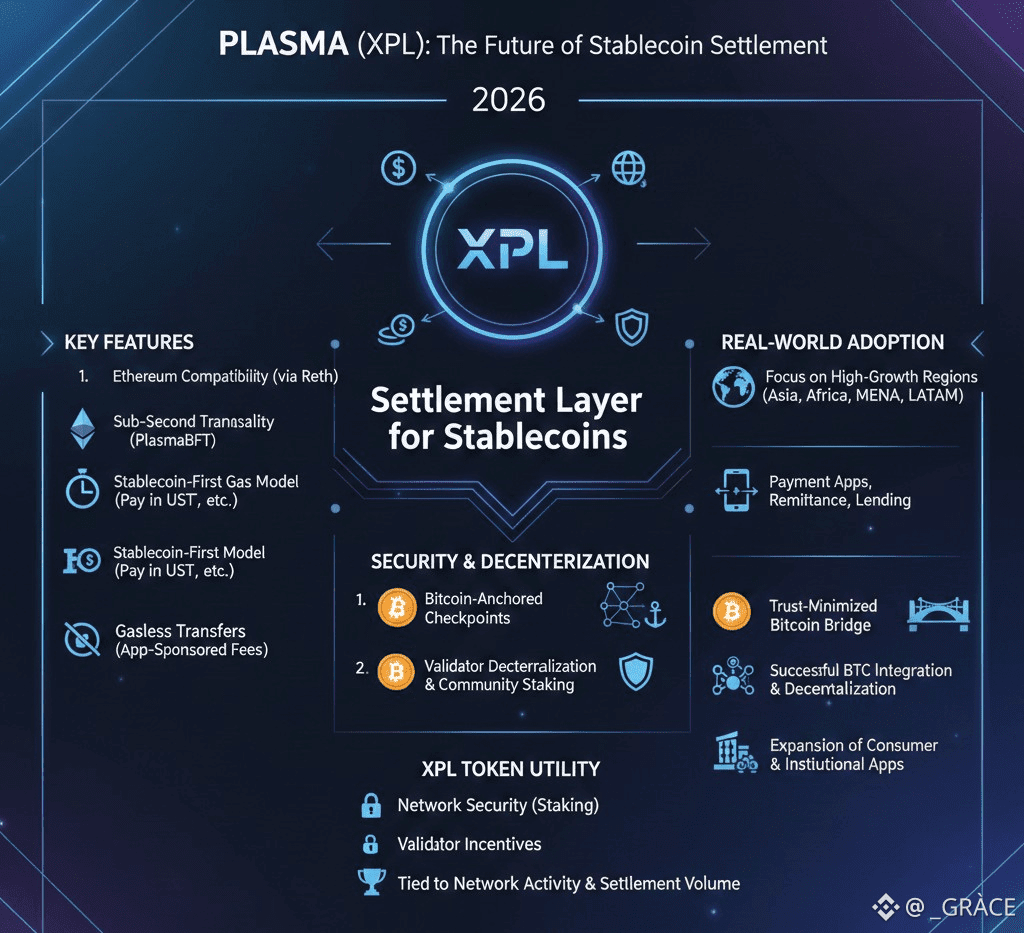
As the crypto world continues its journey from speculative playground to real-world financial infrastructure, a new narrative is quietly emerging. It is no longer about which blockchain generates the most hype, the flashiest NFTs, or the latest memecoins. The next frontier is about moving money reliably, efficiently, and at scale. Among the emerging contenders, Plasma (XPL) is carving out a unique position: a Layer 1 blockchain designed specifically to act as a settlement layer for stablecoins. In 2026, the ecosystem is starting to show that Plasma is not just a conceptual experiment it’s a practical solution built for the realities of digital finance today.
The evolution of blockchain has always followed cycles of experimentation and refinement. Early blockchains proved the viability of decentralized systems but struggled with scalability and speed. Subsequent generations prioritized programmability, opening the doors for smart contracts and decentralized applications, but often at the cost of performance or reliability. Plasma is part of a more pragmatic evolution: a blockchain that identifies a critical problem settling stable value across networks and optimizes for that without trying to be everything for everyone.
The core premise of Plasma is straightforward yet profound: moving stablecoins quickly, securely, and cheaply. While other chains aim to support complex ecosystems simultaneously, Plasma focuses on a single mission. That focus is not a limitation; it’s a strategic advantage. By dedicating itself to this task, Plasma can design every layer from consensus mechanisms to gas mechanics, to security architecture around efficiency, finality, and usability.
One of the defining features of Plasma is full Ethereum compatibility via Reth, allowing developers to deploy Ethereum-based smart contracts without rewriting code or learning new tooling. This is more than a developer convenience it is an essential bridge between existing ecosystems and the specialized needs of stablecoin settlement. For fintech teams building payment apps, wallets, remittance systems, or financial primitives, the transition to Plasma feels familiar while offering the performance enhancements necessary for high-volume financial activity.
Speed and finality are at the heart of the user experience. PlasmaBFT, the network’s consensus mechanism, delivers sub-second transaction finality. In practical terms, this transforms the way blockchain payments feel. Instead of waiting tens of seconds or longer users experience instant settlement, comparable to the speed of traditional payment systems. In 2026, this is no longer a luxury; it is a prerequisite for stablecoin adoption across merchants, payroll systems, and cross-border remittances.
Beyond speed, Plasma introduces a stablecoin-first gas model. Traditional blockchains often require users to hold a volatile native token to cover transaction fees, creating friction and confusion. Plasma allows gas fees to be paid directly in stablecoins such as USDT. For new users, this seemingly small shift removes one of the most common onboarding barriers: the need to acquire and manage a separate token. Users can receive and send stablecoins immediately, without worrying about volatility or conversions. This design choice is subtle, but it is a crucial enabler of mass adoption.
Plasma takes usability further with gasless stablecoin transfers. In this model, applications can sponsor transaction fees on behalf of users, making blockchain payments indistinguishable from traditional Web2 experiences. Companies can build applications where users never encounter blockchain mechanics, making the network feel like invisible infrastructure rather than a system they must manage. For fintech innovators and consumer-facing apps, this opens opportunities to reach audiences who might otherwise be intimidated by crypto technology.
Security is another pillar where Plasma differentiates itself. The network leverages Bitcoin-anchored checkpoints, tying its state to the most secure and decentralized blockchain in existence. By committing checkpoints to Bitcoin, Plasma adds an extra layer of neutrality and censorship resistance. For institutions or large payment operators considering on-chain settlement, this integration increases confidence and trust, creating a bridge between the speed and efficiency of Plasma and the long-standing reliability of Bitcoin.
The network is also moving toward validator decentralization and community staking. By opening up validator participation and enabling delegation, Plasma empowers token holders to contribute to security without running infrastructure. This shift from early centralized control to shared, resilient security is a critical milestone for any Layer 1 aiming to handle high financial volumes. It signals that Plasma is preparing for long-term sustainability rather than short-term experimentation.
Ecosystem development around Plasma has been quietly accelerating. Payment-focused applications are experimenting with stablecoin flows on the network, attracted by low fees and instant confirmation. Developers are deploying lending, liquidity, and settlement-oriented smart contracts that would be cost-prohibitive on general-purpose chains. A pattern emerges: Plasma draws builders who prioritize execution over hype, focusing on practical solutions that matter for everyday finance.
Globally, Plasma is positioning itself as an infrastructure solution for regions with high stablecoin adoption. In parts of Asia, Africa, the Middle East, and Latin America, stablecoins are already used as functional money. Plasma’s architecture naturally accommodates these markets: predictable fees, instant finality, and gasless transfers are not optional they are critical. By meeting the needs of these regions, Plasma is building not just a network, but a financial utility with tangible real-world use.
Looking ahead, one of the most ambitious developments is the trust-minimized Bitcoin bridge. This bridge will allow BTC to enter Plasma’s ecosystem as a productive asset, enabling lending, borrowing, and liquidity provision without centralized custody. If executed successfully, this could inject deep Bitcoin liquidity into Plasma’s stablecoin-centric economy, expanding on-chain activity while preserving security. It’s an illustration of how Plasma’s design aligns with the evolving needs of decentralized finance: bridging assets, enhancing liquidity, and maintaining trust.
At the heart of Plasma’s network is the XPL token, which secures the network through staking, aligns validator incentives, and supports long-term sustainability. Unlike speculative tokens primarily used for trading, XPL’s value is increasingly tied to network activity and settlement volume. As stablecoin transactions grow, the importance of this infrastructure token becomes tangible. It’s not about short-term price swings it’s about underlying network utility and the real economic flows it facilitates.
What makes Plasma particularly relevant in 2026 is timing. Stablecoins are no longer a niche crypto narrative; they are emerging as core financial instruments for individuals, businesses, and institutions. Regulatory frameworks are evolving toward transparency, compliance, and predictable settlement. Plasma’s design aligns with this regulatory reality, making it an infrastructure solution that institutions can trust without sacrificing speed or efficiency.
The path ahead for Plasma can be measured by three critical indicators. First is the growth of stablecoin transaction volume, which will reflect real adoption and usage. Second is the successful rollout of Bitcoin integration and validator decentralization, signaling both liquidity and resilience. Third is the expansion of consumer and institutional applications, demonstrating that Plasma’s architecture is not just theoretically sound but practically indispensable. If these milestones align, Plasma has a clear trajectory toward becoming a foundational settlement layer in the digital economy.
In an environment crowded with noise, speculation, and hype, Plasma takes a quieter but more meaningful approach. It focuses not on capturing attention but on solving core problems that matter for money movement. The network’s evolution is defined not by flashy announcements or trendy tokenomics but by practical infrastructure decisions: instant finality, stablecoin-native gas, gasless transfers, and Bitcoin-anchored security. These are the building blocks that enable real-world adoption.
Ultimately, Plasma represents a shift in perspective for blockchain technology. Instead of asking, “How can we make crypto more exciting?” it asks, “How can we make crypto useful?” The network is a reminder that the most valuable innovations are often the ones that operate quietly behind the scenes, powering systems that people rely on without ever thinking about them. For anyone watching the next phase of blockchain adoption, Plasma is a project worth close attention not because it is loud, but because it is relevant, capable, and ready for the real-world demands of 2026 and beyond.
The next decade of blockchain growth will not be defined by who raises the most capital or launches the most viral projects. It will be defined by networks that enable money to move securely, reliably, and at scale. In this context, Plasma’s laser-focused approach, stablecoin-first innovations, and developer-friendly design position it as a serious contender for the role of the core settlement layer in the emerging digital economy.
The story of Plasma is not just technical; it is strategic, timely, and human-centric. It speaks to a future where blockchain becomes invisible infrastructure like the electricity that powers our homes or the internet that carries information yet essential for the functioning of the global economy. By solving real problems with practical solutions, Plasma is quietly laying the foundation for a decade where stablecoins move seamlessly, reliably, and instantly, in every corner of the world.