 Alright, let's try this again. This time I'll just talk it out like we're figuring it out together. Forget the formal structure. Let's get into what makes Vanar feel different.
You know how most "AI crypto" projects feel like someone just glued the words "AI" and "blockchain" together for a hype tweet? That is what I thought too, until I started peeling back what @Vanarchain is actually building. It is less about slapping a label on something and more about asking: what if a blockchain could understand what it is processing, not just record it?
The Core Idea: It is Not an Add On, It is the Foundation
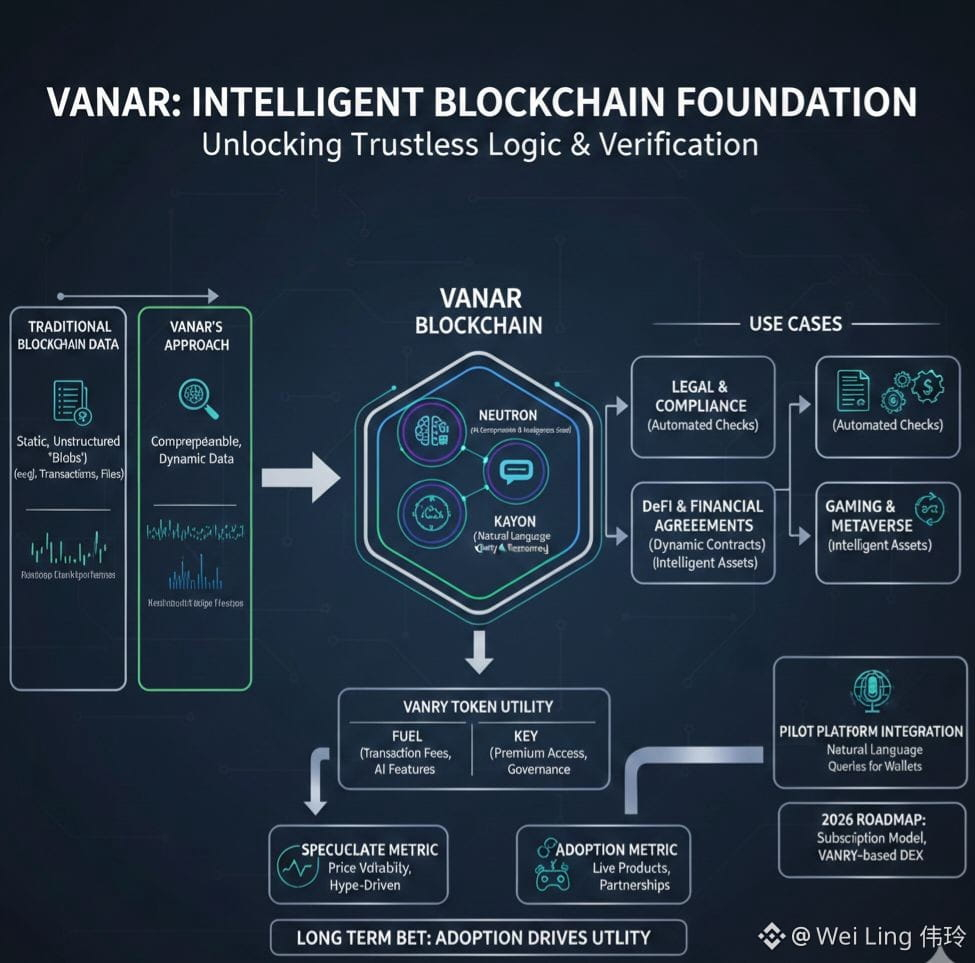
What clicked for me was not a whitepaper. It was realizing Vanar's approach is like building a city with electricity and plumbing planned from the start, versus trying to wire it all afterward. Most blockchains are great ledgers. They are excellent at "this wallet sent X to that wallet." But what about everything else? A legal document, a game asset, a medical record? To a normal chain, it is all just a blob of data. It cannot read it.
Vanar's whole thing is building a chain where data is not just stored. It is made comprehensible. The two parts that make this real are Neutron and Kayon.
Neutron is like giving the blockchain a photographic memory with a brain. Instead of storing a massive file, like a video or a contract, it uses AI to compress it into a tiny, intelligent "seed" that lives on chain. This seed is not just code. It understands what it represents. So a smart contract can actually interact with the contents of a document, not just its existence.
Kayon is the translator and detective. It lets you ask the blockchain questions in plain language. Instead of writing complex queries to track a transaction, you could ask, "Show me all the deals last month that involved Company X and were over $100k." It reasons across data, connects dots, and gives you answers with evidence. It turns a ledger into a searchable, intelligent database.
This shifts the use case from "trustless money transfer" to "trustless logic and verification." Think automatic compliance checks, dynamic financial agreements, or game assets that evolve based on how you use them.
Reading Between the Lines: What the Numbers Do Not Say
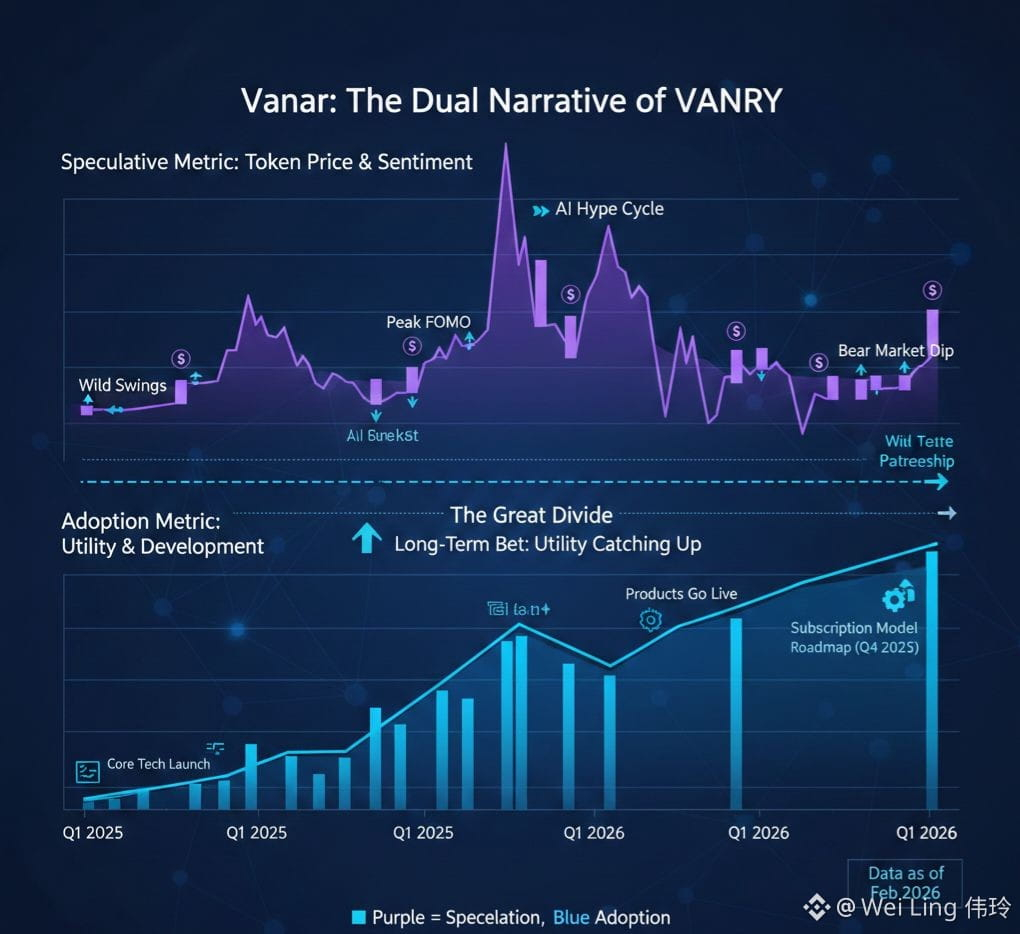
Here is where it gets messy and interesting. If you look at token charts, VANRY has been on a wild ride. It goes way up on hype, way down in a bear market. That is classic crypto volatility. The easy story is "another AI token pumped and dumped."
But the more organic story is in the builders and the roadmap.
While the token price was swinging, the team was quietly launching the core tech. Products went live. They partnered with platforms like Pilot, an AI agent hub. This means real users are already using Vanar's infrastructure to query their crypto wallets with natural language.
The roadmap for this year talks about shifting to a subscription model for their AI tools. That is a big signal. It means they are focusing on creating steady, recurring demand for the token based on actual product usage, not just trading speculation. They are also launching their own DEX. This would bake VANRY into the ecosystem as the base trading pair.
So the metrics are split:
Speculative metric: Token price is highly volatile and sentiment driven.
Adoption metric: Live products, developer tools, and partnership integrations are slowly growing and utility driven.
The long term bet is on the second set of metrics catching up to the first.
Why the Token is Not Just Another Coin
In this setup, the token stops being just a trading chip. It becomes more like a key and a fuel.
Fuel: You will use it to pay for transactions and for advanced AI features, like running a complex query on Kayon or storing a file with Neutron.
Key: Holding it might grant access to premium features or governance. Imagine helping decide how the network's AI models are tuned or which new industry to tackle next.
The vision is to tie the token's value directly to the usefulness of the network. More intelligent dApps, more queries, more sophisticated data storage means more sustainable demand for VANRY.
The Real Talk: What Could Go Right or Wrong
The Potential:
They are tackling a real, unsolved problem: blockchain data is mostly dumb. If they make it smart and accessible, they do not just compete with other Layer 1s. They create a new category. Sectors like legal tech, DeFi, and gaming could be natural fits. These are areas where contracts and assets need to be dynamic and verifiable.
The Pitfalls:
The Builder Gap: Amazing tools need amazing developers to use them. Can they attract enough talent to build the killer apps on Vanar?
The Narrative Trap: Can they outlast the "AI crypto" hype cycle and be judged on utility, not just headlines?
Execution: The subscription model and DEX need to launch and work smoothly. Theory is great, but real world usage is everything.
So, What is the Bottom Line?
To me, Vanar feels less like a short term trade and more like a long term infrastructure bet. It is not asking, "How can we make our token price go up?" It is asking, "What foundational piece is missing from Web3?" Their answer is native intelligence.
The gamble is whether the market will value that foundation before the noise of speculation drowns it out. It is a complicated, ambitious, and genuinely unique path. That makes it far more interesting to follow than the hundredth meme coin.
I hope this version with simpler punctuation hits the mark. If you have other specific changes in mind, just let me know.