


While many blockchains focus on consensus speed, the true scaling bottleneck for stablecoins often lies deeper—in how the system stores and updates account states. Traditional general-purpose blockchains handle these operations in a way that creates overhead, slowing down the high-volume, repetitive transfers typical of payments.
How State Management Bottlenecks Arise
General-purpose blockchains like Ethereum use a Merkle Patricia Trie to manage state. @Plasma This structure is powerful and verifiable but introduces inefficiency for stablecoins. Every simple balance update requires modifying multiple nodes in this tree, leading to random disk access and repeated cryptographic hashing. For millions of near-identical transfers, this design incurs unnecessary computational and I/O costs, limiting throughput and increasing latency.  Blockchains designed for stablecoins, such as Plasma, approach this differently. They assume most transactions are predictable—balance updates, nonce changes, and minimal contract logic. This allows them to restructure state management around two core principles:
· Locality & Caching:
Frequently accessed stablecoin contracts and user accounts are cached aggressively in memory, drastically reducing the need for repeated, slow traversals of the full state tree.
· Batched Execution & Writes:
Instead of processing transactions in isolation, the execution layer groups them. State reads and writes are coalesced before being committed to the trie. This minimizes redundant disk operations and hash recomputations.
Plasma's Scaling Architecture in Practice
Plasma's design integrates these state management optimizations with a broader high-performance architecture:
· Consensus:
PlasmaBFT - A pipelined Fast HotStuff algorithm that enables high throughput (1000+ TPS) and sub-12-second finality by allowing consensus stages to run in parallel.$XPL
· Execution:
Reth EVM - A high-performance, fully compatible Ethereum execution layer written in Rust, which works hand-in-hand with batched state processing.
· Security:
Bitcoin Bridge - State roots are periodically anchored to the Bitcoin blockchain, inheriting its robust security for transaction history.  Proposer Selection & Incentives in PlasmaBFT
To maintain liveness—especially during high transfer volume—PlasmaBFT uses a carefully designed Proof-of-Stake (PoS) mechanism for selecting and incentivizing block proposers.
Selection Process:
Validators stake the native XPL token to participate.For each consensus round, a small committee of validators is chosen via a stake-weighted, cryptographically secure random process. A leader (proposer) is then selected from this committee and rotates periodically. This makes it expensive for an attacker to control the proposer role long enough to halt the network.
Incentive & Slashing Model:
· Rewards:
Proposers and attesters earn rewards from block production and transaction fees.
· Penalties:
Plasma uses a reward-slashing model, not principal stake slashing. Validators who are offline or act maliciously lose their eligibility for rewards but do not have their staked XPL confiscated. This lowers the barrier to participation by reducing the risk of catastrophic loss while still punishing behavior that harms network liveness.  The Developer & User Experience
This technical foundation enables user-friendly features critical for payments:
· Zero-Fee USDT Transfers:
Eligible users can send USDT without paying gas fees, thanks to a protocol-sponsored paymaster contract.
· Custom Gas Tokens:
Users can pay transaction fees directly in USDT or BTC, eliminating the need to hold a separate native token.
· Full EVM Compatibility:
Developers can deploy existing Ethereum smart contracts and use standard tools (like MetaMask, Hardhat) without modification. 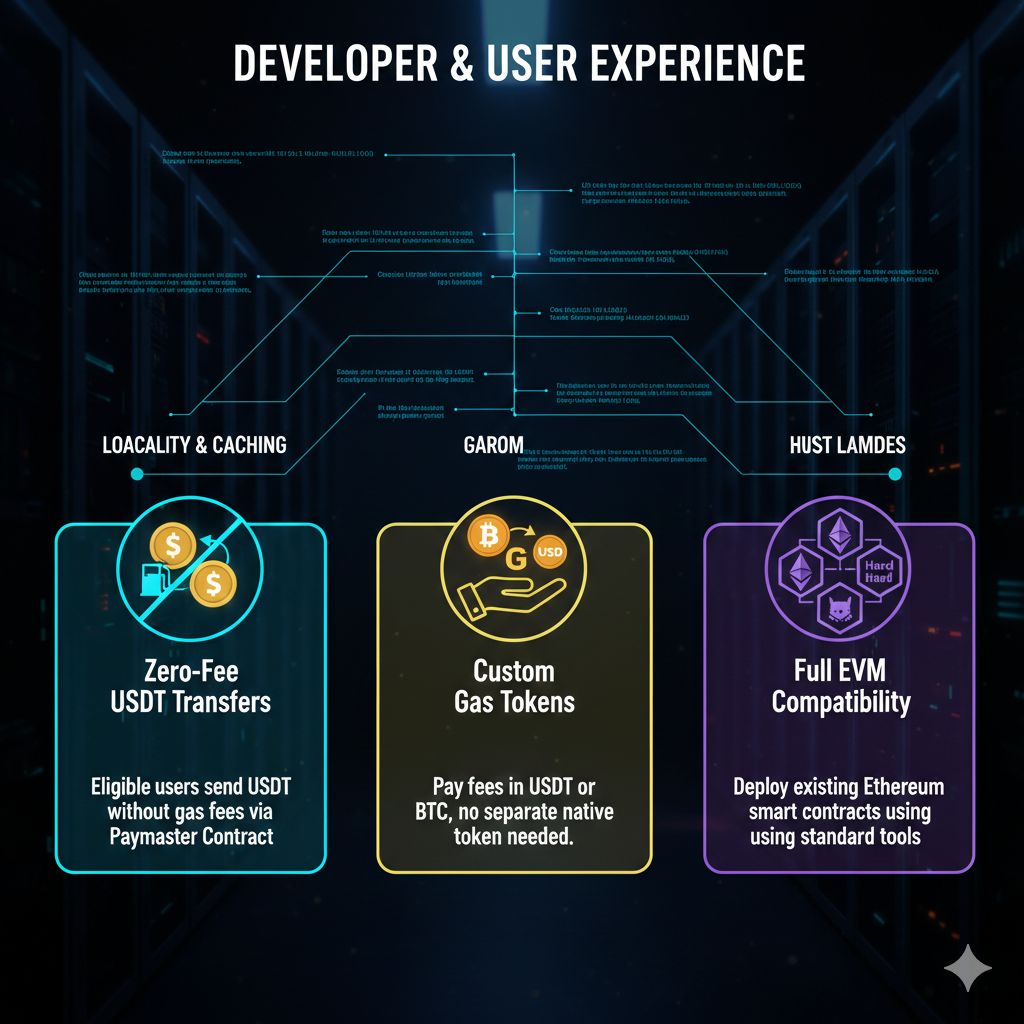 Key Architectural Trade-offs of a Stablecoin Chain
Advantages:
· Optimized Performance:
Achieves high, consistent throughput and low latency for payment transactions.
· Predictable, Low Costs:
Fee abstraction and optimized execution keep costs minimal and stable.
· Superior User Experience:
Features like gas-free transfers remove key friction points for mainstream adoption.
Considerations:
· Use-Case Specialization:
The deep optimizations for stablecoin transfers may not benefit complex, generalized DeFi applications in the same way.
· Ecosystem Dependency:
Success is tied to the adoption and regulatory standing of major stablecoins like USDT.
· Nascent Adoption:
As a newer chain, it must build its network of applications and users from the ground up. 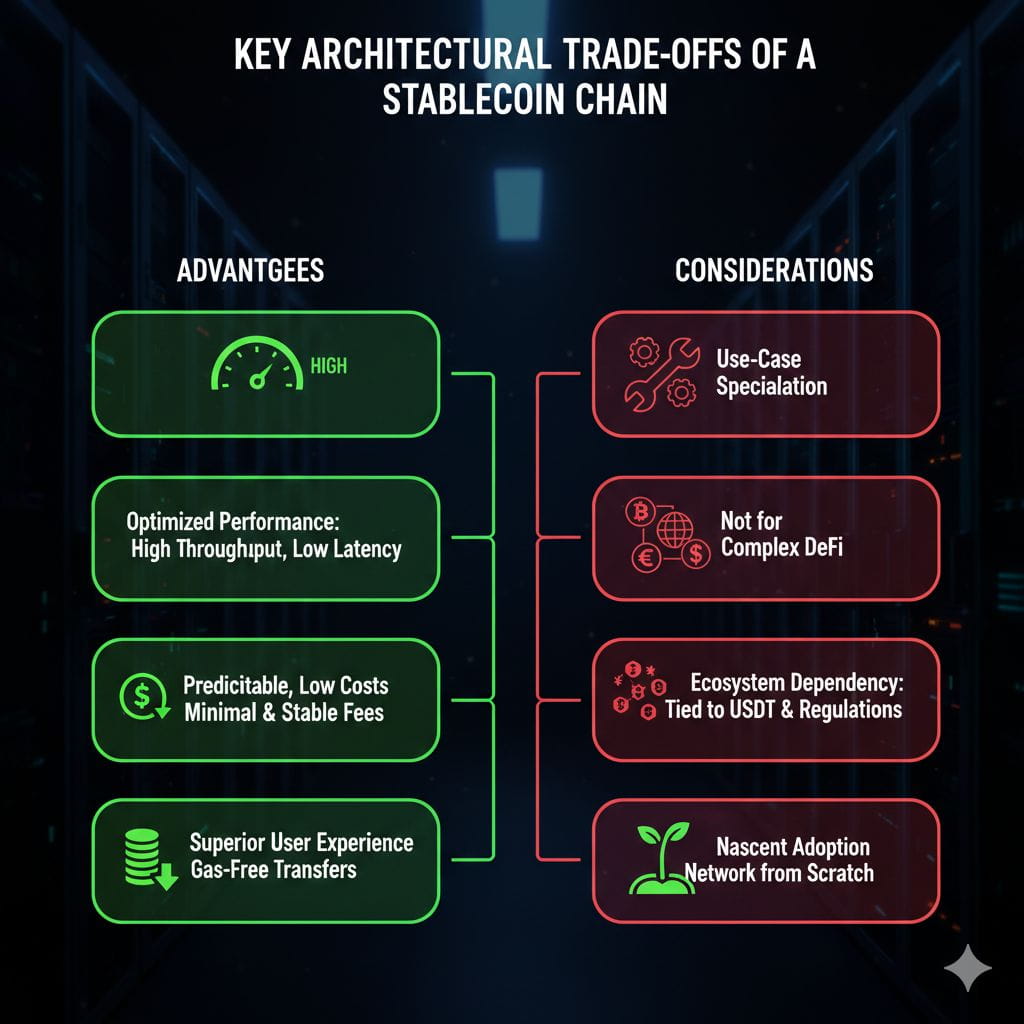
In the race to scale blockchain for global payments, discussions often center on consensus speed and block times. However, a more fundamental and often overlooked bottleneck lies deeper in the architecture: state management. For applications dominated by stablecoin transfers, how a blockchain stores, accesses, and updates millions of account balances is the critical determinant of real-world throughput, cost, and latency. This article provides a technical deep dive into why Ethereum's general-purpose state model hits limits under heavy stablecoin load and how application-specific chains like Plasma are engineered from the ground up to solve this precise problem.
1. The Core Bottleneck: Understanding "State"
In blockchain terms, "state" refers to the current snapshot of all information: account balances, smart contract code, and stored data. Every transaction changes this state. The system that manages these changes—the state trie—is foundational. Its design dictates how quickly the network can read a balance, finalize a transfer, and make that update verifiable to all participants.
For stablecoins, the workload is unique: high volume, low complexity. Millions of transactions follow an identical pattern: check sender balance, subtract amount, add amount to recipient, update nonces. The computational logic is minimal, but the frequency and repetition are extreme.
2. Ethereum's General-Purpose Model: Power at a Cost
Ethereum uses a Merkle Patricia Trie (MPT) for state storage. This is a cryptographically authenticated data structure that provides powerful guarantees crucial for a permissionless, general-purpose blockchain.
· How It Works:
The MPT organizes all accounts and storage into a tree. Each node is hashed, and the root hash of this entire tree is stored in the block header. Any change to a single balance requires recalculating hashes up the tree to a new root. This makes the state cryptographically verifiable but also inherently update-intensive.
· The Scaling Challenge for Stablecoins:
· Random Disk I/O:
Locating an account in the trie often requires multiple disk reads. For millions of concurrent transfers, this results in chaotic, non-sequential disk access, a major performance killer.
· Repeated Hash Computations:
Every balance update changes the trie's leaf node and all nodes along the path to the root, forcing the re-computation of multiple cryptographic hashes. This is computationally expensive.
· Lack of Locality:
Transfers between two active users do not benefit from data locality; their accounts may be stored far apart in the trie, leading to inefficient cache usage.
In essence, Ethereum's MPT is optimized for versatility and security across countless unpredictable use cases (DeFi, NFTs, DAOs), not for the repetitive, high-volume pattern of mass payments. This creates a "state management tax" that limits stablecoin throughput.
3. Plasma's Application-Specific Approach: Designing for the Workload
Chains like Plasma (powering the TON blockchain's stablecoin ecosystem) start with a different premise. By assuming a primary workload of predictable transfers, they can architect state management for locality and batch efficiency.
· Philosophy: Treat the high-frequency stablecoin contract and its users as a "hot" dataset deserving of special treatment.
· Key Optimizations:
1. Aggressive, Structured Caching:
Frequently accessed state data (e.g., top liquidity pool contracts, active user accounts) is kept in a structured, in-memory cache. This bypasses the vast majority of deep trie traversals for the most common operations.
2. Batched Execution and State Commitment:
The execution layer (a modified Reth EVM client) does not process transactions in strict serial order. It can group similar transactions, perform their state reads and writes in a coordinated manner, and then commit the final state delta to the trie in a single, efficient operation. This minimizes redundant I/O and hash computations.
3. Optimized State Trie Access Patterns:
The storage layout itself can be optimized to ensure that accounts interacting within the same stablecoin ecosystem are stored closer together in the trie, improving cache hit rates and read performance.
4. Comparative Analysis: Throughput in Practice
Feature Ethereum (General-Purpose) Plasma (Stablecoin-Optimized) Implication for Stablecoins
State Data Structure Merkle Patricia Trie (MPT) MPT + Optimized Caching Layer & Batched Writes Plasma reduces direct trie access for hot data.
Primary Access Pattern Random, per-transaction Sequential & Batched Plasma's I/O is more predictable and efficient for bulk transfers.
Hash Compute Load High (per-tx path updates) Lower (amortized over batches) Computational overhead is spread across many transfers.
Theoretical Max TPS ~30-100 for simple transfers 1000+ for stablecoin transfers Designed for payment-scale throughput.
Developer Experience Uniform for all dApps Tailored for payments; full EVM compatibility for portability Developers get scale without rewriting contracts.
5. The Bigger Picture: Consensus and State Working in Tandem
State management does not work in isolation. Plasma's performance is a synergy between its state layer and its consensus mechanism, PlasmaBFT (a pipelined HotStuff variant).
· Fast Finality: Sub-12-second finality provides the certainty required for payments.
· Efficient Proposer Rotation: A stake-weighted, committee-based leader election ensures liveness is maintained even during traffic spikes, preventing any single slow proposer from becoming a bottleneck that would leave uncommitted state changes in limbo.
· Unified Goal: Both layers are designed for high, consistent throughput, unlike general-purpose chains where a high-speed consensus engine can be bogged down by a slow state storage layer.
6. Trade-offs and the Future of Application-Specific Chains
The Plasma approach involves deliberate trade-offs:
· Advantage: Unmatched efficiency for its target use case. It delivers low, predictable costs and high throughput for stablecoin transactions.
· Consideration: Specialization. While fully EVM-compatible, its deepest performance gains are realized for applications that fit the high-volume, lower-complexity model. Extremely complex, state-heavy DeFi operations may not see the same linear performance benefits.
This highlights a major trend in blockchain evolution: the rise of application-specific infrastructure. Just as databases evolved from general relational models to specialized engines for time-series, graph, or ledger data, blockchains are beginning to specialize. For stablecoins—which are poised to become the backbone of internet-native finance—dedicated, optimized state management isn't just an optimization; it is a fundamental requirement for global adoption.
Conclusion
The battle for stablecoin scale is not won solely at the consensus layer. The quiet, deeper battle over state management efficiency is decisive. Ethereum's MPT offers robust generality at a performance cost for mass payments. In contrast, chains like Plasma demonstrate that by architecting the state layer—from caching to commit batching—specifically for the payment workload, it is possible to achieve a step-function improvement in throughput and user experience. This specialized approach marks a mature next step in blockchain's@Plasma evolution, building optimized infrastructure for the world's most critical financial use cases.


