
I had watched promising systems decay not because they lacked innovation, but because they treated data as something temporary, something that could be moved fast and forgotten faster. That realization never left me, and it’s the lens through which I see Walrus $WAL .
At the heart of Walrus WAL is the decision to rely on erasure coding paired with blob-based storage. What matters here is not the mechanics, but the philosophy behind it. Instead of assuming that every participant must carry the full burden of memory, Walrus distributes responsibility. Data is fragmented, yet meaning is preserved. No single failure defines the outcome. Ownership becomes collective without becoming careless.
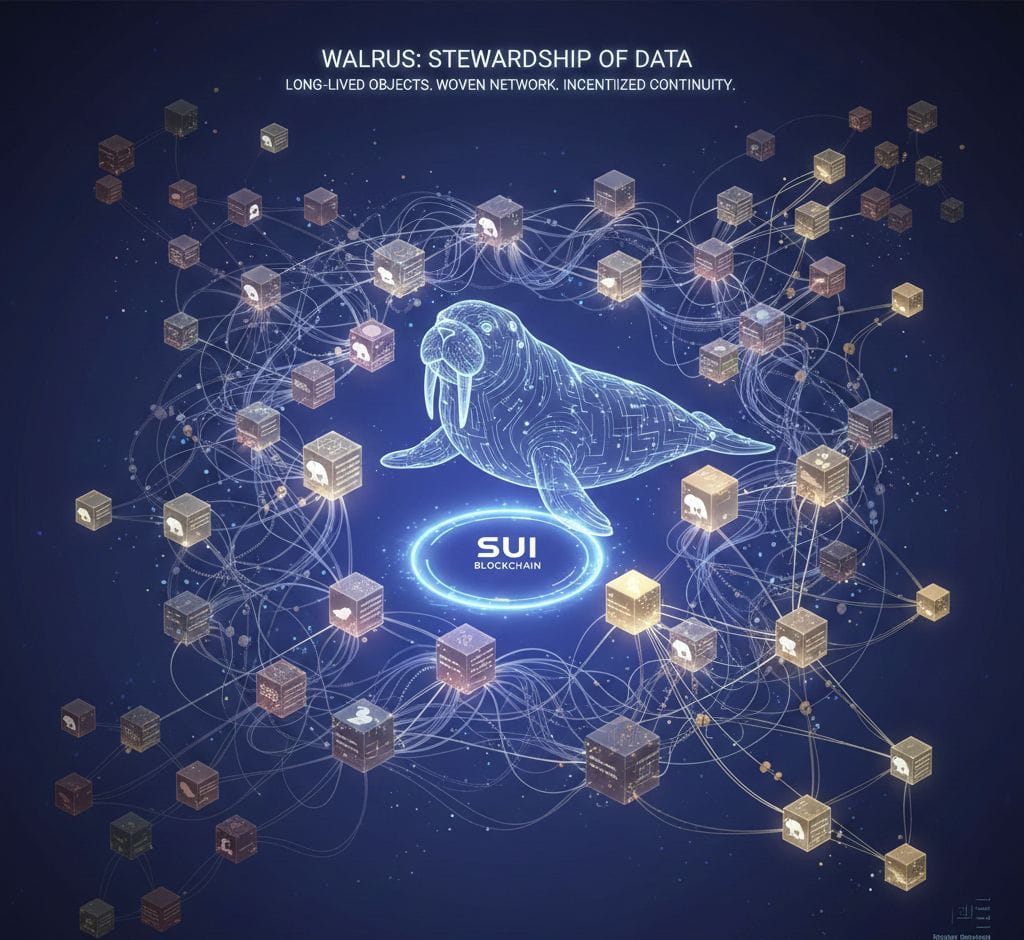
Operating within the $SUI blockchain environment, Walrus inherits a system that treats objects as long-lived entities rather than fleeting state changes. This matters more than it sounds. In traditional systems, storage is something you rent and hope persists. In Walrus, storage feels more like stewardship. Data is not simply placed somewhere; it is woven into a network where incentives quietly reward continuity and punish neglect over time.
I’ve seen DeFi protocols collapse because their infrastructure assumed perfect conditions. I’ve seen decentralized applications depend on centralized storage because it was easier, faster, and more convenient. Walrus WAL takes a slower, more disciplined path. By designing storage that expects partial failure and plans for it, the protocol aligns itself with how humans actually behave. People leave. Nodes go offline. Attention fades. A resilient system is one that anticipates this without resentment.
This design choice reshapes trust in subtle ways. When data survives independently of any single actor, applications gain confidence to build for the long term. Governance decisions carry more weight because the past cannot be easily erased. Composability becomes safer because dependencies rest on something sturdier than goodwill or uptime guarantees. Over time, this changes how developers and users relate to the system. They stop optimizing for immediacy and start optimizing for durability.
Web3 has long promised ownership, but ownership without reliable memory is fragile. Walrus WAL approaches ownership as something that must endure across years, not just market cycles. By making data recovery an expectation rather than an exception, the protocol encourages behavior that values responsibility over convenience. It’s not dramatic, but it’s effective. Systems like this don’t announce their importance. They reveal it slowly, as fewer things break.
As someone who has watched Ethereum evolve, storage networks mature, and governance fail for deeply human reasons, this approach feels earned. Walrus does not try to outshine its peers. It tries to outlast them. Its design acknowledges that decentralization is not a performance, but a commitment to preserving meaning when conditions are imperfect.
What gives a system legitimacy is not how quickly it grows, but how faithfully it remembers. Walrus WAL reflects a quiet understanding that trust is built when data remains intact, ownership remains clear, and incentives remain aligned even after the noise fades. That kind of resilience doesn’t chase attention. It waits patiently, carrying the weight of what it’s been asked to hold, and proving over time that it was worthy of the trust placed in it.


