
Banks have spent years experimenting with “enterprise blockchains”: closed ledgers where a handful of institutions run the nodes and everything happens inside a legal club. They tidy up some back-office processes, but they do not behave like real networks. If a few big members walk away, the chain withers. Assets cannot easily leave. Nothing composes with the wider crypto stack.
Dusk takes a different path. It is a privacy-focused Layer 1 for regulated finance (RegDeFi) that keeps the parts of public blockchains that matter openness, composability, global reach and upgrades privacy so institutions can actually use it.
Traditional bank chains are, in practice, permissioned databases. Validator seats are assigned by contract. Governance moves at committee speed. Each consortium is its own island, with custom integrations and limited interoperability. The result is brittle infrastructure that depends on a small group of sponsors.
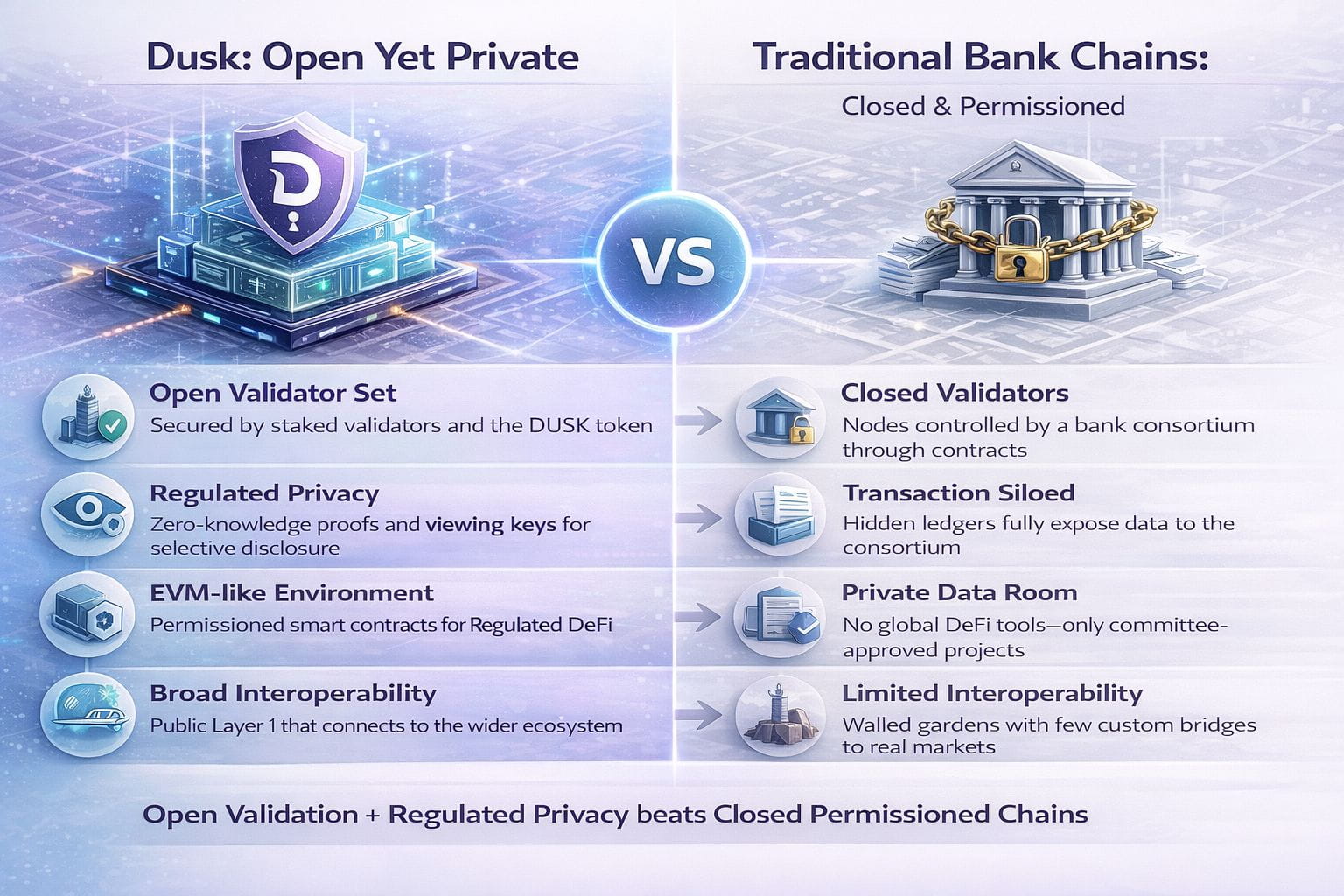
On Dusk, security and liveness are not tied to a closed club. The network is secured by an open validator set and the DUSK token. Anyone who meets protocol rules can help validate, stake, and earn rewards. That broad participation makes the chain more resilient than a consortium where only a few institutions hold the keys.
The other core difference is how Dusk handles information. Most public chains expose everything on a block explorer, which is unacceptable for serious finance. Bank chains respond by hiding the ledger completely. Dusk sits between those extremes.
At the base layer, Dusk uses zero-knowledge proofs so transactions and balances can be verified without revealing raw data. You can prove that a payment settled, that a security token transfer obeyed its rules, or that a loan is performing, without broadcasting every position to the world. Privacy is native, not bolted on.
On top of that, $DUSK offers an EVMnlike environment with permissioned smart contracts. Only authorized issuers and platforms can deploy certain financial contracts, but users still interact through familiar wallets and tooling. This is where regulated securities, RWAs, and compliant DeFi primitives can live.
Crucially, privacy on Dusk is regulated, not absolute. The protocol supports selective disclosure and viewing keys, allowing regulators, auditors, or courts to inspect data when they have the legal right to do so. Markets and competitors stay blind; supervisors see what they need. That balance is almost impossible to achieve on a fully transparent chain or a totally closed bank ledger.
Openness also pays off on the interoperability side. Because Dusk is a public
Layer-1, it can connect to wallets, custodians, bridges, and oracles across the ecosystem. Assets issued on Dusk do not have to remain trapped inside a single banking group; subject to regulation, they can reach new venues, new investors, and new distribution rails. Instead of ten incompatible consortia, you get one privacy preserving settlement layer that others can plug into.
For institutions thinking about tokenizing bonds, equities, funds, or loans, this matters. You want infrastructure that:
Is economically secure and not dependent on one consortium’s budget.
Provides confidentiality for clients and trading strategies.
Still offers verifiability and regulatory visibility when required.
Connects to a wider universe of tools instead of living as a side project in IT.
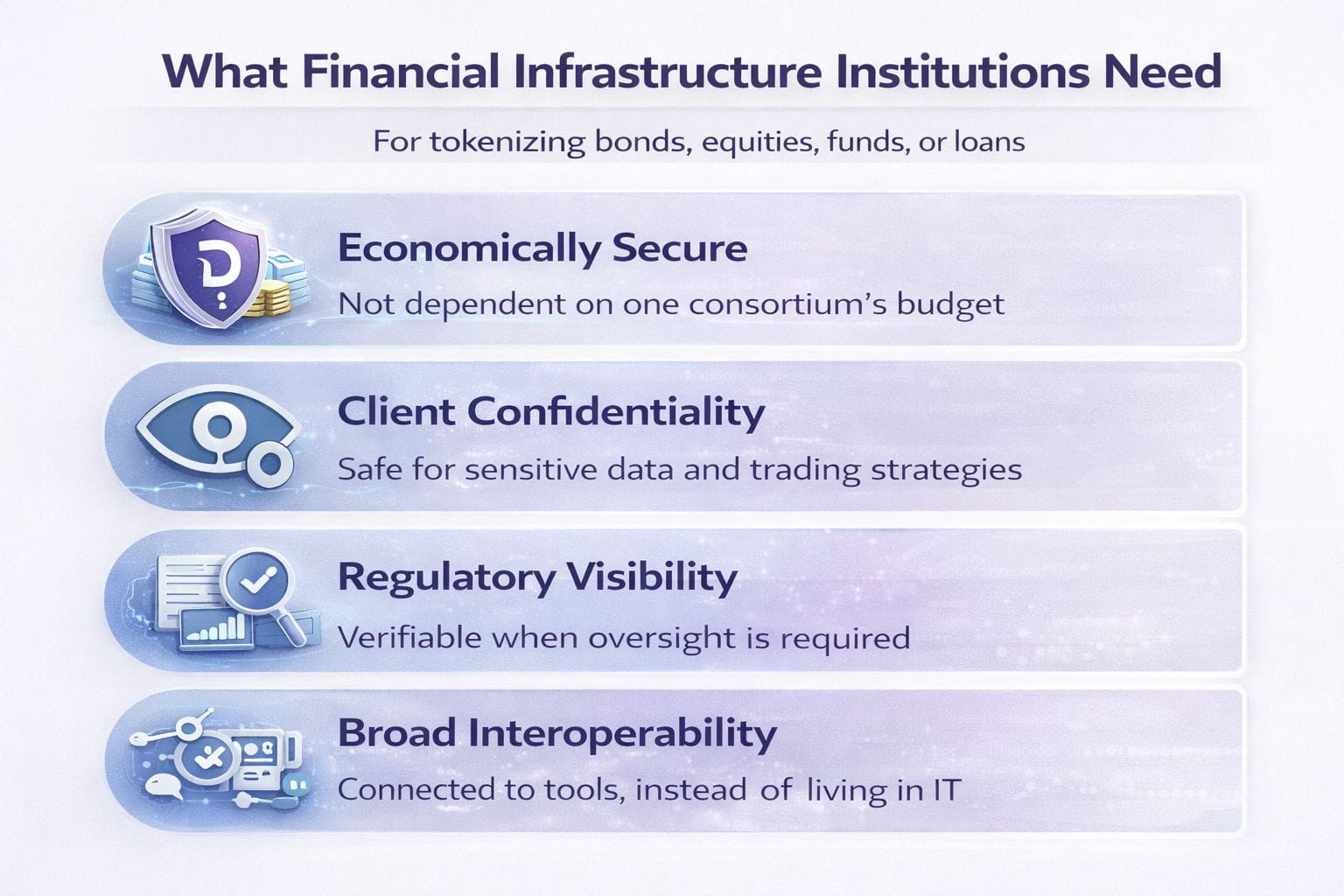
Financial Infrastructure Institutions Need
That is exactly the niche Dusk is aiming to fill. It is not a bank-branded sandbox or a general purpose DeFi casino with a compliance wrapper. It is a public, DUSK-powered settlement layer where openness at the consensus level and privacy at the data level reinforce each other.
In that sense, Dusk does more than “compete” with traditional bank chains. It makes them look outdated. Where they recreate closed systems with new buzzwords, Dusk offers a path to truly shared financial infrastructure open yet private, transparent where it should be, and confidential where it must be.
@Dusk #dusk $DUSK
