
Although I initially viewed @Walrus 🦭/acc as a simplistic measure when learning about Sui based projects in 2025, I found it an effective way to move toward actual data ownership in Web3. Storing data centrally such as AWS provides the convenience but no actual control one can manipulate data, erase it or even sell it to the supplier. Walrus rearranges this by turning data into a verifiable and programmable asset that they can own on chain, and whose users have control over their files in an intermediary-free manner.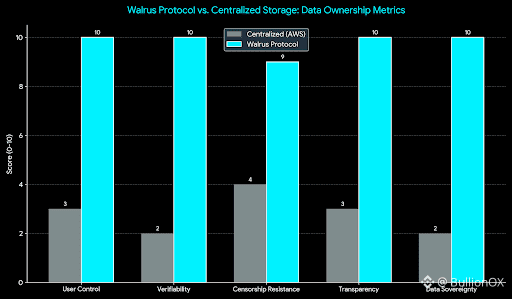
Walrus also provides first class objects on the Sui blockchain as large unstructured data, also known as blobs. On uploading a blob, it is coded with RedStuff which is a 2-D erasure coding, which makes it up of slivers that are spread out across independent nodes. This decentralization will imply that no single entity is fully in charge of the entire dataset, so there will be no chance of unauthorized changes or takedowns.
In the Move language, ownership is represented in Sui as an object. This object depicts a metadata of the blob such as the Proof of Availability certificate that it is stored and can be accessed. Users are able to move this object through smart contracts, giving it to other users or incorporating it into dApps, such as connecting an NFT to its media blob.
Ownership is promoted by the permissionless aspect of the protocol. Anyone is free to stake $WAL to act as a node; however, the incentives of the network make the network reliable by offering rewards as a result of storage fees, and which are given out at epochs. In WAL, users pay a fixed amount of an amount of money in advance and the rent is paid to nodes which demonstrate availability and this makes the economic incentive and data persistence in line.
The verifiability is strengthening control. Sliver cryptographic commitments enable owners to demonstrate integrity without content discovery, whilst records on the Sui blockchain enable owners to audit node behavior. In case of a failed node, slashing of staked data WAL helps to protect the information of the owner, as negligence is characterized.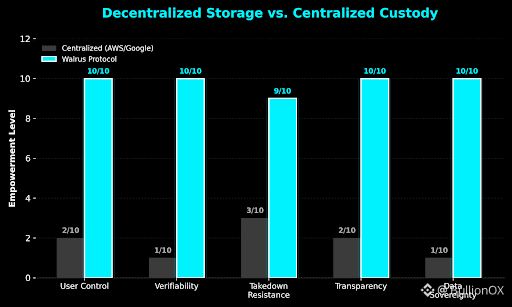
To be applied in reality, it implies actual ownership in such applications as personal archives or AI datasets. Contracts provide their owners with an opportunity to extend storage, version data, or to delete blobs, without a central authority. Use with Seal provides privacy, which allows the owner to encrypt blobs, but can still be accessed.
I believe that Walrus enhances the notion of ownership of data by incorporating it in blockchain primitives. It leaves custody models behind and becomes real sovereignty, where data is an asset that users have complete control over, which encourages a more fair Web3.


