
Plasma was first developed as a means to move high-volume blockchain activity off the base layer while yet safeguarding user safety via the freedom to leave at any moment. It turned out that depending on just one operator produced inappropriate trust expectations as the environment developed. Plasma Proof-of-Stake becomes a more robust approach that substitutes the operator with a bonded validator set whose behavior is governed by smart contracts on the root chain and molded by well crafted financial rewards.

Plasma Proof-of-Stake validators lock ETH or a native staking asset like the Plasma coin XPL to protect a Plasma chain. These connections provide the framework for actual economic weight. While validators who act honestly get transaction fees, those who censor information, delay blocks, or act maliciously risk direct penalties including slashing and loss of future benefits. On-chain handling of enforcement, consensus rules, and staking logic guarantees that no one participant can override the system with power alone.
Replicating the most important incentive property of Nakamoto consensus is a main design goal of this model. Block producers in proof-of-work systems are never quite sure they are the leaders. This ambiguity motivates them to release blocks right away as keeping back lowers their likelihood of being regarded as part of the canonical chain. Large-scale block withholding attacks are seldom seen in Bitcoin-style systems mostly because of this dynamic.
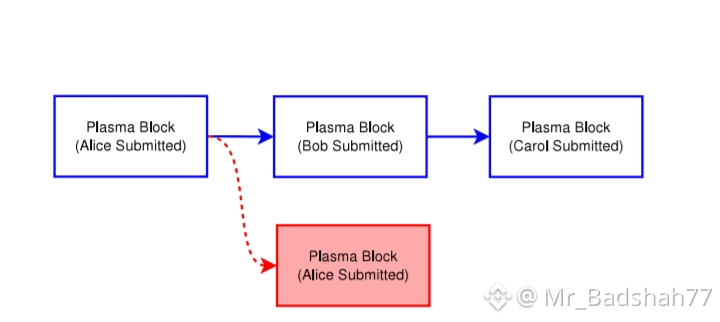
Classic Proof-of-Stake schemes could undermine this shield. If block manufacturers are selected deterministically, a majority cartel can maintain short-term control by coordinating, withholding blocks, or selectively releasing information. Such behavior is extremely risky in a Plasma environment since users rely on data availability to get out safely. Plasma Proof-of-Stake tackles this by substituting pure leader certainty with financial uncertainty and ongoing performance measurement connected to stake, including stake retained in XPL.
Validators have to regularly provide commitments to the root chain. These include a hash of every fresh Plasma block plus a succinct review of recent events, usually spanning the last one hundred blocks. The protocol produces a public and permanent record of alleged state changes by anchoring this data on the root chain. Validators only work on blocks they've fully validated, and having a lot of candidate chains at the same time encourages quick sharing of information rather than secrecy.
Reward distribution goes beyond the confines of one block producer. The protocol examines block generation across a sliding window and contrasts every validator's proportion of blocks to its share of the entire staked XPL. Economically speaking, a validator with three percent of the staked XPL should contribute roughly three percent of recent blocks. Those whose involvement closely fits this expectation get a bigger cut of transaction fees; those who differ get their pay lowered.
Unsatisfactory behavior causes transaction fees not reimbursed to build up in a reserve pool. Validators who show correct participation above a specified threshold can eventually be given parts of this pool, therefore reinforcing long-term honesty. This develops a self-correcting system over time whereby appropriate conduct is always more financially rewarding than manipulation.
Chain choice is guided by economic weight instead of basic length. Every block helps with fees and representation weight. The canonical chain is the one that scores the best overall. In reality, this chain is declared finished after a given quantity of periods without effective challenges. Lower weight competing chains lose significance, and all related expenses go back into the reserve fund.
Plasma Proof-of-Stake relies on Plasma's best assurance: exit to the root chain should validators try to attack the system using block withholding or other Byzantine behavior. Honest contributors can start a small mass withdrawal utilizing the on-chain commitment history. Offending validators are cut off, their bonded XPL is penalised, and the financial value of XPL itself is probably going to go down as people lose faith in the chain. This danger is a great impediment to organized attacks.
This result is a feature rather than a fault. An attack on a Plasma Proof-of-Stake chain directly hurts those who hold and stake XPL, just as a successful attack on a proof-of-work network reduces the value of the attacker's own mining investment. As a result, reasonable actors are motivated to maintain the network instead of using it.
Plasma Proof-of-Stake provides more complexity in return for better guarantees. The frequency of commitment, reward windows, and cutting thresholds must be exactly adjusted. Root-chain expenses have to be weighed against security needs. The model presents a clear road to scalable, distributed Layer-2 systems supported by a local asset like XPL, notwithstanding these compromises.
Plasma Proof-of-Stake combines Nakamoto-inspired incentives, Proof-of-Stake economics, and Plasma's exit-based security to make the Plasma coin XPL more than simply a utility coin. It becomes a main security resource, coordinating network value, user safety, and validator behavior into a unified, incentives-driven system ready for high-throughput Layer-2 implementation.


