
When people talk about stablecoin settlement, they usually focus on speed or fees. That is understandable. Those are the most visible metrics. What gets discussed far less is where risk actually sits once a transaction is considered final.
Plasma forces that question to the surface.
In a typical stablecoin transfer, the user cares about one thing. Did the funds arrive. But from a system perspective, settlement is the moment when the network commits to a state that cannot be reversed. Once that commitment is made, any error becomes a liability, not a bug.
So the relevant question is not who moves value, but who absorbs risk.
In Plasma, stablecoins move value across the network. They are the medium of exchange. They are not the shock absorber. That role belongs elsewhere.
Plasma is structured so that settlement risk is concentrated at the validator layer through XPL staking. Validators are the actors responsible for finalizing blocks and enforcing protocol rules. When finality is reached, they are the ones economically accountable for that decision. If something goes wrong, it is their stake that is exposed, not the stablecoins being transferred.
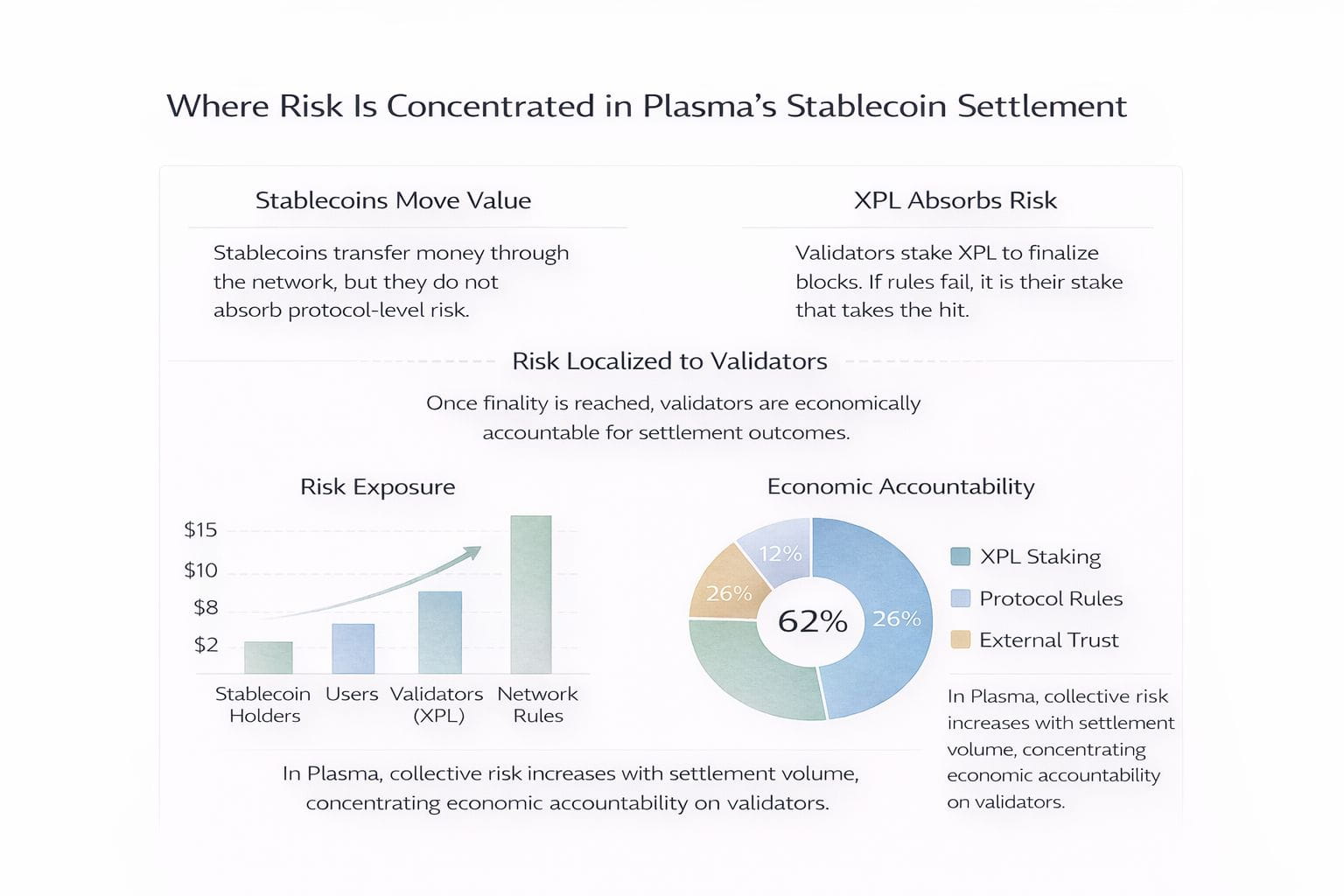
This distinction is easy to overlook, but it matters. Stablecoin holders are shielded from protocol-level failure. End users are not asked to price in settlement risk. Instead, risk is intentionally localized to the actors who control finality.
From a system design perspective, this is a deliberate choice. Risk is placed where control exists.
What becomes interesting is how this scales. As stablecoin settlement volume increases, the economic importance of the validator layer increases with it. More value flowing through the network means finality decisions carry greater weight. The relevance of XPL does not come from transaction usage or speculative demand. It comes from the network’s dependence on it to secure irreversible outcomes.
This is why Plasma’s design is better understood as settlement infrastructure rather than a general-purpose chain. The goal is not to distribute risk evenly. The goal is to concentrate it where it can be managed, priced, and enforced.
Seen this way, Plasma’s architecture is less about enabling payments and more about making settlement accountable. Stablecoins move the money. XPL secures the moment when the network says the money is done moving.
That is the part of stablecoin infrastructure most people do not see. But it is the part that determines whether settlement systems can be trusted at scale.

