
Although #Walrus is intended to be a decentralized storage system, it purposefully avoids integrating intricate control logic directly into the storage network. Rather, for all crucial coordination tasks, Walrus employs an external blockchain as a black box control layer. Because data storage and system governance are kept apart by this architectural choice, each layer can perform its best function independently of the other.
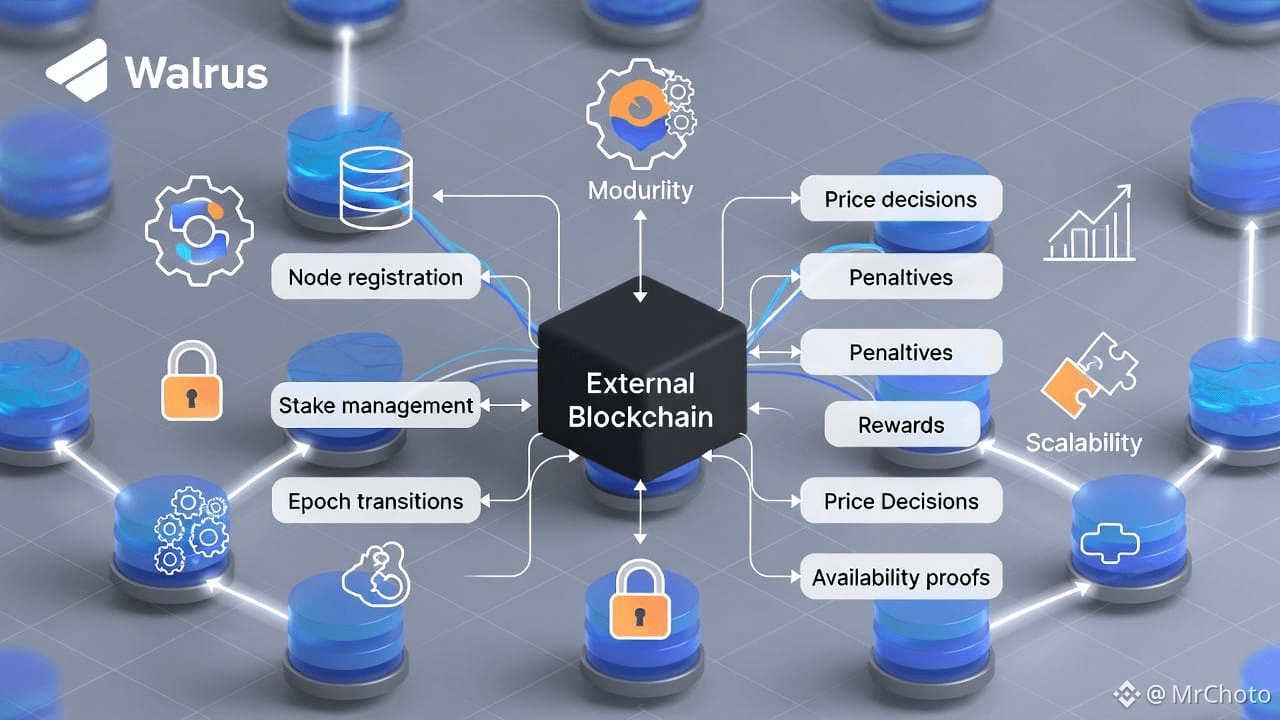
Control-plane operations in Walrus, including node registration, stake management, epoch transitions, price decisions, penalties, rewards, and availability proofs, are handled by the external blockchain. These rules are not arbitrarily agreed upon by storage nodes. Rather, they rely on the consensus of the blockchain to provide a completely ordered, globally accepted series of choices. Walrus views the blockchain as a deterministic machine, submitting transactions as inputs and relying on the blockchain to provide a final, consistent state update.

@Walrus 🦭/acc Walrus's internal protocol is significantly simplified by this approach. For coordination or governance, storage nodes do not need to execute complex consensus procedures. All they have to do is watch the state of the blockchain and take appropriate action. Every honest node receives information about shard assignments, penalties, and the start of a new epoch from the same canonical source. This eliminates the coordination races that afflict many decentralized storage solutions, as well as ambiguity and system state forks.
Walrus also benefits from future-proofing and modularity by seeing the blockchain as a black box. The storage protocol relies solely on the blockchain's guarantees of liveness, finality, censorship resistance, and absolute ordering rather than its internal workings. Walrus can develop on their own as long as such assurances are true. The blockchain itself does not need to be altered in order to improve encoding techniques, recovery mechanisms, or storage efficiency.
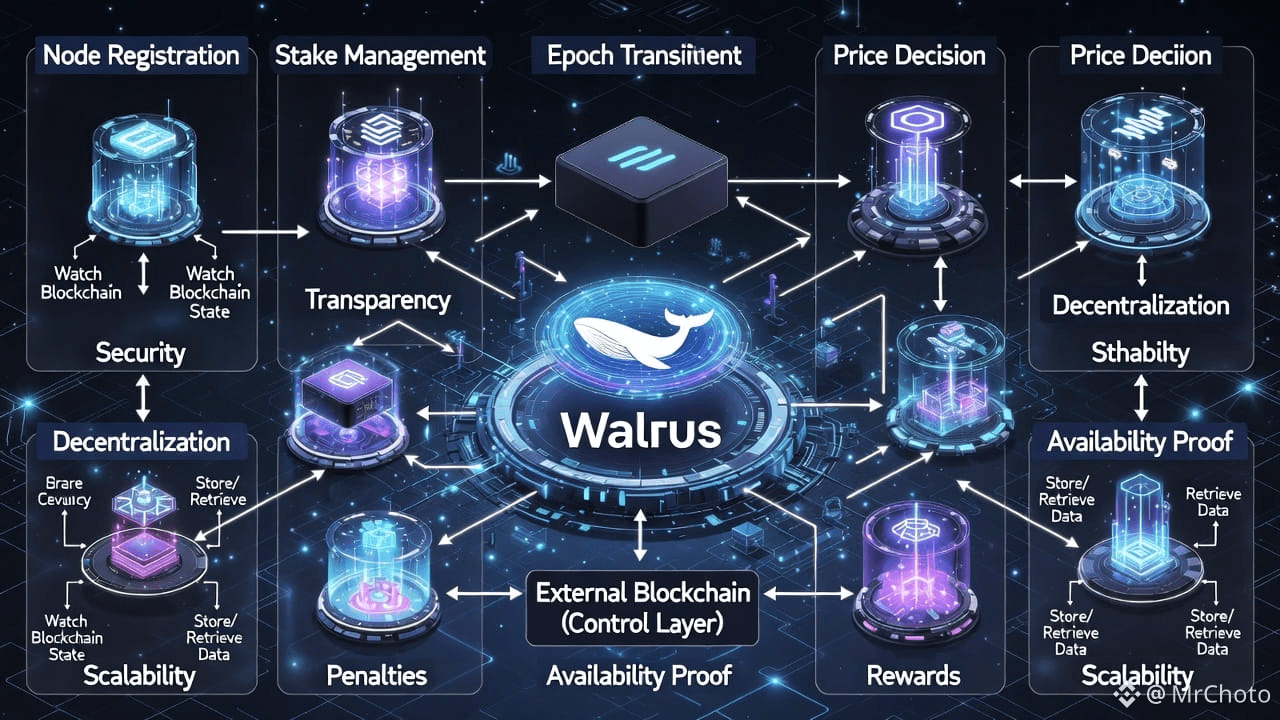
Security is also another important benefit of this strategy. No small group storage nodes may covertly alter shard allocations, modify fines, or stifle system updates because control choices are enforced by blockchain consensus. On-chain, any effort at misbehavior is transparent and provable. In an open storage network where nodes are economically motivated rather than centrally managed, this transparency is essential to preserving confidence.
Walrus can continue to concentrate on what it was designed for—high-throughput, reliable, and economical data storage—by using an external blockchain as a control layer. A tried-and-true consensus system serves as the foundation for governance, incentives, and coordination, while the storage layer is still quick, adaptable, and scalable. One of the main reasons Walrus can function dependably on a big scale without compromising decentralization is this clear separation. $WAL

