
Essentially, what is the most painful aspect of blockchain technology? It occurs when you want everything to be quick, affordable, and safe, but you are only able to select two of the three. And everyone has been pounding their heads against this trilemma's wall for the past ten years or so.
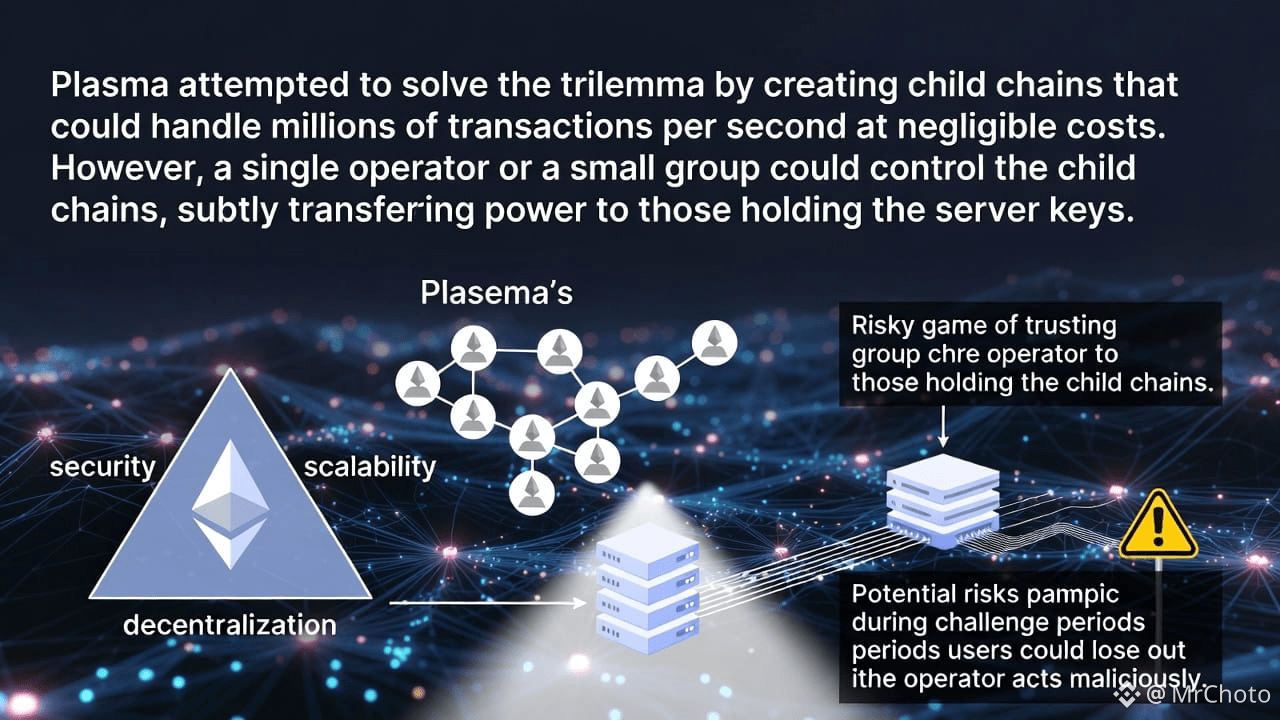
The emergence of plasma was specifically an attempt to overcome this impasse. The concept is stunning: we take Ethereum (or any other "heavy" chain), build a number of little "child" chains that exist independently, handle millions of transactions there, and only periodically send some hash or proof back to the main chain to demonstrate that everything is working as it should. Thousands, if not millions, of transactions per second, negligible costs, and Ethereum's apparent lack of security made it sound like a dream.
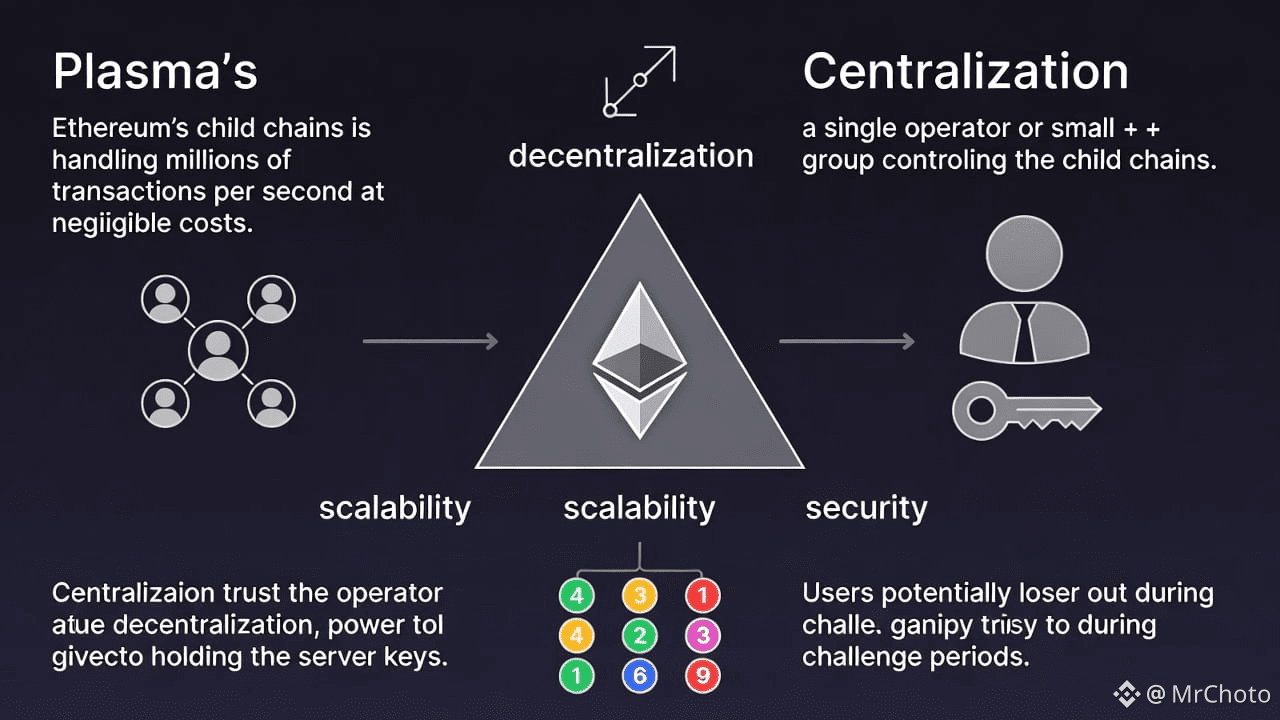
The difficulty, though, is that the more I examine Plasma implementations, the more I realize that we have simply shifted the long-standing centralization issue to a different area.
Because who is in charge of these child chains? typically just one operator. or a small group. This individual (or business) also determines when to "slow down a bit," when to broadcast the merkle root on Ethereum, and which transactions to accept or reject. Additionally, users will either have to wait or migrate to the main chain if the operator abruptly disappears, shuts down the server, or begins censoring. Additionally, a mass escape is always a lottery: someone just doesn't make it, gas shoots into space, and the exit line lengthens.
Decentralization is thus formally present. Everyone is free to challenge and leave. However, in reality, you are already in the risk zone if you are not always sitting and keeping an eye on every block in the child chain. That is not how most people live. They don't care about the exit game; they just want to use tokens to pay for their coffee.
This is how this subtle, undetectable centralization takes place. "We are now centralized!" is not being yelled. Nobody presents it in a white paper. Power is transferred to individuals in possession of the child chain server keys progressively, step by step. After that, to another one. And to five more. Additionally, there are already a number of sizable "child" networks under the authority of well-known individuals and financial institutions.
When compared to rollups, the distinction is evident right away. Data (or at least proofs) are sent straight to L1 in Optimistic Rollup or ZK-rollup. The operator has the ability to filter, but it cannot be concealed. The most important aspect is that the user does not need to search for exit proofs. The system is more "fair" in that it is more harder to conceal problems.
In this sense, Plasma plays a risky game: "trust the operator, and if anything — you will have to claw your money back during the challenge period." Many just can't get it back. They're not going to survive. They won't understand how. They'll give up.I'm not claiming that Plasma is bad. It was one of the most fascinating experiments conducted in 2017 and 2018. Some of its concepts can still be found in contemporary hybrid buildings. However, something tightens inside of me each time I see another project declare with pride that "we are on Plasma." Because it typically indicates that "we are very fast and very cheap... until the operator decides otherwise."
Perhaps we simply haven't figured out how to scale without making these kinds of concessions. Perhaps this path is already in the vicinity. For the time being, however, Plasma serves as an excellent illustration of how solutions "to reduce the load" gradually, subtly, but unmistakably alter the rules of the game regarding who actually has power in the ecosystem.
We don't even realize this until it's too late, which makes it perhaps the scariest thing.@Plasma #Plasma $XPL

