Structure, Distribution, Whale Positioning & Contract Risk Overview
1️⃣ Asset Overview: River ($RIVER )
River ($RIVER) is an Ethereum-based digital asset deployed on 17 September 2025. Current on-chain and derivatives data indicate that RIVER has entered a phase of elevated speculative interest, reflected through whale accumulation, price expansion, and concentrated holder structure.
Key context from the data:
Network: Ethereum
Token age: ~121 days
Analysis tools referenced: Bubble Map, Etherscan, DEX Screener, GMGN
Audit score: 45 / 100
2️⃣ Holder Structure & Supply Distribution
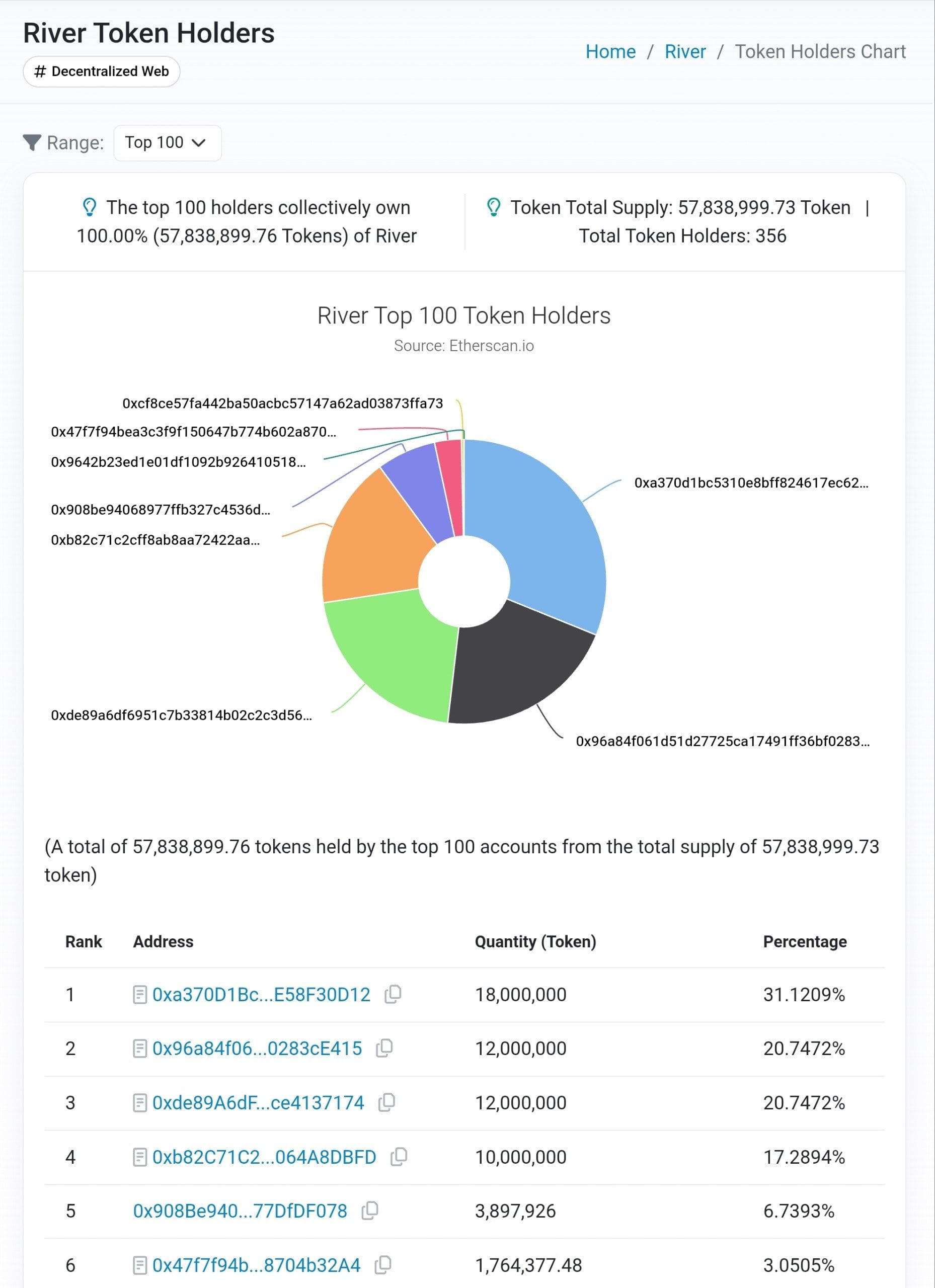
On-chain holder analysis reveals an extremely concentrated supply profile.
Total supply:
57,838,999.73 RIVER
Total holders:
356 wallets
Critical concentration insight:
Top 100 holders control ~100% of total supply
Top 4 wallets alone control over ~70% of supply
Largest wallets hold:
18,000,000 RIVER (~31.1%)
12,000,000 RIVER (~20.7%)
12,000,000 RIVER (~20.7%)
10,000,000 RIVER (~17.2%)
👉 This confirms that RIVER is a highly centralized token from a supply standpoint.
Price behavior is therefore structurally sensitive to a very small number of wallets.
3️⃣ Wallet Network & Bubble Map Insight
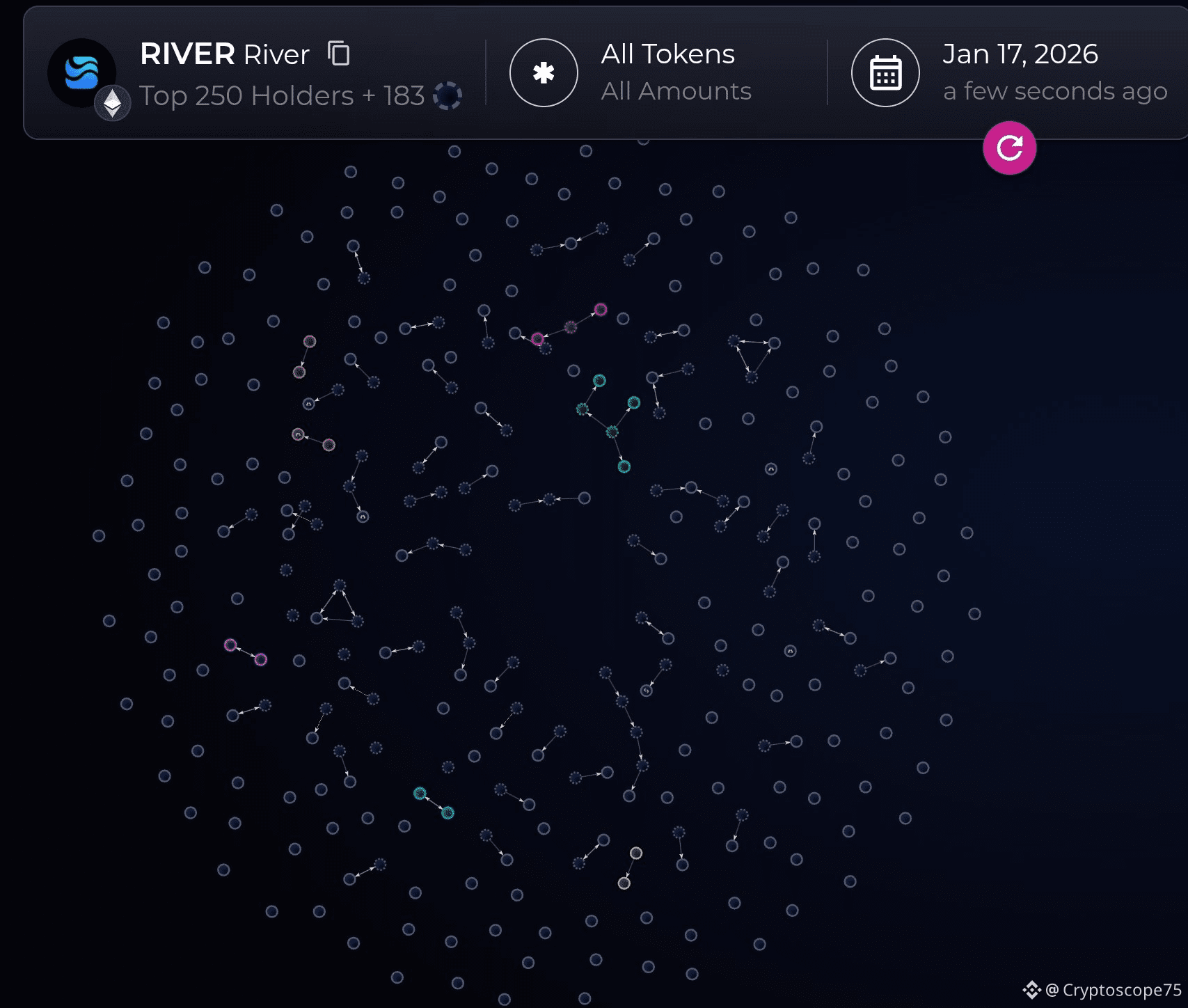
The bubble map visualization shows:
Numerous interconnected wallet clusters
Repetitive micro-distribution patterns
Several linked transaction paths
This type of wallet topology often reflects:
Coordinated wallet management
Liquidity routing behavior
Internal allocation clusters
👉 Such patterns do not imply wrongdoing, but they do indicate non-organic holder dispersion.
Price discovery in these environments is typically liquidity-driven, not demand-driven.
4️⃣ Derivatives & Whale Positioning
Perpetual futures data on RIVERUSDT shows strong whale-side dominance.
Price snapshot:
$29.90 (+9.20%)
Whale positioning:
Total whale capital: ~$32.39M
Long whales: 126 wallets — IN PROFIT
Short whales: 52 wallets — IN LOSS
Capital distribution:
Long exposure: ~$29.30M
Short exposure: ~$3.10M
Average entries:
Longs: $24.21
Shorts: $25.16
Unrealized PnL:
Longs: + $5.57M
Shorts: – $490K
👉 This indicates aggressive whale-side long control, with price expansion being supported by leveraged capital.
However, this also implies:
⚠️ The market is now liquidation-sensitive.
Sharp moves may be driven by forced exits, not organic trend continuation.
5️⃣ Contract & Safety Diagnostics
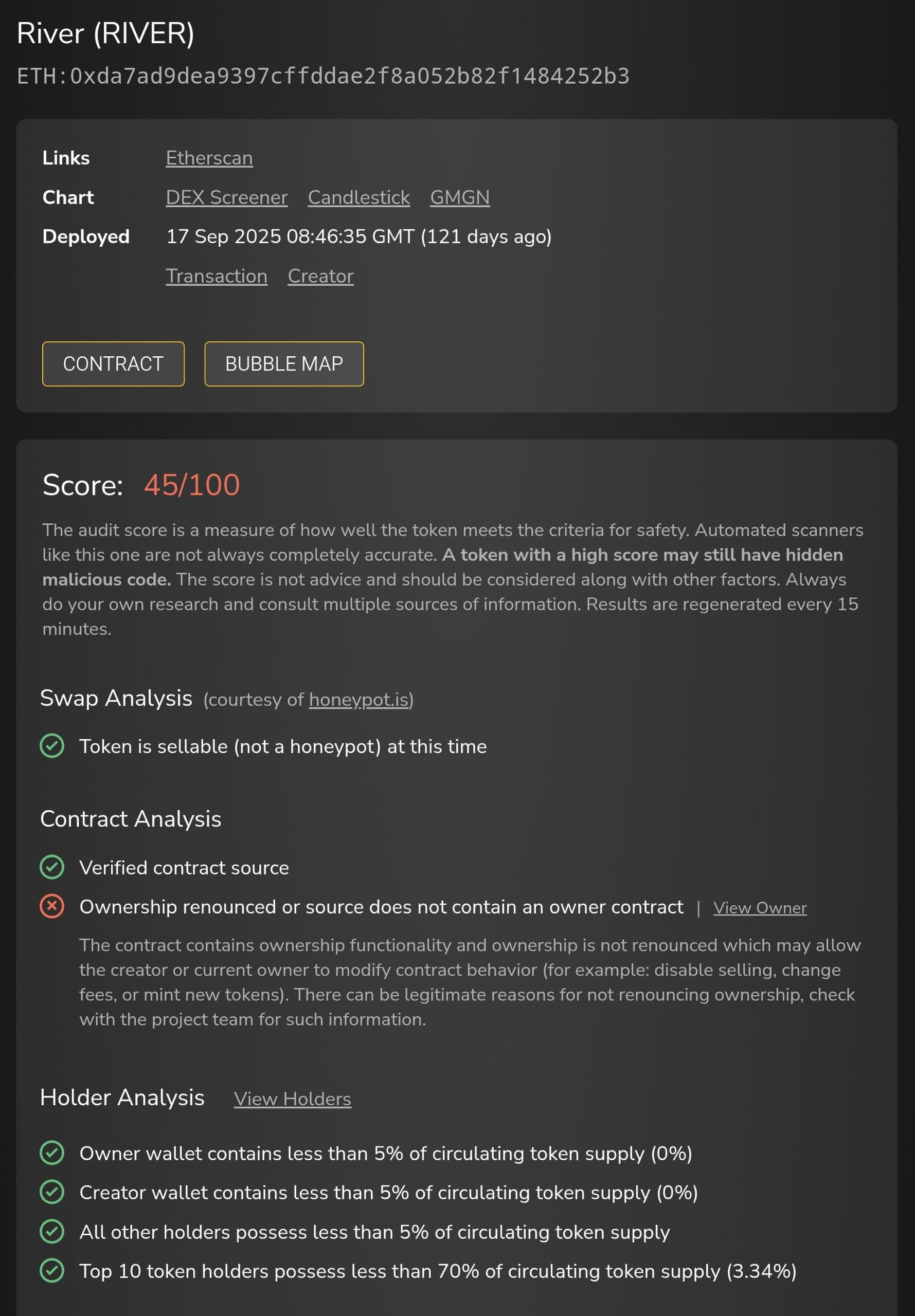
Smart-contract screening reveals mixed-risk signals.
Positive checks
✅ Contract source verified
✅ Token currently sellable
✅ Not flagged as a honeypot
✅ Owner & creator wallets hold 0%
Risk flags
⚠️ Ownership not renounced
⚠️ Contract retains modification authority
⚠️ Audit score only 45 / 100
This means the contract may technically allow behavior changes, including:
fee modification
function restriction
or logic updates
👉 This places RIVER in a “medium-to-high operational risk” category from a contract governance perspective.
6️⃣ Structural Market Interpretation
Combining all datasets:
Supply is extremely centralized
Wallets show coordinated topology
Whales dominate leveraged exposure
Contract ownership remains active
This creates an environment where:
• Price is wallet-driven
• Volatility is event-driven
• Risk is structural, not just technical
👉 Markets with this profile often move in sharp phases — expansion, compression, and rapid repricing.
They tend to reward:
liquidity awareness
timing precision
and strict risk control
While punishing:
emotional positioning
over-leverage
and delayed reaction.
7️⃣ Professional Risk Outlook
$RIVER currently reflects a high-control, high-volatility market structure.
Core strengths
Strong whale participation
High speculative interest
Active derivative engagement
Core risks
Extreme holder concentration
Non-renounced ownership
Centralized liquidity control
Elevated liquidation sensitivity
👉 This is not a traditional supply-demand asset.
👉 It is a liquidity-controlled trading environment.
8️⃣ Strategic Conclusion
RIVER should be categorized as a structure-driven speculative asset, where price action is less about adoption and more about capital behavior, wallet control, and risk transfer.
In such markets, sustainability is not defined by trendlines —
it is defined by who controls supply, who controls leverage, and when incentives shift.